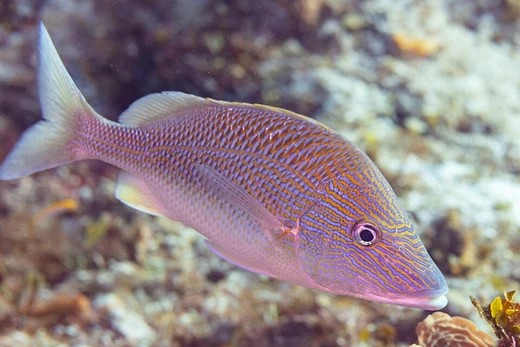
Rhonciscus pauco
A recently described grunt from deep waters off western Puerto Rico.
Last updated
Rhonciscus pauco, commonly called the opalescent grunt, is a marine ray-finned fish in the Haemulidae family, which includes grunts and sweetlips. It was first scientifically described in 2022 based on specimens collected by fishermen off the western coast of Puerto Rico.
The species was formally named in 1922 by Jose Tavera, Michelle T. Schärer-Umpierre, and Arturo Acero Pizarro. Its type locality is Tres Cerros, Rincón, Puerto Rico, at coordinates 18.34433°N, 67.28343°W, taken from a depth of 280 meters (920 feet). It belongs to the genus Rhonciscus within the subfamily Haemulinae, part of the family Haemulidae. The Haemulidae also includes the sweetlips of the subfamily Plectorhinchinae, and the entire family is placed in the order Acanthuriformes.
The genus name Rhonciscus is a diminutive of rhencus, the Greek word for "snore." This refers to the grunting sounds haemulids produce by grinding their pharyngeal teeth, amplified by the swim bladder, especially when removed from water. The specific name pauco honors Pauco, the nickname of fisherman Edwin Font, who caught the type specimens and shared traditional knowledge about the fish’s ecology.
The dorsal fin has 12 spines and 12 soft rays, while the anal fin has 3 spines and 7 soft rays. The body is somewhat elongate, with a depth just over a third of its standard length.
The dorsal profile before the dorsal fin is convex, the eyes are large, and the snout is shorter than the eye’s diameter. The body is silvery-white with some opalescence and golden spots. The maximum published standard length is 25 centimeters (9.8 inches).
Rhonciscus pauco is known only from a small area of the Caribbean Sea off western Puerto Rico, in deep water with fine sandy sediments between Rincón and Mayagüez, at depths greater than 250 meters (820 feet).
Scientific classification
- KingdomAnimalia
- PhylumChordata
- ClassActinopterygii
- DivisionTeleostei
- OrderAcanthuriformes
- FamilyHaemulidae
- GenusRhonciscus
- SpeciesRhonciscus pauco
Named by Tavera, Schärer-Umpierre & Acero P., 2022
Sources: Wikipedia taxobox: Rhonciscus pauco (CC BY-SA 4.0) · differs from this box at order: WoRMS AphiaID 1721312 (CC BY 4.0)
How big is it?
Largest length in the source, 0.25 m, next to a 1.8 m person.
Diagram: drawn by Codexery, schematic shapes to scale (not a likeness). Length: Wikipedia: Rhonciscus pauco
Where the rhonciscus pauco has been recorded
Map: drawn by Codexery. Data: Natural Earth basemap (public domain) · place coordinates: Wikipedia (CC BY-SA 4.0)
More in Grunts
Elsewhere in Snappers and Grunts
Test yourself
Three questions drawn from this entry’s sources. Pick an answer to check it.
Answers checked against the source article
Sources
Compiled from Wikipedia and the sources listed below. Text from Wikipedia is available under CC BY-SA 4.0; this entry is adapted from it.
- Wikipedia: Rhonciscus pauco (CC BY-SA 4.0).
- Classification: the source article's taxobox; compare WoRMS, the World Register of Marine Species (CC BY 4.0).
- Occurrence records: GBIF (CC0 / CC BY). Basemap: Natural Earth (public domain).
- Word definitions: the Codexery glossary, each quoted from its Wikipedia article.
Spotted an error? Know more?
Reader corrections go straight into our review queue. Suggest an edit · How this site is sourced