Emmelichthyops
The only known member of its genus, a western Atlantic grunt.
Last updated
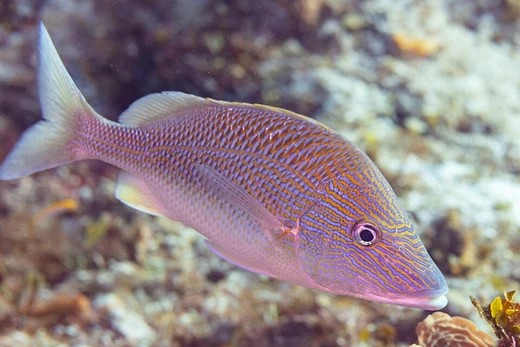
Emmelichthyops is a genus of marine fish in the grunt family, containing the single species Emmelichthyops atlanticus, commonly known as the bonnetmouth. It is notable as the only known member of its genus, and was formerly placed in the family Inermiidae.
Scientific classification
- KingdomAnimalia
- PhylumChordata
- ClassActinopterygii
- DivisionTeleostei
- OrderAcanthuriformes
- FamilyHaemulidae
- GenusEmmelichthyops
- SpeciesEmmelichthyops atlanticus
Named by L. P. Schultz, 1945
Sources: Wikipedia taxobox: Emmelichthyops (CC BY-SA 4.0) · differs from this box at order: WoRMS AphiaID 280669 (CC BY 4.0)
Conservation status
Least Concern (LC)
- LC▲ this species
- NT
- VU
- EN
- CR
- EW
- EX
Source: IUCN Red List assessment · GBIF copy of the Red List category
How big is it?
Largest length in the source, 0.13 m, next to a 1.8 m person.
Diagram: drawn by Codexery, schematic shapes to scale (not a likeness). Length: Wikipedia: Emmelichthyops
Where the emmelichthyops has been recorded
Each dot is a place where the species has been observed and reported (15,894 records, half-degree grid) — not a modelled range. 2 inland records left out (institution coordinates).
Map: drawn by Codexery. Data: GBIF occurrence search (records CC0 / CC BY) · Natural Earth basemap (public domain) · place coordinates: Wikipedia (CC BY-SA 4.0)
Background
The bonnetmouth has a cigar-shaped body and can grow up to 13 cm in total length. Its coloration is generally yellowish-gray, with some blue on the front and silvery-white on the sides. Adults have four brown stripes on the upper halves of their bodies (one mid-dorsal), while juveniles have only three stripes; these stripes are usually more evident near the front and become more faded near the tail.
Found only in the western Atlantic Ocean, bonnetmouths occur from southern Florida and the Bahamas to northern South America. They are most often captured near the Florida Keys, US Virgin Islands, and the Bahamas.
The type specimens were both collected off Cat Island in the Bahamas. They are generally associated with reefs and can be found over coral heads in small groups, at depths from 3 to 90 m, but mainly occur in schools at about 64 m. The species feeds on invertebrates and small fishes.
Emmelichthyops atlanticus was first formally described in 1945 by American ichthyologist Leonard Peter Schultz, with the type locality given as Cat Island, Bahamas. It was formerly placed in the family Inermiidae. The generic name Emmelichthyops means 'like Emmelichthys', as at the time of its description this species was thought to be related to Emmelichthys and the two genera are similar.
More in Grunts
Elsewhere in Snappers and Grunts
Sources
Compiled from Wikipedia and the sources listed below. Text from Wikipedia is available under CC BY-SA 4.0; this entry is adapted from it.
- Wikipedia: Emmelichthyops (CC BY-SA 4.0).
- Classification: the source article's taxobox; compare WoRMS, the World Register of Marine Species (CC BY 4.0).
- Conservation status: IUCN Red List assessment.
- Occurrence records: GBIF (CC0 / CC BY). Basemap: Natural Earth (public domain).
- Word definitions: the Codexery glossary, each quoted from its Wikipedia article.
Spotted an error? Know more?
Reader corrections go straight into our review queue. Suggest an edit · How this site is sourced