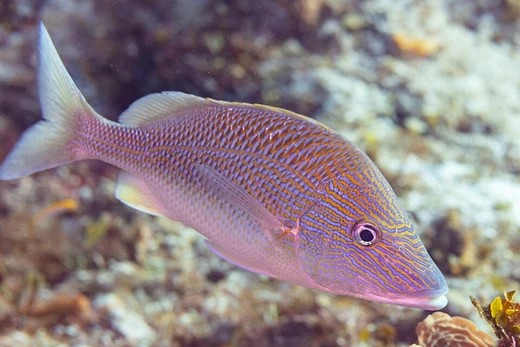
Haemulon parra
A grunt species with striped silver-grey adults and black-striped juveniles.
Last updated
Haemulon parra, known as the sailor's grunt or sailor's choice, is a grunt species found in the Atlantic Ocean. Its genus name derives from the Greek haimaleos, meaning "bloody," and the species name is Latin for "sparrow." Anselme Gaëtan Desmarest first described it in 1823.
The fish has a dull head with a small to medium mouth, lacking fleshy lips. Scales cover part of the eye near the back, and the chin has two small openings with a single furrow down the middle. The eye's edges are typically yellow or bronze.
Adults are silver and grey, with dotted black stripes running along their sides. Juveniles have four black stripes over a white body and a spot on the tail fin. The longest recorded individual measured 41.2 cm (16.2 in).
This species lives in the western Atlantic, from Florida to Brazil, and also enters the Gulf of Mexico. It prefers reefs and hard bottoms at depths from 0 to 80 m (0–262 ft). Juveniles are more drawn to seagrass beds, while adults school and can be seen in more open areas. It feeds at night on mollusks and fish.
Humans fish for it on a small commercial scale, and it sometimes appears in aquariums. In March 2011, the International Union for Conservation of Nature evaluated Haemulon parra and listed it as Least Concern.
Scientific classification
- KingdomAnimalia
- PhylumChordata
- ClassActinopterygii
- DivisionTeleostei
- OrderAcanthuriformes
- FamilyHaemulidae
- GenusHaemulon
- SpeciesHaemulon parra
Named by (Desmarest, 1823)
Close relatives
Other species of Haemulon with a Codexery entry.
- Bluestriped grunt Haemulon sciurus
- Boga Haemulon vittatum
- Haemulon carbonarium
- Haemulon melanurum
- Haemulon flavolineatum
- Haemulon scudderii
- Haemulon plumierii
- Haemulon album
Sources: Wikipedia taxobox: Haemulon parra (CC BY-SA 4.0) · differs from this box at order: WoRMS AphiaID 275731 (CC BY 4.0)
Conservation status
Least Concern (LC)
- LC▲ this species
- NT
- VU
- EN
- CR
- EW
- EX
Source: IUCN Red List assessment · GBIF copy of the Red List category
How big is it?
Largest length in the source, 0.41 m, next to a 1.8 m person.
Diagram: drawn by Codexery, schematic shapes to scale (not a likeness). Length: Wikipedia: Haemulon parra
Where the haemulon parra has been recorded
Each dot is a place where the species has been observed and reported (26,039 records, half-degree grid) — not a modelled range. 30 inland records left out (institution coordinates).
Map: drawn by Codexery. Data: GBIF occurrence search (records CC0 / CC BY) · Natural Earth basemap (public domain) · place coordinates: Wikipedia (CC BY-SA 4.0)
More in Grunts
Elsewhere in Snappers and Grunts
Test yourself
Three questions drawn from this entry’s sources. Pick an answer to check it.
Answers checked against the source article
Sources
Compiled from Wikipedia and the sources listed below. Text from Wikipedia is available under CC BY-SA 4.0; this entry is adapted from it.
- Wikipedia: Haemulon parra (CC BY-SA 4.0).
- Classification: the source article's taxobox; compare WoRMS, the World Register of Marine Species (CC BY 4.0).
- Conservation status: IUCN Red List assessment.
- Occurrence records: GBIF (CC0 / CC BY). Basemap: Natural Earth (public domain).
- Word definitions: the , each quoted from its Wikipedia article.
Spotted an error? Know more?
Reader corrections go straight into our review queue. Suggest an edit · How this site is sourced