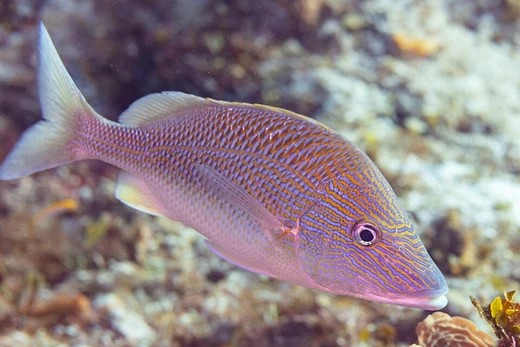
Lutjanus novemfasciatus
Largest snapper species, reaching 170 cm and 35.7 kg.
Last updated
Lutjanus novemfasciatus, called the Pacific cubera snapper or Pacific dog snapper, is a marine ray-finned fish from the snapper family Lutjanidae. It lives in the eastern Pacific Ocean and holds the record as the biggest snapper species, growing up to 170 cm long and weighing as much as 35.7 kg.
Taxonomy
First described in 1862 by American ichthyologist Theodore Nicholas Gill, its type location is Baja California. The name novemfasciatus means "nine-banded," referring to the faint bands on its sides.
Description
The fish has an oblong body with a depth of 31 to 35 percent of its standard length. Its snout is sharp, with two pairs of simple nostrils—one in front, one behind. The mouth is large and can extend outward, with conical and canine-like teeth on the jaws; the front teeth are enlarged into fangs longer than the pupil's diameter. The preoperculum is serrated, with a weakly developed incision and knob.
Vomerine teeth form a crescent-shaped patch with no rear extension, and the tongue has several patches of granular teeth. The dorsal fin is continuous, with 10 spines and 13–14 soft rays; the anal fin has 3 spines and 8 soft rays, both with rounded rear ends. Pectoral fins have 16 or 17 rays, and the caudal fin is either truncate or slightly notched.
Color ranges from dark to pale red, shading to silver on the belly. Juveniles and most adults show 8–9 vertical bars on the upper flanks, though these may fade quickly after death. Adults have mostly brownish fins; juveniles have a black caudal fin and a black margin on the spiny part of the dorsal fin. The skin inside the mouth is orange.
Distribution and habitat
This species ranges from southern California to Peru, including the Gulf of California, Galápagos Islands, Cocos Island, and Malpelo Island. It is an inshore, reef-associated fish that prefers hard substrates, though juveniles have been recorded entering freshwater.
Biology
A nocturnal predator, it feeds at night on crustaceans and schooling fish like croakers, grunts, and wrasses, sheltering during the day. In Mexico, it migrates inshore in early summer in most years.
It is an important catch for subsistence fisheries in Colombia and commercial fisheries in Nicaragua, and is a popular target for spearfishing in the Gulf of California.
Scientific classification
- KingdomAnimalia
- PhylumChordata
- ClassActinopterygii
- DivisionTeleostei
- OrderAcanthuriformes
- FamilyLutjanidae
- GenusLutjanus
- SpeciesLutjanus novemfasciatus
Named by Gill, 1862
Close relatives
Other species of Lutjanus with a Codexery entry.
- African brown snapper Lutjanus dentatus
- Blackfin snapper Lutjanus buccanella
- Blue and gold snapper Lutjanus viridis
- Bluestriped snapper Lutjanus notatus
- Brazilian snapper Lutjanus alexandrei
- Common bluestripe snapper Lutjanus kasmira
- Cubera snapper Lutjanus cyanopterus
- Dog snapper Lutjanus jocu
Sources: Wikipedia taxobox: Lutjanus novemfasciatus (CC BY-SA 4.0) · differs from this box at order: WoRMS AphiaID 276544 (CC BY 4.0)
Conservation status
Least Concern (LC)
- LC▲ this species
- NT
- VU
- EN
- CR
- EW
- EX
Source: IUCN Red List assessment · GBIF copy of the Red List category
How big is it?
Largest length in the source, 1.7 m, next to a 1.8 m person.
Diagram: drawn by Codexery, schematic shapes to scale (not a likeness). Length: Wikipedia: Lutjanus novemfasciatus
Where the lutjanus novemfasciatus has been recorded
Each dot is a place where the species has been observed and reported (1,333 records, half-degree grid) — not a modelled range. 76 inland records left out (institution coordinates).
Map: drawn by Codexery. Data: GBIF occurrence search (records CC0 / CC BY) · Natural Earth basemap (public domain) · place coordinates: Wikipedia (CC BY-SA 4.0)
More in Snappers
Elsewhere in Snappers and Grunts
Test yourself
Three questions drawn from this entry’s sources. Pick an answer to check it.
Answers checked against the source article
Sources
Compiled from Wikipedia and the sources listed below. Text from Wikipedia is available under CC BY-SA 4.0; this entry is adapted from it.
- Wikipedia: Lutjanus novemfasciatus (CC BY-SA 4.0).
- Classification: the source article's taxobox; compare WoRMS, the World Register of Marine Species (CC BY 4.0).
- Conservation status: IUCN Red List assessment.
- Occurrence records: GBIF (CC0 / CC BY). Basemap: Natural Earth (public domain).
- Word definitions: the , each quoted from its Wikipedia article.
Spotted an error? Know more?
Reader corrections go straight into our review queue. Suggest an edit · How this site is sourced