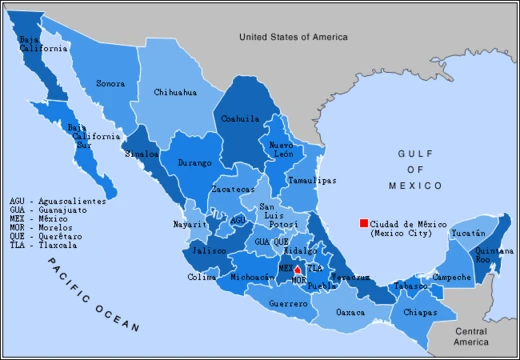
Baja California
Last updated
Where it is
Coordinates: 30°00′00″N 115°10′01″W (30.0000, -115.1670) · Open in OpenStreetMap
Coordinates and connected clubs: the infobox of Wikipedia: Baja California (CC BY-SA 4.0). Map: drawn by Codexery from OpenStreetMap tiles.
Its climate ranges from a pleasant Mediterranean type along the northwestern coast to a desert climate further south and along the Gulf of California.[1][2] As of 2020, the estimated population of Baja California was 3,769,020, and it occupies the northern part of the Baja California peninsula.[3]
Key facts and history
The 1769 expedition under Gaspar de Portolà and Junípero Serra conducted the first overland exploration of the state's northwestern portion.[4] On 4 April 2010, a 7.2 magnitude earthquake struck the Mexicali Valley, felt as far as Los Angeles, Las Vegas, Phoenix, and Tucson.[5] At least two people were confirmed dead from that earthquake and its aftershocks.[6] The Guachimis people, who inhabited the region from 100 BC to 1300 AD, produced the cave paintings in the Sierra de Guadalupe that are recognized as a World Heritage site.[7][8]
Because the state lies along the California Current, the northwestern coast enjoys mild temperatures year-round, while the southern areas receive less rain and are drier.[1] Summer temperatures are extremely high and vegetation is sparse in inland areas and along the Gulf of California.[2]
What the cited sources add
The cultural group that created these paintings disappeared rapidly after contact with European settlers.[8] The World Heritage listing for the Sierra de San Francisco rock paintings calls them one of the world's most remarkable concentrations of prehistoric art.[8]
References
- Wikipedia, "Baja California" (CC BY-SA 4.0), which cites: "Normales Climatológicas 1971–2000", Servicio Meteorológico Nacional, 25 June 2007 (original not read by us) en.wikipedia.org
- Wikipedia, "Baja California" (CC BY-SA 4.0), which cites: Martínez-Ballesté, "Reconstruction of past climatic events using oxygen isotopes in Washingtonia robusta growing in three anthropic oases in Baja California Sur", Boletín de la Sociedad Geológica Mexicana, 2018, p. 79–94 (original not read by us) en.wikipedia.org
- Wikipedia, "Baja California" (CC BY-SA 4.0), which cites: "México en cifras", January 2016 (original not read by us) en.wikipedia.org
- Wikipedia, "Baja California" (CC BY-SA 4.0), which cites: "History of Riverside County, California", Mocavo (original not read by us) en.wikipedia.org
- Wikipedia, "Baja California" (CC BY-SA 4.0), which cites: "Magnitude 7.2 – Baja California, Mexico", Earthquake Hazards Program, 6 April 2010 (original not read by us) en.wikipedia.org
- Wikipedia, "Baja California" (CC BY-SA 4.0), which cites: Associated Press, "At Least Two Die In 7.3-Magnitude Baja Quake", KTVU, 4 April 2010; Rowlands, "Baja governor seeks emergency declaration after quake", CNN Wire, 6 April 2010 (original not read by us) en.wikipedia.org
- Wikipedia, "Baja California" (CC BY-SA 4.0), which cites: "Rock Paintings of the Sierra de San Francisco", World Heritage List (we also read that source) en.wikipedia.org
- "Rock Paintings of the Sierra de San Francisco", World Heritage List. facts only, no text reused. whc.unesco.org
Each numbered sentence above was checked against the source it cites before publication. Sentences citing Wikipedia adapt text from the English Wikipedia article Baja California (contributors), used under CC BY-SA 4.0; this entry is available under the same licence. Other sources were used for facts only; no text or images are copied from them.
Also in the Codexery
More in Mexican States
Related in Mexican States
Links follow this subject's own source article.
Sources
Compiled from Wikipedia and the sources listed below. Text from Wikipedia is available under CC BY-SA 4.0; this entry is adapted from it.
- Wikipedia: Baja California (CC BY-SA 4.0).
Spotted an error? Know more?
Reader corrections go straight into our review queue. Suggest an edit · How this site is sourced