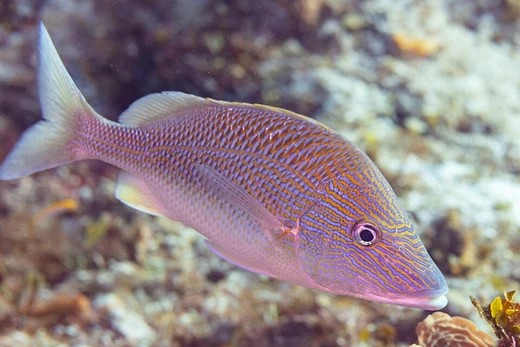
Lutjanus lemniscatus
A snapper with a ribbon-like juvenile pattern and deep-water red adults.
Last updated
The yellowstreaked snapper, also called the darktail snapper, darktail seaperch, or maroon sea-perch, is a marine ray-finned fish belonging to the snapper family Lutjanidae. It lives in the western Pacific and Indian Oceans.
Taxonomy
French zoologist Achille Valenciennes first described this species in 1828, naming it Serranus lemniscatus based on a specimen from Sri Lanka. The species name lemniscatus means "decorated with ribbons," referring to the horizontal banded pattern seen in young fish.
Description
This snapper has a moderately deep body, with its standard length measuring 2.5 to 2.8 times its deepest point. Its forehead slopes steeply, and the snout profile is slightly concave. The preoperculum has a weakly developed knob and notch. Vomerine teeth form a crescent shape without extending backward, and the tongue bears a patch of granular teeth.
The dorsal fin has 10 spines and 13–14 soft rays, while the anal fin has 3 spines and 8 soft rays. Both the dorsal and anal fins are rounded at the rear. Pectoral fins have 16 rays, and the caudal fin is either truncate or weakly emarginate.
The fish can reach a maximum total length of 60 cm (24 in), though 35 cm (14 in) is more typical. Adults vary in color—greyish, pinkish-brown, olive-green, or silvery—with sooty brown to blackish dorsal and caudal fins that often have a thin white margin. Juveniles are light grey with a wide black stripe down the middle of the body, bordered by two thin white stripes running from the snout tip to the base of the tail. Adults living in deeper water frequently appear reddish.
Distribution and habitat
The species ranges across the Indo-West Pacific, from southern India and Sri Lanka east to Papua New Guinea. Confirmed records exist from Bangladesh, Cambodia, Indonesia, and Malaysia; reports from Pakistan and Mozambique need verification. In Australia, its range extends from Shark Bay in Western Australia to Cooktown in Queensland, possibly reaching as far south as Noosa on the east coast.
It lives at depths from 0 to 110 m (0 to 361 ft). Adults inhabit offshore reefs and muddy areas, while juveniles occasionally appear near coral reefs close to shore, often in places with moderate silt and poor visibility. Adults typically stay in very deep water.
Biology
These snappers are found alone or in small groups. They are predators, feeding on fish and benthic invertebrates.
Scientific classification
- KingdomAnimalia
- PhylumChordata
- ClassActinopterygii
- DivisionTeleostei
- OrderAcanthuriformes
- FamilyLutjanidae
- GenusLutjanus
- SpeciesLutjanus lemniscatus
Named by (Valenciennes, 1828)
Close relatives
Other species of Lutjanus with a Codexery entry.
- African brown snapper Lutjanus dentatus
- Blackfin snapper Lutjanus buccanella
- Blue and gold snapper Lutjanus viridis
- Bluestriped snapper Lutjanus notatus
- Brazilian snapper Lutjanus alexandrei
- Common bluestripe snapper Lutjanus kasmira
- Cubera snapper Lutjanus cyanopterus
- Dog snapper Lutjanus jocu
Sources: Wikipedia taxobox: Lutjanus lemniscatus (CC BY-SA 4.0) · differs from this box at order: WoRMS AphiaID 218485 (CC BY 4.0)
Conservation status
Least Concern (LC)
- LC▲ this species
- NT
- VU
- EN
- CR
- EW
- EX
Source: IUCN Red List assessment · GBIF copy of the Red List category
How big is it?
Largest length in the source, 0.6 m, next to a 1.8 m person.
Diagram: drawn by Codexery, schematic shapes to scale (not a likeness). Length: Wikipedia: Lutjanus lemniscatus
Where the lutjanus lemniscatus has been recorded
Each dot is a place where the species has been observed and reported (1,182 records, half-degree grid) — not a modelled range. 23 inland records left out (institution coordinates).
Map: drawn by Codexery. Data: GBIF occurrence search (records CC0 / CC BY) · Natural Earth basemap (public domain) · place coordinates: Wikipedia (CC BY-SA 4.0)
Frequently Asked Questions
What is Lutjanus lemniscatus?
It's a medium-sized member of the snapper family Lutjanidae, widely known as the yellowstreaked or darktail snapper. You'll find it swimming across the western Pacific and Indian Oceans, where it can reach a total length of roughly 60 cm.
Where does Lutjanus lemniscatus hang out?
This snapper is a true depth generalist, ranging from the surface all the way down to about 110 meters. Its moderately deep body, with a standard length roughly 2.5 to 2.8 times its depth, is well suited to that varied vertical habitat.
Who named Lutjanus lemniscatus and when?
French naturalist Achille Valenciennes formally described the species in 1828, originally placing it under the genus Serranus. The type specimen he examined was collected off Sri Lanka, a locality that still anchors the species' taxonomic record.
Ranked in
More in Snappers
Elsewhere in Snappers and Grunts
Test yourself
Three questions drawn from this entry’s sources. Pick an answer to check it.
Answers checked against the source article
Sources
Compiled from Wikipedia and the sources listed below. Text from Wikipedia is available under CC BY-SA 4.0; this entry is adapted from it.
- Wikipedia: Lutjanus lemniscatus (CC BY-SA 4.0).
- Classification: the source article's taxobox; compare WoRMS, the World Register of Marine Species (CC BY 4.0).
- Conservation status: IUCN Red List assessment.
- Occurrence records: GBIF (CC0 / CC BY). Basemap: Natural Earth (public domain).
- Word definitions: the Codexery glossary, each quoted from its Wikipedia article.
Spotted an error? Know more?
Reader corrections go straight into our review queue. Suggest an edit · How this site is sourced