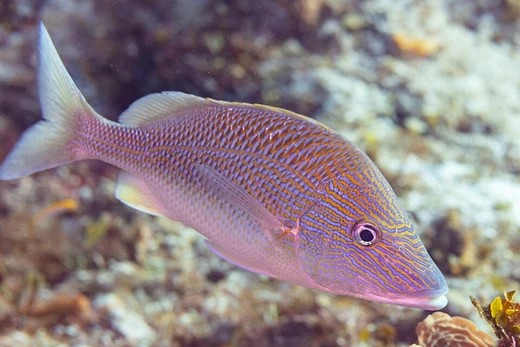
Lutjanus decussatus
A checkered snapper with red bands and brown bars across its flanks.
Last updated
The checkered snapper, also called the checkered seaperch or cross-hatched snapper, is a marine ray-finned fish in the family Lutjanidae. Its body displays a distinctive pattern: five horizontal red bands cross seven vertical brown bands, creating a checkered effect. This species lives in the western Pacific and Indian Oceans.
French zoologist Georges Cuvier first described it in 1828 as Mesoprion decussatus, based on a specimen from Java, Indonesia. The name decussatus means "divided crosswise in the form of an X," referring to the checkered pattern.
Description
The fish has a moderately deep body, with depth measuring between one-quarter and one-third of its standard length, and a moderately sloped upper head profile. The preoperculum features a weak knob and notch. Vomerine teeth form a crescent-shaped patch without a rearward extension, and the tongue has a patch of grain-like teeth.
The dorsal fin has 10 spines and 13–14 soft rays; the anal fin has 3 spines and 8–9 soft rays. Both the rear dorsal and anal fins are rounded. Maximum recorded total length is 35 cm (14 in), though 25 cm (9.8 in) is more typical.
Coloration ranges from whitish to pale greyish brown, with reddish-brown stripes and bars creating the checkered pattern on the upper flanks. A large black spot sits at the base of the caudal fin. The fins are pale, and the caudal fin has a red submarginal stripe.
Distribution and habitat
This species occurs in the Indo-West Pacific, from Sri Lanka and eastern India east to Micronesia, north to the Ryukyu Islands of southern Japan, and south to Australia. In Australia, it is found at the Dampier Archipelago, offshore reefs of northern Western Australia, Ashmore Reef in the Timor Sea, and the northern Great Barrier Reef off Queensland. It inhabits shallow water from 2 to 30 m (6 ft 7 in to 98 ft 5 in) on coastal reef faces and sandy slopes with scattered reef patches, and less commonly on offshore reefs. Juveniles live on sheltered reef flats.
Biology
Adults may be solitary or form small schools. They feed on fishes and crustaceans. Off Okinawa, spawning occurs in June and October, timed by lunar cycles.
Fisheries
Subsistence fisheries catch this snapper with handlines, traps, and gill nets. It is not a major commercial species, though it is taken commercially in parts of its range, such as the Ryukyu Islands. Small numbers occasionally appear in the aquarium trade.
Scientific classification
- KingdomAnimalia
- PhylumChordata
- ClassActinopterygii
- DivisionTeleostei
- OrderAcanthuriformes
- FamilyLutjanidae
- GenusLutjanus
- SpeciesLutjanus decussatus
Named by (Cuvier, 1828)
Close relatives
Other species of Lutjanus with a Codexery entry.
- African brown snapper Lutjanus dentatus
- Blackfin snapper Lutjanus buccanella
- Blue and gold snapper Lutjanus viridis
- Bluestriped snapper Lutjanus notatus
- Brazilian snapper Lutjanus alexandrei
- Common bluestripe snapper Lutjanus kasmira
- Cubera snapper Lutjanus cyanopterus
- Dog snapper Lutjanus jocu
Sources: Wikipedia taxobox: Lutjanus decussatus (CC BY-SA 4.0) · differs from this box at order: WoRMS AphiaID 276530 (CC BY 4.0)
Conservation status
Least Concern (LC)
- LC▲ this species
- NT
- VU
- EN
- CR
- EW
- EX
Source: IUCN Red List assessment · GBIF copy of the Red List category
How big is it?
Largest length in the source, 0.35 m, next to a 1.8 m person.
Diagram: drawn by Codexery, schematic shapes to scale (not a likeness). Length: Wikipedia: Lutjanus decussatus
Where the lutjanus decussatus has been recorded
Each dot is a place where the species has been observed and reported (1,393 records, half-degree grid) — not a modelled range. 43 inland records left out (institution coordinates).
Map: drawn by Codexery. Data: GBIF occurrence search (records CC0 / CC BY) · Natural Earth basemap (public domain) · place coordinates: Wikipedia (CC BY-SA 4.0)
Ranked in
More in Snappers
Elsewhere in Snappers and Grunts
Test yourself
Three questions drawn from this entry’s sources. Pick an answer to check it.
Answers checked against the source article
Sources
Compiled from Wikipedia and the sources listed below. Text from Wikipedia is available under CC BY-SA 4.0; this entry is adapted from it.
- Wikipedia: Lutjanus decussatus (CC BY-SA 4.0).
- Classification: the source article's taxobox; compare WoRMS, the World Register of Marine Species (CC BY 4.0).
- Conservation status: IUCN Red List assessment.
- Occurrence records: GBIF (CC0 / CC BY). Basemap: Natural Earth (public domain).
- Word definitions: the , each quoted from its Wikipedia article.
Spotted an error? Know more?
Reader corrections go straight into our review queue. Suggest an edit · How this site is sourced