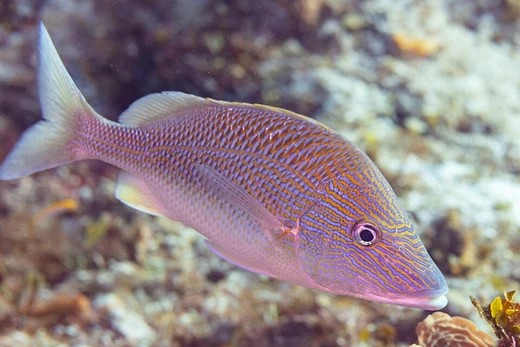
Yellowtail snapper
An abundant snapper with a distinct yellow lateral band.
Last updated
The yellowtail snapper (Ocyurus chrysurus) is a plentiful snapper found in the western Atlantic, from the Gulf of Mexico and Caribbean Sea up to Massachusetts, though its usual range runs from Florida south through the West Indies to Brazil. It mostly lives around coral reefs but can turn up in other spots, at depths from the surface down to 180 meters (590 feet), typically between 10 and 70 meters (33–230 feet).
This fish can grow to 86.3 cm (34 inches) long, but most stay under 40 cm (16 inches), and the heaviest recorded was 4.98 kg (11 pounds). It’s important commercially, farmed, popular with recreational anglers, and often seen in public aquariums. In places like the Florida Keys, divers and snorkelers frequently spot this brightly colored fish.
Taxonomy and naming
It was first described in 1791 as Sparus chrysurus by German naturalist Marcus Elieser Bloch, with the type location given as “Brazilian seas.” It’s the only species in the genus Ocyurus, a name from Greek okys (swift, like the bird) and oura (tail), referring to its forked tail. Chrysurus comes from Greek chryso (golden). Some studies suggest Ocyurus and Rhomboplites might belong inside the genus Lutjanus, and a possible hybrid between Lutjanus synagris and Ocyurus chrysurus (called Lutjanus ambiguus) supports this close relationship.
Description
The fish has a bright yellow stripe starting at the snout and widening toward the forked tail, which is entirely yellow. The rest is olive to bluish black with yellow spots above the stripe. The dorsal fin is yellow; the anal and pelvic fins are whitish. It has one dorsal fin with ten spines and 12–14 soft rays, and one anal fin with three spines and eight or nine soft rays.
Scales cover the bases of the soft parts of these fins. The long pectoral fin reaches the vent. Unlike other snappers, its head and mouth are small, and it lacks a dark spot below the dorsal fin. It has canine teeth in the upper jaw, but most teeth are villiform, and it uniquely has teeth on the ectopterygoid bones.
Ecology
Yellowtails are native to the western Atlantic, ranging from Massachusetts to southeastern Brazil, but are most common in the Bahamas, off south Florida, and throughout the Caribbean. Adults are preyed on by large fish like barracuda, mackerel, grouper, sharks, and other snappers. They eat shrimp, crabs, worms, and smaller fish.
Scientific classification
- KingdomAnimalia
- PhylumChordata
- ClassActinopterygii
- DivisionTeleostei
- OrderAcanthuriformes
- FamilyLutjanidae
- GenusOcyurus
- SpeciesOcyurus chrysurus
Named by (Bloch, 1791)
Sources: Wikipedia taxobox: Yellowtail snapper (CC BY-SA 4.0) · differs from this box at order: WoRMS AphiaID 159803 (CC BY 4.0)
Conservation status
Data Deficient (DD)
Data Deficient: there is not enough information to place this species on the risk scale.
Source: IUCN Red List assessment · GBIF copy of the Red List category
How big is it?
Largest length in the source, 0.86 m, next to a 1.8 m person.
Diagram: drawn by Codexery, schematic shapes to scale (not a likeness). Length: Wikipedia: Yellowtail snapper
Where the yellowtail snapper has been recorded
Each dot is a place where the species has been observed and reported (98,870 records, half-degree grid) — not a modelled range. 25 inland records left out (institution coordinates). 4 isolated far-off records not drawn.
Map: drawn by Codexery. Data: GBIF occurrence search (records CC0 / CC BY) · Natural Earth basemap (public domain) · place coordinates: Wikipedia (CC BY-SA 4.0)
Ranked in
More in Snappers
Elsewhere in Snappers and Grunts
Test yourself
Three questions drawn from this entry’s sources. Pick an answer to check it.
Answers checked against the source article
Sources
Compiled from Wikipedia and the sources listed below. Text from Wikipedia is available under CC BY-SA 4.0; this entry is adapted from it.
- Wikipedia: Yellowtail snapper (CC BY-SA 4.0).
- Classification: the source article's taxobox; compare WoRMS, the World Register of Marine Species (CC BY 4.0).
- Conservation status: IUCN Red List assessment.
- Occurrence records: GBIF (CC0 / CC BY). Basemap: Natural Earth (public domain).
- Word definitions: the , each quoted from its Wikipedia article.
Spotted an error? Know more?
Reader corrections go straight into our review queue. Suggest an edit · How this site is sourced