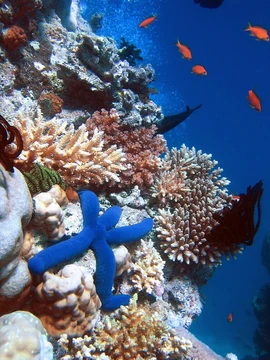
Coral reef
Coral reefs are diverse underwater ecosystems built by coral polyps.

Coral reefs are underwater ecosystems built by living creatures. Reef-building corals, specifically stony corals, form these structures. Their tiny animals, called polyps, live in colonies and are cemented together by calcium carbonate. Corals are part of the class Anthozoa, within the phylum Cnidaria, which also includes sea anemones and jellyfish. Unlike sea anemones, corals create hard, protective external skeletons made of carbonate.
These reefs are often called the rainforests of the sea. Shallow coral reefs are among the most biologically rich ecosystems on the planet. They cover less than 0.1% of the world’s ocean—roughly half the area of France—yet they support at least 25% of all marine species, including fish, mollusks, worms, crustaceans, echinoderms, sponges, tunicates, and other cnidarians. Most reefs thrive in warm, shallow, clear, sunny, and agitated water that is low in nutrients. Deep-water and cold-water reefs also exist, but on a smaller scale.
Coral reefs first appeared 485 million years ago, during the Early Ordovician, replacing the microbial and sponge reefs of the Cambrian. Shallow tropical reefs have declined by 50% since 1950. They are sensitive to water conditions and face threats from excess nutrients (nitrogen and phosphorus), rising ocean heat, acidification, overfishing (including blast fishing, cyanide fishing, and spearfishing on scuba), sunscreen use, and harmful land practices such as runoff and seeps from injection wells and cesspools.
Reefs provide valuable ecosystem services for tourism, fisheries, and shoreline protection. Their annual global economic value has been estimated between US$30–375 billion (1997 and 2003 estimates), US$2.7 trillion (2020 estimate), and US$9.9 trillion (2014 estimate).
**Formation**
Most coral reefs formed after the Last Glacial Period, when melting ice raised sea levels and flooded continental shelves. Most reefs are less than 10,000 years old. As communities established themselves, the reefs grew upward, keeping pace with rising seas. Reefs that grew too slowly could become drowned, lacking sufficient light. Reefs also appear in deep sea areas away from shelves, around oceanic islands and atolls. Most such islands are volcanic; others have tectonic origins from plate movements lifting the ocean floor.
- First appearance
- 485 million years ago
- Percentage of ocean area
- less than 0.1%
- Percentage of marine species housed
- at least 25%
- Decline since 1950
- 50%
- Annual global economic value range
- US$30–375 billion (1997 and 2003 estimates) to US$2.7 trillion (2020 estimate) to US$9.9 trillion (2014 estimate)
- Horizontal growth rate
- 1 to 3 cm per year
- Vertical growth rate
- 1 to 25 cm per year
Lore & Background
Coral reefs first appeared 485 million years ago, at the dawn of the Early Ordovician, displacing the microbial and sponge reefs of the Cambrian. Most coral reefs were formed after the Last Glacial Period when melting ice caused sea level to rise and flood continental shelves; most are less than 10,000 years old. As communities established themselves, the reefs grew upward, keeping pace with rising sea levels. Charles Darwin set out his theory of atoll formation in The Structure and Distribution of Coral Reefs, proposing a sequence of three stages: fringing reef, barrier reef, and atoll, based on uplift and subsidence of oceanic crust. The two main variables determining reef shape are the nature of the substrate and the history of sea level change relative to that substrate.
Healthy tropical coral reefs grow horizontally from 1 to 3 cm per year and vertically from 1 to 25 cm per year, but only at depths shallower than 150 m due to sunlight needs, and cannot grow above sea level. Coral reefs are made up of coral skeletons, with aragonite formed as other chemical elements become incorporated into calcium carbonate deposits. Shell fragments and remains of coralline algae such as Halimeda can add to the reef's ability to withstand storms. The times of maximum reef development were in the Middle Cambrian, Devonian, Carboniferous, Late Cretaceous, and Neogene. Not all past reefs were formed by corals; some resulted from calcareous algae and archaeocyathids, or from rudist bivalves.
Reader's Guide
Coral reefs deliver ecosystem services for tourism, fisheries, and shoreline protection. The annual global economic value of coral reefs has been estimated at anywhere from US$30–375 billion (1997 and 2003 estimates) to US$2.7 trillion (a 2020 estimate) to US$9.9 trillion (a 2014 estimate). Shallow tropical coral reefs have declined by 50% since 1950, partly because they are sensitive to water conditions. They are under threat from excess nutrients (nitrogen and phosphorus), rising ocean heat content and acidification, overfishing (e.g., from blast fishing, cyanide fishing, spearfishing on scuba), sunscreen use, and harmful land-use practices, including runoff and seeps (e.g., from injection wells and cesspools). The approximately 20,000-year-old Great Barrier Reef offers an example of how coral reefs formed on continental shelves; sea level was then 120 m lower than in the 21st century. As sea level rose, corals encroached on hills of the Australian coastal plain. By 13,000 years ago, sea level had risen to 60 m lower than at present, and many hills became continental islands. Sea level on the Great Barrier Reef has not changed significantly in the last 6,000 years, and the age of living reef structure is estimated between 6,000 and 8,000 years. Darwin's principles apply to the Great Barrier Reef, which formed the world's largest barrier reef, stretching for 2,000 km. Measurements of oxygen isotopic composition of coral skeletons can indicate changes in sea surface temperature and salinity, used to infer paleoclimate.
Did You Know?
- The Great Barrier Reef is approximately 20,000 years old and stretches for 2,000 km.
- Charles Darwin theorized that atolls form through a sequence of fringing reef, barrier reef, and atoll stages.
Biodiversity and the Architecture of Life
Coral reefs are often dubbed the rainforests of the sea because of their extraordinary concentration of living organisms. Despite covering less than 0.1 percent of the world's ocean floor—an expanse roughly equivalent to half of France—they shelter at least a quarter of all known marine species, including fish, mollusks, worms, crustaceans, echinoderms, sponges, tunicates, and other cnidarians. What makes this remarkable is that these ecosystems thrive in nutrient-poor tropical waters, typically at shallow depths where sunlight still penetrates. The reef framework itself is constructed by colonies of coral polyps belonging to the class Anthozoa within the phylum Cnidaria, the same broad group that includes sea anemones and jellyfish. Unlike their anemone relatives, these polyps secrete hard calcium carbonate exoskeletons that support and protect the colony. Most reef-building corals are stony corals whose polyps cluster in dense groups. While the majority of reefs flourish in warm, shallow, clear, sunny, and agitated water, smaller deep-water and cold-water reefs exist in other regions. Coral reefs first appeared 485 million years ago at the dawn of the Early Ordovician, displacing the microbial and sponge reefs that had dominated the Cambrian seas.
Formation and Darwin's Atoll Theory
The physical shape of a coral reef is governed by two principal variables: the nature of the substrate beneath it and the history of sea-level change relative to that substrate. Most modern reefs are fewer than 10,000 years old, having taken shape after the Last Glacial Period when melting ice raised sea levels and flooded continental shelves. Charles Darwin, during the voyage of the Beagle, proposed a three-stage model for atoll formation. He described how a fringing reef first forms around a volcanic island, transitions into a barrier reef as the island and ocean floor subside, and ultimately becomes a roughly circular atoll once the island sinks below sea level. He predicted that bedrock bases—the remnants of the original volcano—would lie beneath each lagoon, a hypothesis later confirmed by research. The Great Barrier Reef illustrates this process on a continental shelf: as sea levels rose over roughly 20,000 years, corals overgrew coastal hills, and the living reef structure is now estimated at 6,000 to 8,000 years old. Darwin's principles apply here as well, though development halted at the barrier reef stage because Australia is not submerging.
Decline and the Pressures on Reefs
Shallow tropical coral reefs have lost approximately half their extent since 1950, a decline driven by their sensitivity to shifting water conditions. Multiple stressors compound one another: excess nutrients from nitrogen and phosphorus pollution, rising ocean heat content, and acidification all degrade reef health. Human fishing practices—including blast fishing, cyanide fishing, and spearfishing on scuba—remove the species that help maintain reef balance. Even sunscreen chemicals and harmful land-use practices such as agricultural runoff, injection-well seeps, and cesspool discharge introduce toxins into reef waters. The biological vulnerability is rooted in the coral-algae symbiosis: corals that depend on zooxanthellae for nutrition can die when water becomes too deep for adequate photosynthesis, or when heat and acidity disrupt the relationship. Reefs that grow too slowly to keep pace with rising sea levels face what is called coral drowning, losing the light their symbionts need. The combination of these pressures means that even reefs in otherwise suitable warm, shallow, agitated waters are increasingly unable to sustain the polyp colonies that build their carbonate frameworks.
Economic Value and Ecosystem Services
Beyond their biological richness, coral reefs deliver tangible services that underpin human economies and coastal safety. They support tourism industries, sustain fisheries that feed coastal communities, and serve as natural breakwaters that protect shorelines from storm surge and erosion. The economic value of these services has been estimated across a wide range depending on methodology and year: figures span from US$30 billion to US$375 billion in assessments from 1997 and 2003, to US$2.7 trillion in a 2020 calculation, and as high as US$9.9 trillion in a 2014 estimate. This spread reflects the difficulty of quantifying ecosystem services, but all figures point to reefs being among the most economically productive environments on Earth relative to their tiny footprint. The physical structure—built from calcium carbonate skeletons, aragonite deposits, and reinforced by shell fragments and coralline algae such as Halimeda—provides the substrate that makes these services possible. Healthy tropical reefs grow horizontally at one to three centimeters per year and vertically at one to twenty-five centimeters per year, but only at depths shallower than 150 meters where sunlight still reaches.
More in Coral Reefs 1-24
Spotted an error? Know more?
Reader corrections go straight into our review queue. Suggest an edit · How this site is sourced