Pernambuco
Brazilian state with rich cultural traditions and varied history.

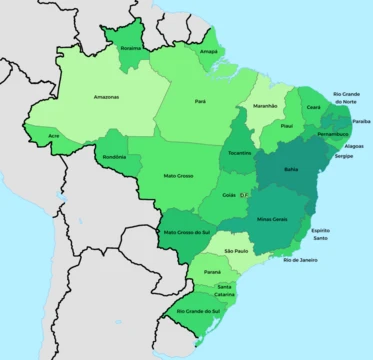
Pernambuco is a Brazilian state on the country's northeastern coast. With roughly 9.5 million residents as of 2024, it ranks as the seventh most populous state and the nineteenth largest by area, covering about 98,068 square kilometers. It is also the sixth most densely populated, with around 92 people per square kilometer. Its capital, Recife, is a major economic and urban center; its metropolitan region was the seventh largest in Brazil and the second largest in the Northeast as of 2019. In 2015, the state held 4.4% of the national population and contributed 2.8% of Brazil's GDP.
The state's name comes from the Captaincy of Pernambuco, founded in 1534. Before European contact, Tupi–Guarani-speaking peoples lived here. Portuguese colonization began in the 1500s, with a short Dutch interlude, and Brazil gained independence in 1822. During the colonial period, many enslaved Africans were brought to work sugarcane plantations, and a large part of the population today has African ancestry. This mix of histories and peoples has created rich cultural traditions, including the famous Carnivals in Recife and the historic colonial city of Olinda. Recife's Galo da Madrugada parade has held world records for its size.
Sugarcane farming once dominated the economy thanks to the climate, but the modern economy is now mostly services, though sugarcane is still widely grown. Since democracy returned in 1985, the state has seen progress in economic and health indicators, but inequality remains high.
The origin of the name Pernambuco is debated, with most theories pointing to the now-extinct Tupi language. One idea combines Tupi words for "great river" or "sea" (para'nã) and "hole" (buka), meaning "hole in the sea"—possibly referring to the Canal de Santa Cruz on Itamaracá Island or a reef opening between Olinda and Recife. Another theory says "pernambuco" was the local indigenous name for brazilwood, which grew widely in the region's forests. A third suggests it comes from paranãbuku, meaning "long river," possibly the Capibaribe River, as early maps show a "Pernambuco river" near Cabo de Santo Agostinho. Scholar Jacques Ribemboim proposed a Portuguese origin: the Canal de Santa Cruz was once called Boca de Fernão (after explorer Fernão de Noronha), and indigenous speakers may have turned "Fernão" into "Pernao" and reversed the words to get "Pernão Boca" or "Pernambuka," leading to the modern name. The state also has nicknames like Lion of the North, Land of Frevo and Maracatu, and Blessed Land.
Geographically, Pernambuco has a narrow coastal zone, a high inland plateau, and a middle zone of terraces and slopes. The surface is broken by remnants of an ancient plateau worn down by erosion, leaving escarpments and flat-topped mountain ranges called chapadas, capped with sandstone. These chapadas form borders with three states: the Serra dos Irmãos and Serra Vermelha with Piauí, the Serra do Araripe with Ceará, and the Serra dos Cariris Velhos with Paraíba.
The fertile coastal area was once covered by humid Pernambuco coastal forests, part of the Atlantic Forests of eastern Brazil, but is now mostly sugarcane plantations. It has a hot, humid climate, cooled somewhat by southeast trade winds. The middle zone, the agreste, is drier with lighter vegetation, including semi-deciduous interior forests where trees lose leaves in the dry season. The inland sertão is high, rocky, and dry, often hit by long droughts. It has hot days and cool nights, with a rainy season from March to June and a dry season the rest of the year. The interior is mostly covered by caatinga, a dry thorny scrub. The Rio São Francisco is the main water source here. The Borborema Plateau has a milder climate; some towns are over 1,000 meters above sea level, and winter temperatures can drop to 10 °C or even 5 °C in places like Triunfo. The volcanic archipelago of Fernando de Noronha, 535 kilometers northeast of Recife, has been part of Pernambuco since 1988.
The state's rivers include small plateau streams flowing south to the São Francisco—such as the Moxotó, Ema, Pajeú, Terra Nova, Brigida, Boa Vista, and Pontai—which are dry channels most of the year. Larger coastal rivers include the Goiana, formed by the Tracunhaem and Capibaribe-mirim, draining a rich agricultural area in the northeast; and the Capibaribe, which starts in the Serra de Jacarara and flows eastward to the Atlantic.
- Population (2024 estimate)
- 9.5 million
- Density
- 92.37 people per km²
- Capital
- Recife
- GDP share (2015)
- 2.8% of national GDP
- Founded as captaincy
- 1534
Lore & Background
The origins of the name Pernambuco are debated, with most hypotheses deriving it from the now-extinct Tupi language. Some scholars claim it means 'hole in the sea,' possibly referring to the Canal de Santa Cruz. Others say it was the name of brazilwood in local indigenous languages. A third hypothesis suggests it means 'long river,' referencing the Capibaribe River. Another hypothesis, from academic Jacques Ribemboim, asserts Portuguese origins from 'Boca de Fernão.' The state also has nicknames such as Lion of the North, Land of Frevo and Maracatu, and Blessed Land. Geographically, Pernambuco comprises a narrow coastal zone, a high inland plateau, and an intermediate zone. The coastal area was formerly covered by humid Pernambuco coastal forests, now occupied by sugarcane plantations. The middle agreste region has a drier climate, and the inland sertão is high, stony, and dry, frequently devastated by droughts. The volcanic archipelago of Fernando de Noronha has been part of Pernambuco since 1988. Historically a center of sugarcane cultivation, the state's modern economy is dominated by the services sector, though large amounts of sugarcane are still grown.
Reader's Guide
Pernambuco is significant as a state that encapsulates much of Brazil's colonial and cultural history. Its name, debated among scholars, reflects indigenous and Portuguese influences. The state was a major center of sugarcane cultivation during the colonial era, relying on enslaved African labor, which has left a lasting demographic and cultural legacy. Today, Pernambuco's economy is dominated by the services sector, though sugarcane remains important. The state is known for its vibrant cultural traditions, including the Galo da Madrugada parade in Recife, which has held world records for its size. The Recife Metropolitan Region is the seventh-most populous in Brazil and the second-largest in the Northeast. Pernambuco's geography ranges from coastal forests to dry inland sertão, and it includes the volcanic archipelago of Fernando de Noronha. The state's rivers, such as the Capibaribe and Ipojuca, are vital to its hydrology. Overall, Pernambuco represents a blend of indigenous, African, and European heritage, with a modern economy and ongoing social challenges.
Did You Know?
- The name Pernambuco may derive from Tupi words meaning 'hole in the sea' or 'long river,' or from the Portuguese 'Boca de Fernão.'
- The Galo da Madrugada parade in Recife has held world records for its size.
- Fernando de Noronha has been part of Pernambuco since 1988.
- The state's inland sertão region is frequently devastated by prolonged droughts.
More in Brazilian States 1-24
Spotted an error? Know more?
This is a living reference — every entry is fact-audited, and reader corrections feed straight into our audit queue. Suggest an edit · See this site's audit record