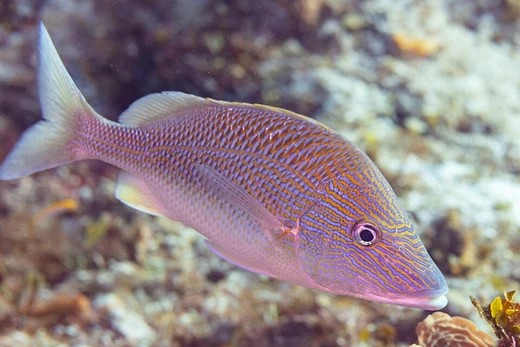
Lutjanus indicus
Indian Ocean snapper with seven horizontal stripes and a black spot.
Last updated
Lutjanus indicus, commonly known as the striped snapper, is a species of marine ray-finned fish belonging to the family Lutjanidae. It is native to the Indian Ocean and was first formally described in 2013. This species is notable as the western sister species of the Western Pacific Lutjanus russellii, and many historical records of that species from the Red Sea and East Africa are likely to be L. indicus, though this requires confirmation.
Scientific classification
- KingdomAnimalia
- PhylumChordata
- ClassActinopterygii
- DivisionTeleostei
- OrderAcanthuriformes
- FamilyLutjanidae
- GenusLutjanus
- SpeciesLutjanus indicus
Named by Allen, White & Erdmann, 2013
Close relatives
Other species of Lutjanus with a Codexery entry.
- Lutjanus russellii Lutjanus russellii
- African brown snapper Lutjanus dentatus
- Blackfin snapper Lutjanus buccanella
- Blue and gold snapper Lutjanus viridis
- Bluestriped snapper Lutjanus notatus
Sources: Wikipedia taxobox: Lutjanus indicus (CC BY-SA 4.0) · differs from this box at order: WoRMS AphiaID 835109 (CC BY 4.0)
Conservation status
Least Concern (LC)
- LC▲ this species
- NT
- VU
- EN
- CR
- EW
- EX
Source: IUCN Red List assessment · GBIF copy of the Red List category
How big is it?
Largest length in the source, 0.23 m, next to a 1.8 m person.
Diagram: drawn by Codexery, schematic shapes to scale (not a likeness). Length: Wikipedia: Lutjanus indicus
Where the lutjanus indicus has been recorded
Each dot is a place where the species has been observed and reported (54 records, half-degree grid) — not a modelled range. 12 inland records left out (institution coordinates).
Map: drawn by Codexery. Data: GBIF occurrence search (records CC0 / CC BY) · Natural Earth basemap (public domain) · place coordinates: Wikipedia (CC BY-SA 4.0)
Background
Lutjanus indicus was first formally described in 2013 by Gerald R. Allen, William T. White and Mark V. Erdmann, with the type locality given as Trincomalee in Sri Lanka. The specific name indicus refers to the Indian Ocean. Within the genus Lutjanus, it is closest to the Western Pacific L. russellii, and it appears to be the western sister species of that fish. Records of L. russellii from the Red Sea, Eastern Africa, Madagascar, the Seychelles and the Mascarenes are likely to be of L. indicus, but this needs confirmation.
The striped snapper has a spindle-shaped body with a steeply sloped forehead and a large mouth. Its coloration is pale grey shading to silvery white on the lower body, with seven dark brown to yellow horizontal stripes on the back of the head and flanks. A distinctive black spot, larger than the eye, is present on the back underneath the first 6-7 dorsal fin rays, extending to just below the lateral line. The maximum recorded standard length is 22.6 cm.
Lutjanus indicus is known with certainty from the Persian Gulf and Sea of Oman, along the northern shores of the Indian Ocean to eastern India, the Gulf of Mannar, and western Thailand. It has been observed in coral reef habitat at depths between 5 and 15 m, though it has been trawled from as deep as 50 m. It is thought that juveniles inhabit brackish habitats such as mangroves and estuaries, even reaching into lower parts of freshwater streams, similar to L. russellii.
Frequently Asked Questions
What is Lutjanus indicus known for?
The striped snapper is easily recognized by its seven horizontal body stripes and a single black spot, and it tops out at roughly 22.6 cm (8.9 in) in standard length. Its fin formula includes 10 dorsal spines with 13–14 soft rays and 3 anal spines with 8 soft rays.
Where can I find Lutjanus indicus?
The striped snapper is a resident of the Indian Ocean, with its original collection site at Trincomalee, Sri Lanka. Its seven horizontal stripes and distinctive black spot make it stand out among other lutjanid snappers in that region.
Ranked in
More in Snappers
Elsewhere in Snappers and Grunts
Test yourself
Three questions drawn from this entry’s sources. Pick an answer to check it.
Answers checked against the source article
Sources
Compiled from Wikipedia and the sources listed below. Text from Wikipedia is available under CC BY-SA 4.0; this entry is adapted from it.
- Wikipedia: Lutjanus indicus (CC BY-SA 4.0).
- Classification: the source article's taxobox; compare WoRMS, the World Register of Marine Species (CC BY 4.0).
- Conservation status: IUCN Red List assessment.
- Occurrence records: GBIF (CC0 / CC BY). Basemap: Natural Earth (public domain).
- Word definitions: the Codexery glossary, each quoted from its Wikipedia article.
Spotted an error? Know more?
Reader corrections go straight into our review queue. Suggest an edit · How this site is sourced