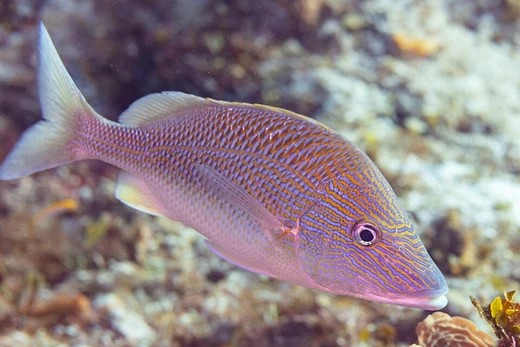
Lutjanus maxweberi
A small snapper from western Pacific fresh and brackish waters.
Last updated
The pygmy snapper (Lutjanus maxweberi) is a ray-finned fish in the snapper family Lutjanidae. It lives in the western Pacific Ocean and has only been recorded in fresh and brackish waters.
Dutch ichthyologist Canna Maria Louise Popta first scientifically described this species in 1921, using a specimen collected on the Siboga expedition. The type location is Muna Island, off Sulawesi. Popta originally spelled the genus as Lutianus and the species name as max weberi, but these are now considered misspellings. The species name honors Dutch ichthyologist Max Weber, who led the expedition.
The pygmy snapper has a fairly deep body, with its standard length measuring 2.2 to 2.7 times its deepest point. Its forehead slopes steeply, and the preopercular notch and knob are faint. The vomerine teeth form a crescent or triangular patch without a rearward extension, and the tongue has no teeth.
The dorsal fin has 10 spines and 13 soft rays, while the anal fin has 3 spines and 8 soft rays. Both the dorsal and anal fins are rounded or slightly angular at the rear. The pectoral fins have 16 rays, and the caudal fin is emarginate.
Juveniles have a whitish body with four dark brown to blackish stripes along the sides. Adults are plain brownish on the back and sides, with whitish undersides. The maximum known standard length is 15 cm (5.9 in).
This species is found in the Philippines, Sulawesi, and New Guinea. Juveniles inhabit mangrove-lined inlets, brackish waters, and freshwater streams, but the habitat of adults is unknown.
Little is known about its biology. It has been observed in small groups.
Scientific classification
- KingdomAnimalia
- PhylumChordata
- ClassActinopterygii
- DivisionTeleostei
- OrderAcanthuriformes
- FamilyLutjanidae
- GenusLutjanus
- SpeciesLutjanus maxweberi
Named by Popta, 1921
Close relatives
Other species of Lutjanus with a Codexery entry.
- African brown snapper Lutjanus dentatus
- Blackfin snapper Lutjanus buccanella
- Blue and gold snapper Lutjanus viridis
- Bluestriped snapper Lutjanus notatus
- Brazilian snapper Lutjanus alexandrei
- Common bluestripe snapper Lutjanus kasmira
- Cubera snapper Lutjanus cyanopterus
- Dog snapper Lutjanus jocu
Sources: Wikipedia taxobox: Pygmy snapper (CC BY-SA 4.0) · differs from this box at order: WoRMS AphiaID 276542 (CC BY 4.0)
Conservation status
Data Deficient (DD)
Data Deficient: there is not enough information to place this species on the risk scale.
Source: IUCN Red List assessment · GBIF copy of the Red List category
How big is it?
Largest length in the source, 0.15 m, next to a 1.8 m person.
Diagram: drawn by Codexery, schematic shapes to scale (not a likeness). Length: Wikipedia: Pygmy snapper
Where the lutjanus maxweberi has been recorded
Map: drawn by Codexery. Data: Natural Earth basemap (public domain) · place coordinates: Wikipedia (CC BY-SA 4.0)
More in Snappers
Elsewhere in Snappers and Grunts
Test yourself
Three questions drawn from this entry’s sources. Pick an answer to check it.
Answers checked against the source article
Sources
Compiled from Wikipedia and the sources listed below. Text from Wikipedia is available under CC BY-SA 4.0; this entry is adapted from it.
- Wikipedia: Pygmy snapper (CC BY-SA 4.0).
- Classification: the source article's taxobox; compare WoRMS, the World Register of Marine Species (CC BY 4.0).
- Conservation status: IUCN Red List assessment.
- Occurrence records: GBIF (CC0 / CC BY). Basemap: Natural Earth (public domain).
- Word definitions: the , each quoted from its Wikipedia article.
Spotted an error? Know more?
Reader corrections go straight into our review queue. Suggest an edit · How this site is sourced