Lutjanus madras
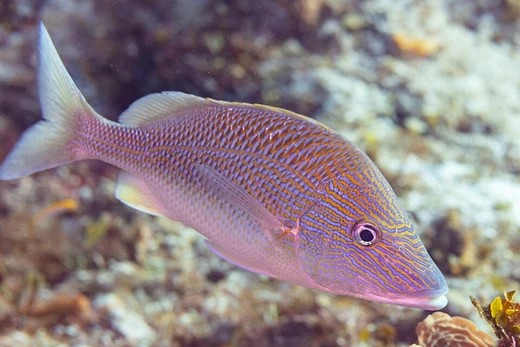
Indian snapper with yellow fins and thin yellow lines.
Last updated
Lutjanus madras, known as the Indian snapper, is a marine ray-finned fish in the snapper family Lutjanidae. Its range includes the western Pacific and Indian Oceans.
Taxonomy
The species was first formally described in 1831 by French zoologist Achille Valenciennes, who named it Mesoprion madras based on a specimen from Mahé in the Seychelles. The specific name madras is the local Seychellois name for the fish. Records of this species from the Pacific were once attributed to the yellowfin snapper (Lutjanus xanthopinnis), described from Japan in 2013.
Description
The Indian snapper has a slender, fusiform body, with a standard length 2.6 to 3.1 times its deepest point. Its forehead slopes gently to moderately, and the preopercular notch and knob are faint. The vomerine teeth form a triangular patch with a rearward extension, or a diamond shape, and the tongue has a patch of grain-like teeth.
The dorsal fin has 10–11 spines and 13–14 soft rays; the anal fin has 3 spines and 8–9 soft rays. Both the dorsal and anal fins have angular rear profiles. The pectoral fins have 16–17 rays, and the caudal fin is truncate or slightly emarginate. Maximum total length is 30 cm (12 in), though 20 cm (7.9 in) is more typical.
The upper back is brownish, the flanks whitish with very thin yellow lines along each scale row on the lower body. Above the lateral line, fine brownish diagonal lines run. All fins are yellow except the pelvic fins, which are whitish or very pale yellow.
Distribution and habitat
Originally thought restricted to the western Indian Ocean—recorded from Zanzibar, the Seychelles, Oman, southern India, and Sri Lanka—the species was later believed replaced in the Pacific by L. xanthopinnis. However, a recent record places L. madras in the Philippines. It inhabits coral and rocky reefs at depths of 5 to 90 m (16 to 295 ft).
Biology
The Indian snapper gathers in small to large aggregations around coral or rocky outcrops. It spawns pelagic eggs, forming spawning aggregations. It is a daytime predator.
In the Andaman and Nicobar Islands, it is common in fish markets, caught with handlines. Elsewhere, subsistence fisheries use gill nets and traps.
Scientific classification
- KingdomAnimalia
- PhylumChordata
- ClassActinopterygii
- DivisionTeleostei
- OrderAcanthuriformes
- FamilyLutjanidae
- GenusLutjanus
- SpeciesLutjanus madras
Named by (Valenciennes, 1831)
Close relatives
Other species of Lutjanus with a Codexery entry.
- African brown snapper Lutjanus dentatus
- Blackfin snapper Lutjanus buccanella
- Blue and gold snapper Lutjanus viridis
- Bluestriped snapper Lutjanus notatus
- Brazilian snapper Lutjanus alexandrei
- Common bluestripe snapper Lutjanus kasmira
- Cubera snapper Lutjanus cyanopterus
- Dog snapper Lutjanus jocu
Sources: Wikipedia taxobox: Lutjanus madras (CC BY-SA 4.0) · differs from this box at order: WoRMS AphiaID 218478 (CC BY 4.0)
Conservation status
Least Concern (LC)
- LC▲ this species
- NT
- VU
- EN
- CR
- EW
- EX
Source: IUCN Red List assessment · GBIF copy of the Red List category
How big is it?
Largest length in the source, 0.3 m, next to a 1.8 m person.
Diagram: drawn by Codexery, schematic shapes to scale (not a likeness). Length: Wikipedia: Lutjanus madras
Where the lutjanus madras has been recorded
Each dot is a place where the species has been observed and reported (35 records, half-degree grid) — not a modelled range. 6 inland records left out (institution coordinates).
Map: drawn by Codexery. Data: GBIF occurrence search (records CC0 / CC BY) · Natural Earth basemap (public domain) · place coordinates: Wikipedia (CC BY-SA 4.0)
Frequently Asked Questions
What does Lutjanus madras look like?
It has a slender, fusiform (spindle-shaped) body, yellow fins, and thin yellow lines running along its flanks.
Why was Lutjanus madras once confused with Lutjanus xanthopinnis?
Pacific records of the Indian snapper were long misattributed to the yellowfin snapper, a species that was not formally described from Japan until 2013. This mix-up meant the true range and identity of the Indian snapper in Pacific waters went unrecognized for a long time.
Ranked in
More in Snappers
Elsewhere in Snappers and Grunts
Test yourself
Three questions drawn from this entry’s sources. Pick an answer to check it.
Answers checked against the source article
Sources
Compiled from Wikipedia and the sources listed below. Text from Wikipedia is available under CC BY-SA 4.0; this entry is adapted from it.
- Wikipedia: Lutjanus madras (CC BY-SA 4.0).
- Classification: the source article's taxobox; compare WoRMS, the World Register of Marine Species (CC BY 4.0).
- Conservation status: IUCN Red List assessment.
- Occurrence records: GBIF (CC0 / CC BY). Basemap: Natural Earth (public domain).
- Word definitions: the , each quoted from its Wikipedia article.
Spotted an error? Know more?
Reader corrections go straight into our review queue. Suggest an edit · How this site is sourced