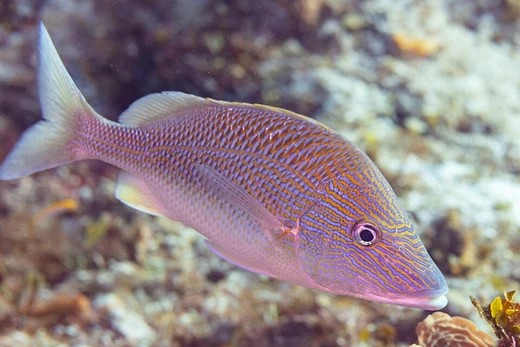
Papuan black snapper
A freshwater snapper of New Guinea and Borneo, prized by anglers.
Last updated
Lutjanus goldiei, commonly known as the Papuan black snapper, Papuan black bass, New Guinea bass, or Niugini black bass, is a species of freshwater and brackish water ray-finned fish in the family Lutjanidae. It is found in the western Pacific Ocean, primarily in southern New Guinea and parts of Borneo. The species is notable for its two color phases, large size reaching up to 100 cm, and its popularity as a game fish that attracts anglers from around the world.
Scientific classification
- KingdomAnimalia
- PhylumChordata
- ClassActinopterygii
- DivisionTeleostei
- OrderAcanthuriformes
- FamilyLutjanidae
- GenusLutjanus
- SpeciesLutjanus goldiei
Named by (W.J. Macleay, 1882)
Close relatives
Other species of Lutjanus with a Codexery entry.
- African brown snapper Lutjanus dentatus
- Blackfin snapper Lutjanus buccanella
- Blue and gold snapper Lutjanus viridis
- Bluestriped snapper Lutjanus notatus
- Brazilian snapper Lutjanus alexandrei
- Common bluestripe snapper Lutjanus kasmira
- Cubera snapper Lutjanus cyanopterus
- Dog snapper Lutjanus jocu
Sources: Wikipedia taxobox: Lutjanus goldiei (CC BY-SA 4.0) · differs from this box at order: WoRMS AphiaID 276537 (CC BY 4.0)
Conservation status
Data Deficient (DD)
Data Deficient: there is not enough information to place this species on the risk scale.
Source: IUCN Red List assessment · GBIF copy of the Red List category
How big is it?
Largest length in the source, 1 m, next to a 1.8 m person.
Diagram: drawn by Codexery, schematic shapes to scale (not a likeness). Length: Wikipedia: Lutjanus goldiei
Where the papuan black snapper has been recorded
Map: drawn by Codexery. Data: Natural Earth basemap (public domain) · place coordinates: Wikipedia (CC BY-SA 4.0)
Background
Lutjanus goldiei was first formally described in 1882 by Scots-born Australian naturalist William John Macleay, who named it Mesoprion goldiei. The specific name honors Andrew Goldie, a Scots-born merchant and explorer who provided Macleay with specimens and notes. The type locality is Hood Bay in Papua New Guinea.
The species has a relatively deep body with a steep forehead, weak preopercular incision and knob, and a crescent-shaped vomerine tooth patch. It has a large eye with a reddish yellow iris and black pupil. The dorsal and anal fins have rounded rear profiles, and the caudal fin is truncate.
Two color phases exist: one entirely blackish, the other with 6-7 wide greyish bars on the flanks; juveniles are always barred. The species was once thought confined to southern New Guinea between Port Moresby and the Fly River, but has since been found in Sabah, Borneo, and possibly other islands. It inhabits freshwater streams and rivers, as well as brackish estuarine environments, and has been recorded up to 828 km inland in the Fly River, though typically 200-400 km from the sea.
More in Snappers
Elsewhere in Snappers and Grunts
Test yourself
Three questions drawn from this entry’s sources. Pick an answer to check it.
Answers checked against the source article
Sources
Compiled from Wikipedia and the sources listed below. Text from Wikipedia is available under CC BY-SA 4.0; this entry is adapted from it.
- Wikipedia: Lutjanus goldiei (CC BY-SA 4.0).
- Classification: the source article's taxobox; compare WoRMS, the World Register of Marine Species (CC BY 4.0).
- Conservation status: IUCN Red List assessment.
- Occurrence records: GBIF (CC0 / CC BY). Basemap: Natural Earth (public domain).
- Word definitions: the , each quoted from its Wikipedia article.
Spotted an error? Know more?
Reader corrections go straight into our review queue. Suggest an edit · How this site is sourced