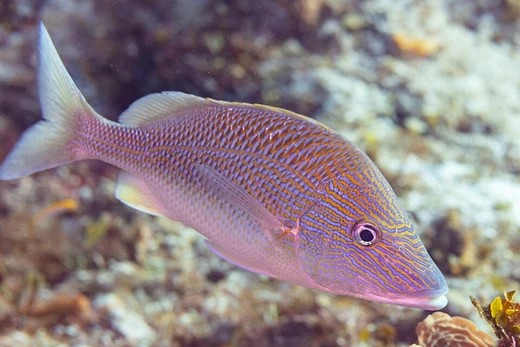
Lutjanus endecacanthus
Guinea snapper, a data-deficient reef fish of West Africa.
Last updated
The Guinea snapper, Lutjanus endecacanthus, is a marine ray-finned fish belonging to the snapper family Lutjanidae. Its range is the eastern Atlantic Ocean, along the west coast of Africa.
Taxonomy
Dutch physician and herpetologist Pieter Bleeker first formally described this species in 1863, giving the type locality as "Ashantee in Guinea." The specific name endecacanthus combines endeka ("eleven") and acanthus ("thorn" or "spine"), a reference to the 11 spines in its dorsal fin. Bleeker also described L. modestus in the same year, and it remains unclear whether that name is a synonym of this species or of L. agennes. Other authorities suggest L. endecacanthus itself may be a synonym of Lutjanus dentatus.
Description
This snapper has a moderately deep body and a pointed head with an acute snout. The knob and incision on the preoperculum are weakly developed. Vomerine teeth form a triangular patch, sometimes with a rearward extension.
The dorsal fin has 10–11 spines and 13–14 soft rays, while the anal fin has 3 spines and 8 soft rays. The long pectoral fins, with 17 rays, reach the level of the anus, and the caudal fin is truncate. Adults reach a maximum total length of 85 cm (33 in).
Their coloration is brown, darker on the back and upper flanks, paler on the lower flanks, with a silvery abdomen and brown fins. Juveniles often show 6 to 8 vertical lines of white spots on the flanks and a pair of blue lines on the cheek below the eye. Individuals around 15 cm (5.9 in) standard length have a dusky patch with white front and rear margins on the upper part of the caudal peduncle and behind the dorsal fin.
Distribution and habitat
The species occurs in the tropical eastern Atlantic, from Ghana to the mouth of the Congo River. Reports from the Republic of Guinea may be erroneous. It inhabits shallow waters between 5 and 30 m (16–98 ft), associated with reefs, rocky bottoms, and coral reefs. It has also been recorded in brackish lagoons, occasionally in rivers, and in shallow inshore waters.
Fisheries and conservation
Lutjanus endecacanthus is a predator, feeding mainly on fishes and crustaceans, but its biology is otherwise very poorly known. It is important to artisanal and subsistence fisheries within its range. Because it is known only from museum specimens, and its range and taxonomic status are uncertain, the IUCN lists it as Data Deficient.
Scientific classification
- KingdomAnimalia
- PhylumChordata
- ClassActinopterygii
- DivisionTeleostei
- OrderAcanthuriformes
- FamilyLutjanidae
- GenusLutjanus
- SpeciesLutjanus endecacanthus
Named by Bleeker, 1863
Close relatives
Other species of Lutjanus with a Codexery entry.
- Lutjanus agennes Lutjanus agennes
- African brown snapper Lutjanus dentatus
- Blackfin snapper Lutjanus buccanella
- Blue and gold snapper Lutjanus viridis
- Bluestriped snapper Lutjanus notatus
- Brazilian snapper Lutjanus alexandrei
- Common bluestripe snapper Lutjanus kasmira
- Cubera snapper Lutjanus cyanopterus
Sources: Wikipedia taxobox: Lutjanus endecacanthus (CC BY-SA 4.0) · differs from this box at order: WoRMS AphiaID 276533 (CC BY 4.0)
Conservation status
Data Deficient (DD)
Data Deficient: there is not enough information to place this species on the risk scale.
Source: IUCN Red List assessment · GBIF copy of the Red List category
How big is it?
Largest length in the source, 0.85 m, next to a 1.8 m person.
Diagram: drawn by Codexery, schematic shapes to scale (not a likeness). Length: Wikipedia: Lutjanus endecacanthus
Where the lutjanus endecacanthus has been recorded
Each dot is a place where the species has been observed and reported (59 records, half-degree grid) — not a modelled range. 25 inland records left out (institution coordinates).
Map: drawn by Codexery. Data: GBIF occurrence search (records CC0 / CC BY) · Natural Earth basemap (public domain)
Ranked in
More in Snappers
Elsewhere in Snappers and Grunts
Test yourself
Three questions drawn from this entry’s sources. Pick an answer to check it.
Answers checked against the source article
Sources
Compiled from Wikipedia and the sources listed below. Text from Wikipedia is available under CC BY-SA 4.0; this entry is adapted from it.
- Wikipedia: Lutjanus endecacanthus (CC BY-SA 4.0).
- Classification: the source article's taxobox; compare WoRMS, the World Register of Marine Species (CC BY 4.0).
- Conservation status: IUCN Red List assessment.
- Occurrence records: GBIF (CC0 / CC BY). Basemap: Natural Earth (public domain).
- Word definitions: the , each quoted from its Wikipedia article.
Spotted an error? Know more?
Reader corrections go straight into our review queue. Suggest an edit · How this site is sourced