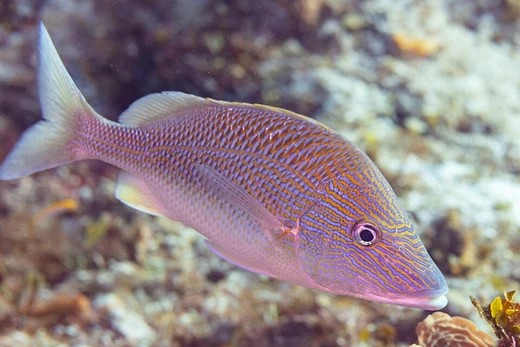
Lutjanus carponotatus
A striped snapper of Indo-West Pacific coral reefs.
Last updated
Lutjanus carponotatus, known commonly as the Spanish flag snapper or stripey snapper, is a species of marine ray-finned fish in the family Lutjanidae. It is native to the western Pacific and Indian Oceans, ranging from India to northern Australia, and is notable for its distinctive horizontal yellow to golden-brown stripes and a blackish spot on the pectoral fin.
Scientific classification
- KingdomAnimalia
- PhylumChordata
- ClassActinopterygii
- DivisionTeleostei
- OrderAcanthuriformes
- FamilyLutjanidae
- GenusLutjanus
- SpeciesLutjanus carponotatus
Named by (Richardson, 1842)
Close relatives
Other species of Lutjanus with a Codexery entry.
- African brown snapper Lutjanus dentatus
- Blackfin snapper Lutjanus buccanella
- Blue and gold snapper Lutjanus viridis
- Bluestriped snapper Lutjanus notatus
- Brazilian snapper Lutjanus alexandrei
- Common bluestripe snapper Lutjanus kasmira
- Cubera snapper Lutjanus cyanopterus
- Dog snapper Lutjanus jocu
Sources: Wikipedia taxobox: Lutjanus carponotatus (CC BY-SA 4.0) · differs from this box at order: WoRMS AphiaID 276528 (CC BY 4.0)
Conservation status
Least Concern (LC)
- LC▲ this species
- NT
- VU
- EN
- CR
- EW
- EX
Source: IUCN Red List assessment · GBIF copy of the Red List category
How big is it?
Largest length in the source, 0.4 m, next to a 1.8 m person.
Diagram: drawn by Codexery, schematic shapes to scale (not a likeness). Length: Wikipedia: Lutjanus carponotatus
Where the lutjanus carponotatus has been recorded
Each dot is a place where the species has been observed and reported (6,142 records, half-degree grid) — not a modelled range. 19 inland records left out (institution coordinates). 2 isolated far-off records not drawn.
Map: drawn by Codexery. Data: GBIF occurrence search (records CC0 / CC BY) · Natural Earth basemap (public domain) · place coordinates: Wikipedia (CC BY-SA 4.0)
Background
Lutjanus carponotatus was first formally described in 1842 as Mesoprion carponotatus by Scottish naval surgeon Sir John Richardson, with the type locality given as Port Essington in the Northern Territory of Australia. The specific name is a compound of karpos meaning 'wrist' and notatus meaning 'marked', referring to the blackish spot at the base of the highest rays and upper axil of the pectoral fins. The species has a moderately deep body, a pointed snout, and weakly developed preopercular knob and incision.
Its dorsal fin has 10 spines and 14-16 soft rays, the anal fin has 3 spines and 9 soft rays, and the caudal fin is emarginate. Adults are bluish-grey to whitish with 8-9 yellow to golden-brown horizontal stripes, yellow fins, and a blackish spot on the pectoral fin axil. Juveniles have a wide white longitudinal stripe bordered by dark brown to black stripes.
Ranked in
More in Snappers
Elsewhere in Snappers and Grunts
Test yourself
Three questions drawn from this entry’s sources. Pick an answer to check it.
Answers checked against the source article
Sources
Compiled from Wikipedia and the sources listed below. Text from Wikipedia is available under CC BY-SA 4.0; this entry is adapted from it.
- Wikipedia: Lutjanus carponotatus (CC BY-SA 4.0).
- Classification: the source article's taxobox; compare WoRMS, the World Register of Marine Species (CC BY 4.0).
- Conservation status: IUCN Red List assessment.
- Occurrence records: GBIF (CC0 / CC BY). Basemap: Natural Earth (public domain).
- Word definitions: the Codexery glossary, each quoted from its Wikipedia article.
Spotted an error? Know more?
Reader corrections go straight into our review queue. Suggest an edit · How this site is sourced