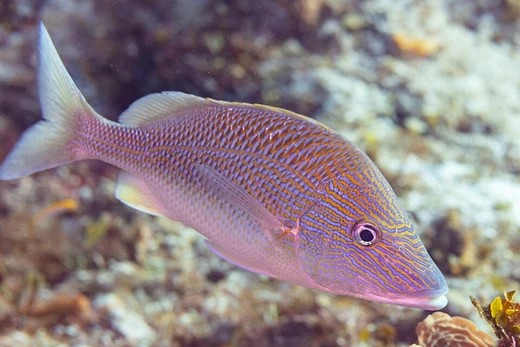
Lutjanus adetii
A southwestern Pacific snapper valued as a game fish.
Last updated
The yellow-banded snapper, also called the hussar, is a marine fish in the snapper family Lutjanidae. It lives in the southwestern Pacific Ocean. While not a major commercial species, it is caught by local fisheries and is popular with recreational anglers.
Taxonomy
French naturalist François-Louis Laporte, comte de Castelnau, first described this species in 1873, naming it Diacope adetii. He based the description on specimens collected in Nouméa, New Caledonia, by a man identified only as "Mr. Adet," whose full name was not recorded.
Description
This snapper has a fairly deep body, with a standard length about 2.5 to 2.7 times its depth. Its snout is somewhat pointed, the preorbital bone is wider than the eye’s diameter, and it has a well-developed preopercular protuberance and notch. The tongue has a patch of granular teeth, and the vomerine teeth form a triangular patch.
The dorsal fin has 10 spines and 14 soft rays; the anal fin has 3 spines and 8 soft rays; both fins have rounded rear edges. The pectoral fins have 17 rays, and the tail fin may be slightly notched or forked. The body is rosy-pink, fading to silvery on the belly, with a dusky to golden stripe running from the middle of the gill cover to the base of the tail fin. A golden patch surrounds the eye and extends onto the snout, and there is a yellow blotch at the base of the pectoral fin.
The dorsal and anal fins have white margins. Juveniles have a large red spot on the tail stalk, which some keep as the mid-lateral stripe appears. The fish can reach a total length of 50 cm (20 in), though 30 cm (12 in) is more typical.
Distribution and habitat
Its range is limited to the southwestern Pacific, including eastern Australia, eastern Papua New Guinea, and New Caledonia. In Australia, it occurs from the northern Great Barrier Reef in Queensland south to Sydney, New South Wales, with small juveniles recorded even farther south, and also around Lord Howe Island in the Tasman Sea. It lives from the surface down to 40 m (130 ft) among rocky and coral reefs.
Biology
The hussar is a nocturnal hunter. Adults gather in large groups during the day and scatter at night to feed. Off New Caledonia, spawning occurs from August to February, peaking between November and January.
The species is mainly caught by recreational fishers. Its flesh is considered good quality, and it is sold fresh in some local markets, especially in New Caledonia.
Scientific classification
- KingdomAnimalia
- PhylumChordata
- ClassActinopterygii
- DivisionTeleostei
- OrderAcanthuriformes
- FamilyLutjanidae
- GenusLutjanus
- SpeciesLutjanus adetii
Named by (Castelnau, 1873)
Close relatives
Other species of Lutjanus with a Codexery entry.
- African brown snapper Lutjanus dentatus
- Blackfin snapper Lutjanus buccanella
- Blue and gold snapper Lutjanus viridis
- Bluestriped snapper Lutjanus notatus
- Brazilian snapper Lutjanus alexandrei
- Common bluestripe snapper Lutjanus kasmira
- Cubera snapper Lutjanus cyanopterus
- Dog snapper Lutjanus jocu
Sources: Wikipedia taxobox: Lutjanus adetii (CC BY-SA 4.0) · differs from this box at order: WoRMS AphiaID 276519 (CC BY 4.0)
Conservation status
Least Concern (LC)
- LC▲ this species
- NT
- VU
- EN
- CR
- EW
- EX
Source: IUCN Red List assessment · GBIF copy of the Red List category
How big is it?
Largest length in the source, 0.5 m, next to a 1.8 m person.
Diagram: drawn by Codexery, schematic shapes to scale (not a likeness). Length: Wikipedia: Lutjanus adetii
Where the lutjanus adetii has been recorded
Each dot is a place where the species has been observed and reported (627 records, half-degree grid) — not a modelled range. 8 inland records left out (institution coordinates). 1 isolated far-off record not drawn.
Map: drawn by Codexery. Data: GBIF occurrence search (records CC0 / CC BY) · Natural Earth basemap (public domain) · place coordinates: Wikipedia (CC BY-SA 4.0)
Ranked in
More in Snappers
Elsewhere in Snappers and Grunts
Test yourself
Three questions drawn from this entry’s sources. Pick an answer to check it.
Answers checked against the source article
Sources
Compiled from Wikipedia and the sources listed below. Text from Wikipedia is available under CC BY-SA 4.0; this entry is adapted from it.
- Wikipedia: Lutjanus adetii (CC BY-SA 4.0).
- Classification: the source article's taxobox; compare WoRMS, the World Register of Marine Species (CC BY 4.0).
- Conservation status: IUCN Red List assessment.
- Occurrence records: GBIF (CC0 / CC BY). Basemap: Natural Earth (public domain).
- Word definitions: the , each quoted from its Wikipedia article.
Spotted an error? Know more?
Reader corrections go straight into our review queue. Suggest an edit · How this site is sourced