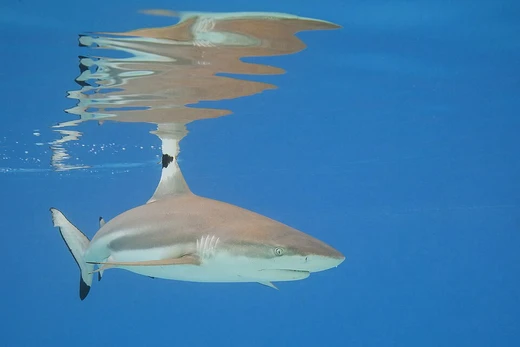
Speartooth shark
A rare river shark adapted to turbid tidal waters.

The speartooth shark (Glyphis glyphis) is a rare species of river shark belonging to the family Carcharhinidae. It inhabits coastal marine waters and tidal reaches of large tropical rivers in northern Australia and New Guinea, favoring highly turbid environments over a wide range of salinities. Despite being a member of the river shark genus, it is also found in near-shore marine waters. This species is notable for its extremely small population, restricted range, and stringent habitat requirements, which have led to its listing as vulnerable by the International Union for Conservation of Nature.
Quick Facts
- Genus
- Glyphis
Facts from the source article.
Lore & Background
German biologists Johannes Müller and Jakob Henle originally described the speartooth shark as Carcharias (Prionodon) glyphis in their 1839–41 Systematische Beschreibung der Plagiostomen, based on a stuffed juvenile female 1 m (3.3 ft) long of unknown origin. In 1843, Swiss-American zoologist Louis Agassiz proposed the new genus Glyphis for this species and a fossil relative. The use of Glyphis for river sharks did not gain wide acceptance until Jack Garrick's 1982 revision of Carcharhinus. Müller and Henle's type specimen remained the sole known record until specimens of the 'Bizant river shark' were caught in Australia in 1982; subsequent work by Leonard Compagno, William White, and Peter Last confirmed it was the same species as G. glyphis.
The speartooth shark has a streamlined, robust body with a short, wide head, tiny eyes, and a relatively large second dorsal fin. Its teeth are large, triangular, and serrated in the upper jaw, and narrow, spear-like, and serrated only near the tips in the lower jaw. Adults grow to about 2.6 m (8.5 ft) long. The species is plain slate-gray above and white below, with a black blotch beneath each pectoral fin near the tip. It preys on demersal bony fishes and crustaceans, and is adapted for hunting in near-complete darkness, relying more on electroreception than sight. Reproduction is viviparous, with females forming a placental connection to their young; birthing seems to occur from October to December.
Reader's Guide
The speartooth shark is significant as one of the rarest and most specialized members of the river shark genus, with a global population estimated at no more than 2,500 mature individuals. Its restricted range—limited to a few large, mangrove-lined tropical rivers in northern Australia and New Guinea—and stringent habitat requirements make it highly susceptible to threats such as incidental capture in fisheries and habitat degradation. The species' ability to tolerate a wide range of salinities, from nearly fresh to nearly marine, and its behavior of moving with tidal currents to conserve energy, highlight its unique adaptations to turbid, fast-flowing environments. The discovery of adults only in 2014, and a new population in the Roper River in 2024, underscore how little is known about this species. Fossil teeth from the Early Miocene to Pliocene of Portugal and the Pliocene of Italy suggest it once had a much larger range. Its listing as vulnerable by the International Union for Conservation of Nature reflects the urgent need for conservation measures to protect this elusive shark.
Did You Know?
- The speartooth shark was originally described from a single stuffed juvenile female of unknown origin, possibly from the Indian Ocean or the South China Sea.
- Adults were entirely unknown until 2014, when three specimens were documented on Daru island, Papua New Guinea.
- A new population was found in the Roper River of the Northern Territory in 2024, the first time documented living in that area.
- The species' teeth are large, triangular, and serrated in the upper jaw, but narrow and spear-like in the lower jaw.
Frequently Asked Questions
What is the Speartooth shark?
The Speartooth shark (Glyphis glyphis) is a rare river shark in the family Carcharhinidae, native to northern Australia and New Guinea. It bridges both freshwater and saltwater habitats, living in tidal river reaches as well as near-shore coastal waters.
Where does the Speartooth shark live and what kind of environment does it prefer?
It favors highly turbid (muddy) waters in the tidal reaches of large tropical rivers, but it also ranges into coastal marine areas. Its tolerance for a wide salinity gradient lets it move between river and sea, though it is most at home in murky, sediment-heavy conditions.
How big does a Speartooth shark get and what do its teeth look like?
Adults reach roughly 2.6 m (about 8.5 ft) at maximum length. The upper jaw carries 26–29 rows of teeth and the lower jaw 27–29, and the second dorsal fin stands at 67–77 % of the first dorsal fin's height, giving it a distinctive silhouette.
How does the Speartooth shark reproduce?
As a member of the river-shark genus Glyphis, it gives birth to live young, with anecdotal reports of litters containing six or seven pups. Newborns measure around 50–59 cm (20–23 in), and the species grows at roughly 19 cm (7.5 in) per year.
Why is the Speartooth shark considered vulnerable?
Its population is extremely small, its range is tightly restricted to a handful of river systems, and it demands very specific turbid, tidal habitat. These combined factors led the IUCN to list the species as Vulnerable, flagging it as one of the most threatened sharks in the region.
More in Reef Sharks and Rays, Part 2 1-24
Spotted an error? Know more?
Reader corrections go straight into our review queue. Suggest an edit · How this site is sourced