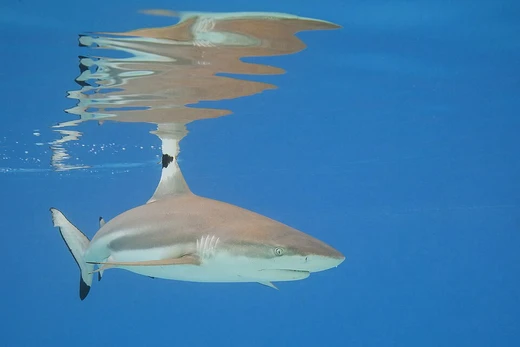
Ganges shark
A rare, poorly known river shark with a disputed range.

The Ganges shark (Glyphis gangeticus) is a critically endangered requiem shark that lives in the Ganges River (including the Padma River) and the Brahmaputra River in India and Bangladesh. Genetic studies have reclassified the Borneo river shark (G. fowlerae) and the Irrawaddy river shark (G. siamensis) as the same species, meaning the Ganges shark’s range now includes Pakistan, Myanmar, Borneo, and Java. Very little is known about this shark, and it is extremely rare wherever it appears. People often mistake Glyphis sharks for the more common bull shark (Carcharhinus leucas), which also swims in the Ganges and is sometimes wrongly called the Ganges shark. The Borneo river shark was once considered a separate species. It is known only from the Kinabatangan River in Borneo, reaching about 78 cm long. Scientists have only 13 specimens, all collected in 1996. Expeditions in 2010 and 2011 found none, and local fishermen say they haven’t seen one in years. The Irrawaddy river shark was also thought to be a distinct species. It is known from a single museum specimen caught in the 19th century at the mouth of the Irrawaddy River in Myanmar—a brackish, silty area lined with mangroves. Austrian ichthyologist Franz Steindachner described it as *Carcharias siamensis* in 1896. Later experts doubted it, thinking it was just an odd bull shark, until shark systematist Leonard Compagno confirmed it as a true *Glyphis* in 2005. That specimen is a 60-cm immature male. It looks like the Ganges shark but has more vertebrae (209 versus 169) and fewer teeth (29/29 versus 32–37/31–34). A possible new *Glyphis* species has been found in Mukah, Borneo, and in Bangladesh. Another specimen from Sampit, Borneo, remains unclear. The Ganges shark itself is poorly described. It is born at 56 to 61 cm long, reaches maturity at about 178 cm, and can grow to roughly 204 cm. No other *Glyphis* species have known birth or maturity sizes. It has a stocky, typical requiem shark body with two spineless dorsal fins and an anal fin. The first dorsal fin starts above the last third of the pectoral fins, and its free rear tip sits well ahead of the pelvic fins. The second dorsal fin is about half the height of the first. The anal fin is slightly smaller than the second dorsal, and the pectoral fins are broad. It has a longitudinal upper precaudal pit but no interdorsal ridge.
Quick Facts
- Genus
- Glyphis
- Species
- gangeticus
Facts from the source article.
Lore & Background
The Ganges shark is often confused with the more common bull shark (Carcharhinus leucas), which also inhabits the Ganges River and is sometimes incorrectly referred to as the Ganges shark. Most literature records and specimens labelled as this species are in fact bull sharks or other carcharhinid species. An extensive 10-year search produced only a few specimens, caught in 1996 in the Ganges River. The Borneo river shark is known only from the Kinabatangan River in Borneo.
Reader's Guide
The Ganges shark is significant as a critically endangered species that remains one of the least understood sharks in the world. Its rarity and the confusion with bull sharks have hindered conservation efforts. The species is known to inhabit only freshwater, inshore marine, and estuarine systems in the lower reaches of the Ganges-Hooghly River system. Its feeding habits are mostly unknown, though its small eyes and slender teeth suggest it is primarily a fish-eater adapted to turbid water. In the Bay of Bengal, it was found to feed heavily on dasyatid stingrays. The shark is probably viviparous with a yolk-sac placenta, but litter size and gestation period are unknown. Its life history cycle is probably similar to other river sharks, characterized by long gestation, slow growth, delayed maturity, and small litter size, making populations vulnerable to even low levels of exploitation such as sport angling or gill netting. Glyphis species exhibit a very slow rate of genetic change, making them unable to adapt to rapid human-caused environmental changes. The species' legacy is one of uncertainty: a specimen photographed in 2011 at Negombo fish market in Sri Lanka prompted speculation about range extension, but leading shark expert Leonard Compagno emphasized the need to check dentition and dorsal fin proportions to confirm identification.
Did You Know?
- Only 13 specimens of the former Borneo river shark are known to science, all collected in 1996.
- The Irrawaddy river shark is known only from a single museum specimen collected in the 19th century.
- A 266 cm (105 in) female specimen was recorded at Sassoon Docks in Mumbai in February 2016, caught in the Arabian Sea.
Taxonomic Reunification: From Three Species to One
The Ganges shark's taxonomic story is one of consolidation. For decades, the genus Glyphis was thought to contain three distinct river-dwelling species across South and Southeast Asia. Genetic evidence has since demonstrated that the Borneo river shark and the Irrawaddy river shark are not separate species at all but rather synonyms of G. gangeticus. This reclassification dramatically expands the known range of the Ganges shark to include Pakistan, Myanmar, Borneo, and Java. The Borneo form, known only from the Kinabatangan River, is represented by just thirteen specimens all collected in 1996, with subsequent expeditions in 2010 and 2011 turning up nothing despite local fishermen still recognizing the animal. The Irrawaddy form rests on a single sixty-centimeter immature male housed in a museum, originally described in 1896 by Franz Steindachner but doubted by later researchers until Leonard Compagno validated its distinctiveness in 2005. Notably, this specimen possesses two hundred and nine vertebrae compared to one hundred and sixty-nine in the Ganges shark, along with fewer teeth. A possibly undescribed Glyphis has also been reported from Mukah in Borneo and from Bangladesh, hinting that the genus may still harbor undiscovered diversity.
A Body Built for Murky Waters
The Ganges shark is a stocky requiem shark that reaches roughly fifty-six to sixty-one centimeters at birth and is estimated to attain about one hundred and seventy-eight centimeters at maturity, with a maximum size near two meters. Its body is uniformly grey to brownish with no visible markings, and it bears two spineless dorsal fins along with an anal fin. The first dorsal fin sits over the rear third of the pectoral fins, while the second is roughly half the height of the first. The snout is broadly rounded and noticeably shorter than the width of the long, broad mouth, which curves back and upward toward the eyes. Perhaps the most striking feature is the pair of minute eyes, strongly suggesting an adaptation to the heavily silt-laden, low-visibility waters of the Ganges and Bay of Bengal. The upper teeth are high, broad, and serrated with triangular cusps, while the lower front teeth display long, hooked, protruding cusps with unserrated cutting edges that give them a distinctive claw-like appearance. These claw-shaped lower teeth, combined with the second dorsal fin being approximately half the height of the first, serve as the primary diagnostic features separating this species from look-alikes.
A Ghost in the River: Rarity and Misidentification
Despite bearing the name of one of the world's great rivers, the Ganges shark is extraordinarily rare and remains one of the least-known requiem sharks. Its confirmed range is largely confined to the middle and lower reaches of rivers in eastern and northeastern India, including the Hooghly in West Bengal, the Ganges in Bihar, the Brahmaputra in Assam, and the Mahanadi in Odisha, as well as the Padma in Bangladesh. A single specimen found in a Mumbai fish market in 2018 may have originated from somewhere along the Arabian Sea coast, though no verified marine records exist for the species. The taxonomic history is clouded by persistent confusion with the far more common bull shark, which also inhabits the Ganges and is frequently mislabeled as the Ganges shark in both literature and local trade. An extensive ten-year search yielded only a handful of genuine specimens, all caught in 1996 in the Ganges River. Most historical records and museum specimens attributed to this species are now believed to be bull sharks or other carcharhinid requiem sharks, meaning the true population size and distribution remain shrouded in uncertainty.
Feeding in the Dark and a Slow, Vulnerable Life
The Ganges shark inhabits freshwater, estuarine, and inshore marine environments in the lower reaches of the Ganges-Hooghly system, yet its feeding ecology is only partially understood. Its tiny eyes and slender teeth point toward a diet dominated by fish, with the animal likely relying on hearing, smell, and electroreception to locate prey in the perpetually turbid waters of tropical rivers. The unusual posterior tilt of its eyes suggests it may cruise along the riverbed, scanning the water column above for prey silhouetted against sunlight. In the Bay of Bengal, however, it was observed feeding heavily on dasyatid stingrays, which spend much of their time resting on the bottom. Reproductively, the species is probably viviparous with a yolk-sac placenta, inferred by analogy with related carcharhinids, though litter size and gestation period remain unknown. Its life history is expected to mirror other river sharks: long gestation, slow growth, delayed sexual maturity, and small litters. This combination of reproductive traits renders G. gangeticus populations acutely vulnerable to even modest levels of fishing pressure, compounding the threats that have already pushed the species to the brink of extinction.
Frequently Asked Questions
What is the Ganges shark?
The Ganges shark (Glyphis gangeticus) is a small, critically endangered requiem shark that lives in freshwater river systems across South and Southeast Asia. It is a member of the rare Glyphis genus, which contains only a handful of recognized species.
Where does the Ganges shark live?
It is documented from the Ganges and Brahmaputra river basins in India and Bangladesh, but genetic work has expanded its known range to include Pakistan, Myanmar, Borneo, and Java. In every one of those locations the shark is extremely rare and poorly understood.
How big does the Ganges shark get?
Adults top out at roughly 204 cm (about 80 inches), while newborns measure 56 to 61 cm. Maturity is estimated near 178 cm, though that figure is tentative because so few specimens have ever been studied.
Why is the Ganges shark critically endangered?
Its populations are tiny, fragmented across a wide river-network range, and subject to ongoing habitat degradation in the major waterways it depends on. Because the species is so elusive, even basic life-history data are incomplete, which makes targeted conservation action very difficult.
Are the Irrawaddy and Borneo river sharks separate species from the Ganges shark?
No—genetic analyses have folded Glyphis fowlerae and G. siamensis into G. gangeticus, so all three former names now point to a single species. This reclassification stretches the Ganges shark's documented range from Pakistan all the way to Java.
More in Reef Sharks and Rays, Part 2 1-24
Spotted an error? Know more?
Reader corrections go straight into our review queue. Suggest an edit · How this site is sourced