Mendeleev's predicted elements
Mendeleev predicted elements using Sanskrit-derived prefixes.
Last updated
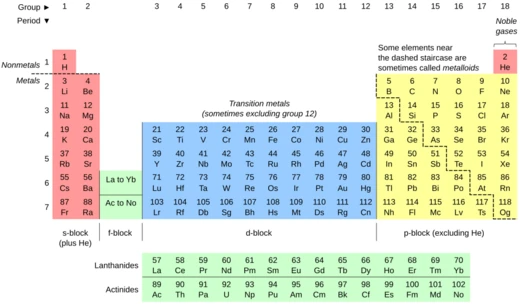
In 1869, Dmitri Mendeleev created a periodic table by arranging elements from lightest to heaviest, noticing repeating patterns in their properties. He saw empty spots in his table and predicted unknown elements would be found to fill them. He gave these predicted elements the names eka-boron, eka-aluminium, eka-silicon, and eka-manganese, assigning them atomic masses of 44, 68, 72, and 100.
Quick Facts
- Field
- Chemistry
Facts from the source article.
Prefixes
Dmitri Mendeleev coined temporary names for elements he predicted using the Sanskrit-based prefixes eka-, dvi- (or dwi-), and tri-, which correspond to the numbers 1, 2, and 3. These prefixes indicated how many places below a known element in the same group of his table the predicted element fell.
For instance, germanium was provisionally called eka-silicon until it was found in 1886, and rhenium was known as dvi-manganese prior to its 1926 discovery. The eka- prefix was also adopted by other scientists for their own predictions; francium was once called eka-caesium and astatine eka-iodine before they were discovered. Today, the International Union of Pure and Applied Chemistry (IUPAC) instead assigns a systematic provisional name based on the element's atomic number, rather than its position in the table.
Original predictions
Dmitri Mendeleev used his periodic table to predict four elements lighter than the rare-earth group, naming them eka-boron, eka-aluminium, eka-manganese, and eka-silicon. These names, written in pre-1917 Russian orthography, corresponded to positions under boron, aluminium, manganese, and silicon. Each prediction later matched a discovered element: scandium, gallium, technetium, and germanium, respectively, filling the exact spots Mendeleev had left open. Early periodic tables did not separate rare earths from transition metals, which explains why his predictions for heavier unknown elements were less accurate and are less well documented.
Scandium oxide was first isolated in late 1879 by Lars Fredrick Nilson. Per Teodor Cleve noticed its similarity to eka-boron and informed Mendeleev that same year. Mendeleev had forecast an atomic mass of 44 for eka-boron in 1871; scandium’s actual atomic mass is 44.955907. For eka-aluminium, Mendeleev predicted its existence in 1871, naming it for its proximity to aluminium.
Paul Emile Lecoq de Boisbaudran discovered gallium in 1875, and a comparison of predicted and actual properties confirmed the match. Technetium, corresponding to eka-manganese, was isolated much later, in 1937, by Carlo Perrier and Emilio Segrè. They worked with molybdenum samples that Ernest Lawrence had bombarded with deuterium nuclei in a cyclotron. Mendeleev had predicted an atomic mass of 100 for eka-manganese in 1871; the most stable technetium isotopes are 97Tc and 98Tc.
Germanium, isolated in 1886, provided the strongest confirmation of Mendeleev’s theory up to that point. It contrasted more sharply with its neighboring elements than scandium or gallium did with theirs, making the match especially convincing.
Other predictions
In 1871, Mendeleev predicted an element would exist between thorium (90) and uranium (92). Thirty years later, William Crookes obtained an unidentified radioactive substance from uranium, later found to be a mix of thorium-234 and protactinium-234m. German scientists identified protactinium-234m in 1913, calling it "brevium," but the name protactinium only came in 1918 with the discovery of protactinium-231. After Glenn T. Seaborg's actinide concept was accepted in 1945, thorium, uranium, and protactinium were grouped as actinides, meaning protactinium does not fill the spot of eka-tantalum (below element 73).
That spot actually belongs to the synthetic superheavy element dubnium (105). Mendeleev's 1869 table had hinted at a heavier version of titanium and zirconium, but by 1871 he placed lanthanum there instead. Hafnium's discovery in 1923 confirmed his earlier 1869 prediction. Some of Mendeleev's predictions failed because he overlooked the lanthanides in the sixth row.
In 1902, Bohuslav Brauner moved the lanthanides into a separate series, replacing Mendeleev's extra period. He then renamed tri-manganese as dvi-manganese and dvi-tellurium as eka-tellurium (polonium was already known but its chemistry was unstudied). Dvi-caesium was also renamed eka-caesium.
Later predictions
By 1902, Mendeleev had come to accept the existence of helium and argon, and he added these noble gases to his periodic table as a new Group 0. Because he had doubts about whether atomic theory could fully account for the law of definite proportions, he saw no reason to assume hydrogen was the lightest possible element. He proposed that an even lighter, chemically inert member of Group 0 might exist, undetected, and could be the cause of radioactivity.
Some modern periodic tables place a lone neutron—sometimes called neutronium—in that spot, but no such element has ever been found. Mendeleev identified the heavier of his hypothetical proto-helium elements with coronium, a name taken from an unexplained spectral line seen in the Sun's corona. An initial measurement gave its wavelength as 531.68 nm, but this was later corrected to 530.3 nm; in 1939, Grotrian and Edlén showed that line actually came from highly ionized iron (Fe XIV, or Fe13+).
The lightest Group 0 gas, placed first in the table, was assigned a theoretical atomic mass between two unspecified values. Mendeleev calculated its kinetic velocity at 2,500,000 meters per second. He imagined these nearly massless gases permeated all matter, rarely engaging in chemical reactions. Their extreme mobility and tiny mass meant they could be highly rarefied yet still appear very dense.
In 1904, Mendeleev published a small booklet titled A Chemical Conception of the Ether, which again described two atomic elements lighter than hydrogen. He viewed the ether as an interstellar atmosphere made of at least two such light elements, produced by violent internal bombardments within stars, with the Sun as the most abundant source. His booklet also suggested that this interstellar atmosphere likely contained several other elemental species.
More in Periodic Table & Elements
Sources
Compiled from Wikipedia and the sources listed below. Text from Wikipedia is available under CC BY-SA 4.0; this entry is adapted from it.
- Wikipedia: Mendeleev's predicted elements (CC BY-SA 4.0).
- Word definitions: the , each quoted from its Wikipedia article.
Spotted an error? Know more?
Reader corrections go straight into our review queue. Suggest an edit · How this site is sourced