Technetium
Last updated

Marco Cardin · via Wikipedia: Technetium · CC BY-SA 4.0
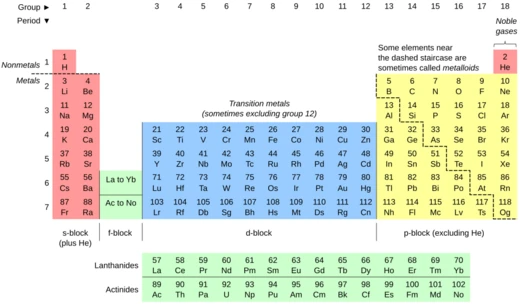
Technetium is a silvery-gray radioactive metal with atomic number 43 and chemical symbol Tc.[1][2] All isotopes of the element with atomic number 43 are radioactive, making it the element with the lowest atomic number that has no stable isotopes.[3] In the Earth's crust, technetium is found naturally at a concentration of roughly 0.003 parts per trillion.[4]
Quick Facts
- Atomic number
- 43
- Group
- 7
- Crystal structure
- hexagonal close-packed
- Superconducting temperature
- below 7.46 K
Facts from the source article.
Key facts and history
Dmitri Mendeleev predicted a missing element between molybdenum and ruthenium in 1871, naming it eka-manganese.[5] German chemists Walter Noddack, Otto Berg, and Ida Tacke reported discovering element 43 in 1925 and named it masurium.[6][7] Their claim was later dismissed because other experimenters could not replicate the discovery.[8][7] Technetium was first synthesized in 1937 by Carlo Perrier and Emilio Segrè at the University of Palermo.[9][1]
Segrè obtained a molybdenum foil from Ernest Lawrence's cyclotron that had become radioactive.[10] Perrier and Segrè proved the molybdenum activity came from element 43 through comparative chemistry.[11][1] Astronomer Paul W. Merrill detected technetium's spectral signature in S-type red giant stars in 1952.[12] Technetium-99 was isolated from pitchblende in 1962 at about 0.2 ng/kg.[13]
The name technetium, derived from the Greek word "technetos" meaning artificial, was assigned to element 43 in 1947.[11] Each year, substantial quantities of technetium-99 are generated from the processing of spent nuclear fuel rods.[14][15]
What the research sources say
The Nies account states that most scientists believed element 43 had such a short half-life it had probably disappeared from Earth.[7] Holden's history notes that technetium was first synthesized using deuteron bombardment of molybdenum to produce 95mTc and 97mTc.[1] Holden's account states that the 1909 claim of nipponium is now argued to be element 75, not element 43.[1] The Nies source notes that uranium contains element 43 from spontaneous fission at billionths of a gram per kilogram.[7]
References
- Holden, "History of the Origin of the Chemical Elements and Their Discoverers", Brookhaven National Laboratory. nndc.bnl.gov
- Wikipedia, "Technetium" (CC BY-SA 4.0), which cites: Lide, "The CRC Handbook", CRC press, 2004–2005, p. 10–70 (1672); German, "Tc carbide and new orthorhombic Tc metal phase", Journal of Nuclear and Radiochemical Sciences, 2005, p. 211–214; Rimshaw, "The Encyclopedia of the Chemical Elements", Reinhold Book Corporation, 1968, p. 689–693; Schwochau 2000, p. 96; Autler, "Technetium as a material for AC superconductivity applications", Summer 1968 (original not read by us) en.wikipedia.org
- Wikipedia, "Technetium" (CC BY-SA 4.0), which cites: Husted, "Technetium", Los Alamos National Laboratory, 2003-12-15; Clayton, "Principles of stellar evolution and nucleosynthesis: with a new preface", University of Chicago Press, 1983, p. 547 (original not read by us) en.wikipedia.org
- Wikipedia, "Technetium" (CC BY-SA 4.0), which cites: ; Dixon, "Analysis of naturally produced technetium and plutonium in geologic materials", Analytical Chemistry, 1997, p. 1692–1699; Curtis, "Nature's uncommon elements: Plutonium and technetium", Geochimica et Cosmochimica Acta, 1999, p. 275; Moore, "Technetium in the Sun", Science, 1951, p. 59–61 (original not read by us) en.wikipedia.org
- Wikipedia, "Technetium" (CC BY-SA 4.0), which cites: Jonge, "Technetium, the missing element", European Journal of Nuclear Medicine, 1996, p. 336–44 (original not read by us) en.wikipedia.org
- Wikipedia, "Technetium" (CC BY-SA 4.0), which cites: van der Krogt, "Technetium"; Scerri, "A tale of seven elements", Oxford University Press, 2013, p. 109–114, 125–131; Emsley 2001, p. 423 (we also read that source) en.wikipedia.org
- Nies, "Ida Tacke and the warfare behind the discovery of fission", 2001. hypatiamaze.org
- Wikipedia, "Technetium" (CC BY-SA 4.0), which cites: Armstrong, "Technetium", Chemical & Engineering News, 2003, p. 110; Nies, "Ida Tacke and the warfare behind the discovery of fission", 2001; Weeks, "The discovery of the elements. XX. Recently discovered elements", Journal of Chemical Education, 1933, p. 161–170; Scerri, "A tale of seven elements", Oxford University Press, 2013, p. 109–114, 125–131; Habashi, "The History of Element 43—Technetium", Journal of Chemical Education, 2006, p. 213 (we also read that source) en.wikipedia.org
- Wikipedia, "Technetium" (CC BY-SA 4.0), which cites: Heiserman, "Exploring Chemical Elements and their Compounds", TAB Books, 1992, p. 164 (original not read by us) en.wikipedia.org
- Wikipedia, "Technetium" (CC BY-SA 4.0), which cites: Segrè, "A Mind Always in Motion: The autobiography of Emilio Segrè", University of California Press, 1993, p. 115–118 (original not read by us) en.wikipedia.org
- Wikipedia, "Technetium" (CC BY-SA 4.0), which cites: Perrier, "Technetium: The element of atomic number 43", Nature, 1947, p. 24; Holden, "History of the Origin of the Chemical Elements and Their Discoverers", Brookhaven National Laboratory; van der Krogt, "Technetium" (we also read that source) en.wikipedia.org
- Wikipedia, "Technetium" (CC BY-SA 4.0), which cites: Merrill, "Technetium in the stars", Science, 1952, p. 479–489, esp. 484 (original not read by us) en.wikipedia.org
- Wikipedia, "Technetium" (CC BY-SA 4.0) en.wikipedia.org
- Wikipedia, "Technetium" (CC BY-SA 4.0), which cites: Rimshaw, "The Encyclopedia of the Chemical Elements", Reinhold Book Corporation, 1968, p. 689–693; Schwochau 2000, p. 96; Yoshihara, "Technetium and Rhenium: Their chemistry and its applications", Springer-Verlag, 1996, p. 17–35; Garcia-Leon, "Tc in the environment: Sources, distribution, and methods", Journal of Nuclear and Radiochemical Sciences, 2005, p. 253–259 (we also read that source) en.wikipedia.org
- Open Library record, ISBN 9783540594697 ("Technetium and rhenium"). CC0 (metadata); book content not read. openlibrary.org
Each numbered sentence above was checked against the source it cites before publication. Sentences citing Wikipedia adapt text from the English Wikipedia article Technetium (contributors), used under CC BY-SA 4.0; this entry is available under the same licence. Other sources were used for facts only.
Also in the Codexery
More in Periodic Table & Elements
Sources
Compiled from Wikipedia and the sources listed below. Text from Wikipedia is available under CC BY-SA 4.0; this entry is adapted from it.
- Wikipedia: Technetium (CC BY-SA 4.0).
- Word definitions: the Codexery glossary, each quoted from its Wikipedia article.
Spotted an error? Know more?
Reader corrections go straight into our review queue. Suggest an edit · How this site is sourced