Group (periodic table)
Last updated

Sandbh · CC BY-SA 4.0
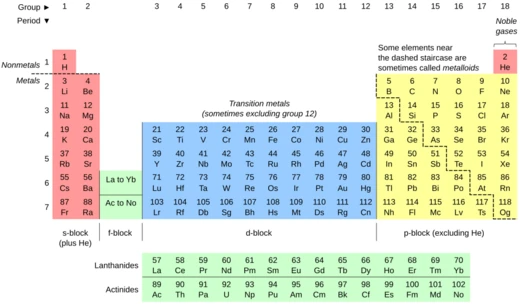
Groups are also called families.[1] The modern numbering system uses numbers 1 through 18 for the groups.[2] A vertical column within the periodic table, where each element shares comparable characteristics, is referred to as a group.[1]
Quick Facts
- Number of numbered groups
- 18
- Unnumbered columns
- 14 f-block columns
- Older systems
- CAS (Chemical Abstracts Service) and old IUPAC
Facts from the source article.
Key facts and history
The International Union of Pure and Applied Chemistry (IUPAC) recommended the 1-18 numbering system in 1988.[2] In the old IUPAC system, A and B designated the left and right parts of the table.[3] In the CAS system, A and B designated main group elements and transition elements respectively.[3] Since 1988, IUPAC has promoted a numbering system from 1 to 18 that counts the s, p, and d electrons in an atom that are additional to those found in the preceding noble gas's atoms.[2]
The periodic table's 32 columns are formed by 18 numbered groups plus 14 unnumbered f-block columns.[4] Groups are often referred to by common names, such as the halogens.[4] Roman numerals I through VIII, sometimes combined with "A" or "B" suffixes, were employed in various historical group naming conventions.[4] Because the older systems assigned identical labels to different concepts, causing confusion, the updated IUPAC scheme was created to replace them.[3]
What the research sources say
The Shmoop educational resource states that alkali metals make up the first column from Li through Fr.[1] Alkaline earth metals make up the second column from Be through Ra.[1] The d-block comprises groups 3 through 12.[1] Main-group elements are groups 1-2 and 13-18.[1]
Noble gases comprise group 18 and are generally very stable, colorless, and odorless.[1] The f-block consists of lanthanide and actinide elements below the main section.[1]
References
- "The Periodic Table Terms", www.shmoop.com. shmoop.com
- Wikipedia, "Group (periodic table)" (CC BY-SA 4.0), which cites: Fluck, "New notations in the periodic table", Pure and Applied Chemistry, 1988-01-01, p. 431–436 (original not read by us) en.wikipedia.org
- Wikipedia, "Group (periodic table)" (CC BY-SA 4.0), which cites: Fluck, "New Notations in the Periodic Table", Pure Appl. Chem., 1988, p. 431–436; Leigh, G. J. Nomenclature of Inorganic Chemistry: Recommendations 1990. Blackwell Science, 1990. . (original not read by us) en.wikipedia.org
- Wikipedia, "Group (periodic table)" (CC BY-SA 4.0), which cites: Fluck, "New Notations in the Periodic Table", Pure Appl. Chem., 1988, p. 431–436; IUPAC, "Nomenclature of inorganic chemistry", 2005 (original not read by us) en.wikipedia.org
Each numbered sentence above was checked against the source it cites before publication. Sentences citing Wikipedia adapt text from the English Wikipedia article Group (periodic table) (contributors), used under CC BY-SA 4.0; this entry is available under the same licence. Other sources were used for facts only.
More in Periodic Table & Elements
Sources
Compiled from Wikipedia and the sources listed below. Text from Wikipedia is available under CC BY-SA 4.0; this entry is adapted from it.
- Wikipedia: Group (periodic table) (CC BY-SA 4.0).
- Word definitions: the Codexery glossary, each quoted from its Wikipedia article.
Spotted an error? Know more?
Reader corrections go straight into our review queue. Suggest an edit · How this site is sourced