Superheavy element
Last updated
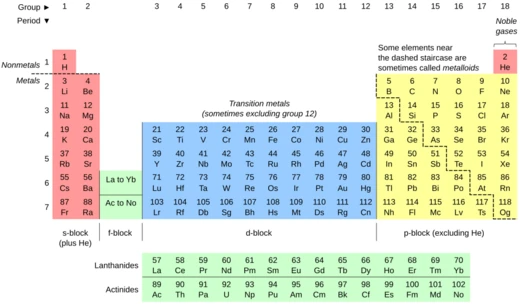
Superheavy elements are chemical elements with atomic number at least 104, lying beyond the actinides in the periodic table.[1] Elements beyond atomic number 104 are referred to as superheavy elements.[2]
Quick Facts
- Preceded by
- Actinides (lawrencium, atomic number 103)
- Minimum lifetime for recognition
- 10 seconds (IUPAC definition)
Facts from the source article.
Key facts and history
The creation of lawrencium was first reported by the Lawrence Berkeley National Laboratory in 1961.[3] The actinide series gained acceptance after Glenn T. Seaborg introduced the actinide concept.[4] Seaborg additionally suggested a transactinide series covering elements 104 through 121 and a superactinide series roughly covering elements 122 through 153, though later research indicates the superactinide series may end at element 157.[4] In 1992, the discovery was formally acknowledged by IUPAC-IUPAP.[3]
Element 113, named nihonium, was discovered by RIKEN, making it the first chemical element discovered by an Asian institution.[5] Collaborative experiments at JINR with U.S. laboratories resulted in the discovery of elements 114 through 118.[5]
What the research sources say
Morita succeeded in observing a signature of element 113 in 2004, and then again in 2005.[6] On 12 August 2012, Morita’s group measured a sequence of six alpha particles that clearly showed that element 113 was the source of the decay chain.[6] An international team discovered element 117 by bombarding a radioactive berkelium target with calcium ions at the JINR U400 cyclotron in Dubna.[7] The experiment produced six atoms of element 117.[7]
In 1998, Livermore scientists collaborated with Russian scientists to create element 114 (flerovium).[2] The first atom survived for 30 seconds before it began to decay.[2]
References
- Wikipedia, "Superheavy element" (CC BY-SA 4.0), which cites: "Superheavy Element Discovery Glenn T. Seaborg Institute", seaborg.llnl.gov (original not read by us) en.wikipedia.org
- "Superheavy Element Discovery Glenn T. Seaborg Institute", seaborg.llnl.gov. seaborg.llnl.gov
- Wikipedia, "Superheavy element" (CC BY-SA 4.0), which cites: Kragh, "The search for superheavy elements: Historical and philosophical perspectives", 2017-08-14 (original not read by us) en.wikipedia.org
- Wikipedia, "Superheavy element" (CC BY-SA 4.0), which cites: IUPAC Provisional Recommendations for the Nomenclature of Inorganic Chemistry (2004) (online draft of an updated version of the "Red Book" IR 3-6); "The Chemistry of the Actinide and Transactinide Elements", Springer, 2006 (we also read that source) en.wikipedia.org
- Wikipedia, "Superheavy element" (CC BY-SA 4.0), which cites: "RIKEN discovers superheavy element 113 RIKEN", www.riken.jp, 2016-04-08; "Superheavy Element Discovery ORNL", www.ornl.gov, 2019-09-12; "International team discovers element 117 Lawrence Livermore National Laboratory", www.llnl.gov; "Superheavy Element Discovery Glenn T. Seaborg Institute", seaborg.llnl.gov (we also read that source) en.wikipedia.org
- "RIKEN discovers superheavy element 113 RIKEN", www.riken.jp, 2016-04-08. riken.jp
- "International team discovers element 117 Lawrence Livermore National Laboratory", www.llnl.gov. llnl.gov
Each numbered sentence above was checked against the source it cites before publication. Sentences citing Wikipedia adapt text from the English Wikipedia article Superheavy element (contributors), used under CC BY-SA 4.0; this entry is available under the same licence. Other sources were used for facts only.
More in Periodic Table & Elements
Sources
Compiled from Wikipedia and the sources listed below. Text from Wikipedia is available under CC BY-SA 4.0; this entry is adapted from it.
- Wikipedia: Superheavy element (CC BY-SA 4.0).
- Word definitions: the Codexery glossary, each quoted from its Wikipedia article.
Spotted an error? Know more?
Reader corrections go straight into our review queue. Suggest an edit · How this site is sourced