Group 10 element
Group of d-block transition metals including nickel, palladium, platinum, and darmstadtium.
Last updated

KKPCW · CC BY-SA 4.0
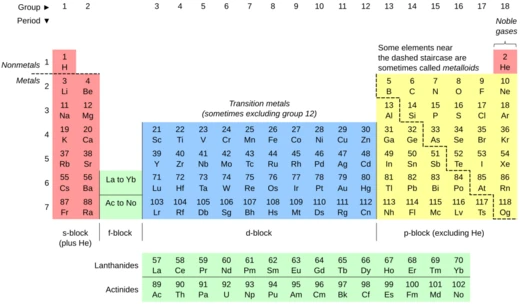
Group 10, according to the current IUPAC numbering system, includes nickel (Ni), palladium (Pd), platinum (Pt), and darmstadtium (Ds). These elements are all d-block transition metals. While nickel, palladium, and platinum have been studied directly, darmstadtium has never been isolated in a pure form, and its properties remain unconfirmed; all known isotopes of darmstadtium are radioactive with very short half-lives, do not occur naturally, and have only been created in tiny amounts in laboratories. The ground-state electron configurations of palladium and platinum do not follow Madelung’s rule.
Chemical properties
Based on that rule, palladium would be expected to have [Kr] 5s² 4d⁸ and platinum [Xe] 4f¹⁴ 5d⁸ 6s². In reality, palladium’s 5s orbital is empty, and platinum’s 6s orbital is only partly filled. For darmstadtium, relativistic stabilization of the 7s orbital leads to an electron configuration that, unusually for this group, matches the Aufbau principle’s prediction. In general, predicting ground-state configurations for heavier atoms and transition metals is more challenging.
Group 10 elements display oxidation states from +1 to +4. Nickel and palladium commonly appear in the +2 state, while platinum is often seen in both +2 and +4. Oxidation states of –2 and –1 have been observed for nickel and platinum, and +5 has been noted for both palladium and platinum. Platinum has also been found in the –3 and +6 states.
Physical properties
Theory suggests platinum might reach a +10 oxidation state under the right conditions, but this has not yet been demonstrated experimentally. Only nickel, palladium, and platinum have had their physical properties confirmed through experiment. These three are typically silvery-white, hard, lustrous, and highly ductile metals, and they can be obtained as powders. They resist tarnish (oxidation) at standard temperature and pressure, are refractory, and have high melting and boiling points.
Occurrence and production
Nickel occurs naturally in ores and is the Earth’s 22nd most abundant element. Two major ore types are laterites and sulfide ores. Indonesia holds the world’s largest nickel reserves and is also the top producer. Nickel, often mistaken for copper, has been used since at least 3500 BCE.
Discoveries of the elements
It has been found in a dagger from 3100 BCE, in Egyptian iron beads, a bronze reamer from Syria (3500–3100 BCE), copper-nickel coins from Bactria, weapons and pots near the Senegal River, and agricultural tools used by Mexicans in the 1700s. Evidence suggests ancient nickel came from meteoric iron, reflected in the Sumerian name for iron, an-bar (“fire from heaven”), and in Hittite texts describing iron’s celestial origin. Nickel was not formally named until 1751, when A. F. Cronstedt isolated an impure metal from “kupfernickel” (Old Nick’s copper).

In 1804, J. B. Richter determined its physical properties using a purer sample, describing it as ductile, strong, and high-melting. The strength of nickel-steel alloys was reported in 1889, leading to widespread military use and later to corrosion- and heat-resistant alloys in the 20th century. William Hyde Wollaston isolated palladium in 1803 while refining platinum metals. It came from a residue left after platinum was precipitated from a hydrochloric and nitric acid solution as (NH₄)PtCl₆.
Wollaston named it after the recently discovered asteroid 2 Pallas and anonymously sold small samples to a shop, which advertised it as a “new noble metal” called “Palladium, or New Silver.” This sparked doubts about its purity, source, and discoverer, causing controversy. Wollaston eventually revealed himself and presented his discovery paper to the Royal Society in 1805. Before its formal discovery, native Ecuadorians in the province of Esmeraldas used platinum in jewelry. They found small grains mixed with gold in river deposits and sintered them with gold to make trinkets like rings.

The first published report came from Antonio de Ulloa, a Spanish mathematician, astronomer, and naval officer, who observed “platina” (little silver) in Ecuadorian gold mines during a 1736 French expedition. Miners found it hard to separate from gold, leading to abandoned mines. Charles Wood, an ironmaster, brought samples to England in 1741 and studied their properties, noting their high melting point and appearance as small white grains in black metallic sand. Interest grew after Wood’s findings were reported to the Royal Society.

In 1751, Swedish scientist Henrik Teofilus Scheffer called the metal “white gold” and the “seventh metal,” noting its durability, density, and easy melting when mixed with copper or arsenic. Pierre-François Chabaneau (1780s) and William Hyde Wollaston (1800s) each developed a secret powder metallurgy technique to produce malleable platinum, but their ingots were brittle and prone to cracking, likely due to impurities. In the 1800s, high-temperature furnaces were invented, eventually replacing powder metallurgy and introducing melted platinum to the market. The group 10 metals share several uses, including decorative purposes.
Lore & Background
Nickel, palladium, and platinum are silvery-white transition metals that are hard, lustrous, and highly ductile; they can also be obtained as powders. These three are resistant to tarnish at standard temperature and pressure, are refractory, and possess high melting and boiling points. Darmstadtium, the fourth element in the group, has not been isolated in pure form and its properties remain unconfirmed, as all its known isotopes are radioactive with short half-lives and have only been synthesized in minute laboratory quantities, never found in nature.

The group's chemical behavior shows oxidation states from +1 to +4, with nickel and palladium commonly exhibiting +2, while platinum shows both +2 and +4. Rarer states include −2 and −1 for nickel and platinum, +5 for palladium and platinum, and −3 and +6 for platinum; theory suggests platinum might reach +10 under specific conditions, though this is unproven. Electron configurations for palladium and platinum deviate from Madelung's rule: palladium has an empty 5s orbital, and platinum has a partially filled 6s orbital. Darmstadtium’s predicted configuration, unusually for this group, follows the Aufbau principle due to relativistic stabilization of the 7s orbital.
Nickel occurs naturally in laterite and sulfide ores, being Earth's 22nd most abundant element, with Indonesia holding the largest reserves and production. Palladium was isolated by William Hyde Wollaston in 1803 from residues of platinum refining, named after the asteroid Pallas. Platinum was used in pre-Columbian Ecuadorian jewelry and first reported by Antonio de Ulloa in 1736.
Reader's Guide
Group 10 elements are significant for their diverse applications and historical roles. Nickel, palladium, and platinum are used in jewelry, electroplating, catalysts, metal alloys, electrical components, and superconductors. Platinum complexes are commonly used in chemotherapy as anticancer drugs, while palladium complexes show marginal antitumor activity. The group includes darmstadtium, a synthetic radioactive element with short half-lives not found in nature.
Nickel occurs naturally in ores and is Earth's 22nd most abundant element, with Indonesia holding the world's largest reserve and being its largest producer. The discovery histories of these elements involve early ancient use, controversies over isolation and naming, and the development of powder metallurgy techniques for platinum. Their resistance to tarnish, high melting points, and ductility make them valuable in industrial and decorative contexts.
Frequently Asked Questions
Who is Group 10 element?
Group 10 is a vertical column of four d-block transition metals on the periodic table, comprising nickel, palladium, platinum, and darmstadtium. The number 10 follows the current IUPAC convention for labeling groups.
What is Group 10 element known for?
These metals are silvery-white, hard, lustrous, and ductile, with notably high melting and boiling points that classify them as refractory. A defining shared trait is their resistance to tarnishing under standard temperature and pressure conditions.
More in Periodic Table & Elements
Sources
Compiled from Wikipedia and the sources listed below. Text from Wikipedia is available under CC BY-SA 4.0; this entry is adapted from it.
- Wikipedia: Group 10 element (CC BY-SA 4.0).
- Word definitions: the Codexery glossary, each quoted from its Wikipedia article.
Spotted an error? Know more?
Reader corrections go straight into our review queue. Suggest an edit · How this site is sourced