Extended periodic table
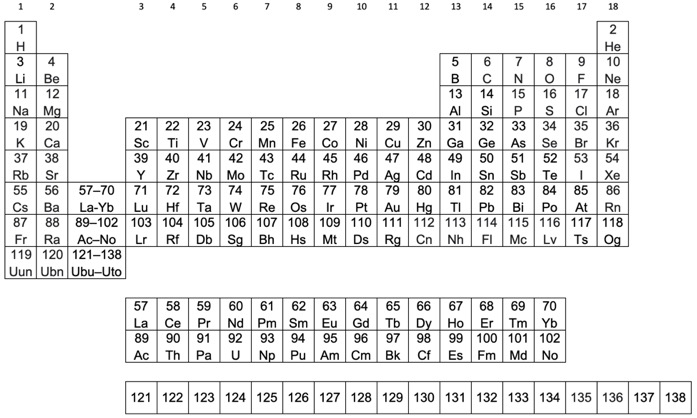
Hypothetical extension of the periodic table beyond element 118.
Last updated

Pekka Pyykkö (original Pyykko table), WhiteTimberwolf (SVG Pyykko version) CxHy · CC BY-SA 3.0
The extended periodic table is a theoretical expansion of the standard periodic table to include chemical elements beyond the currently known and proven ones, with the highest confirmed atomic number being oganesson (Z = 118), which completes the seventh period. All elements in the eighth period and beyond remain hypothetical, and their placement is subject to ongoing debate due to uncertainties in predictions of chemical and physical properties, especially as relativistic effects become significant at high atomic numbers.
History
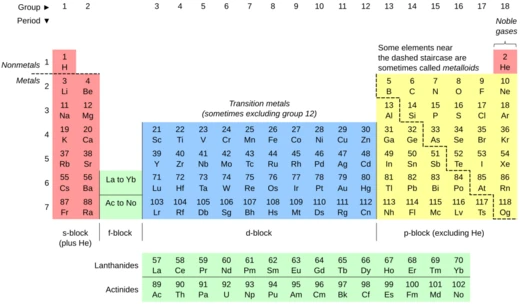
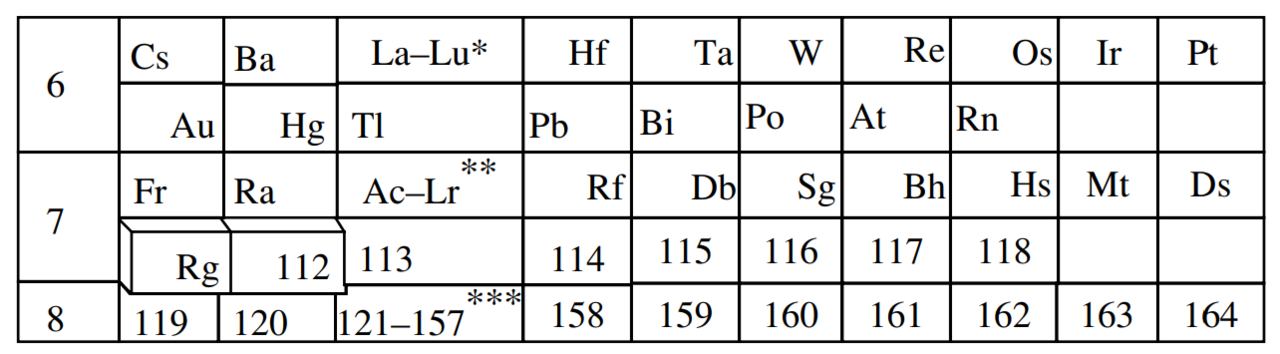
Any additional periods are expected to contain more elements than the seventh, as they are calculated to include a so-called g-block of at least 18 elements with partially filled g-orbitals per period. Glenn T. Seaborg suggested an eight-period table containing this block in 1969.
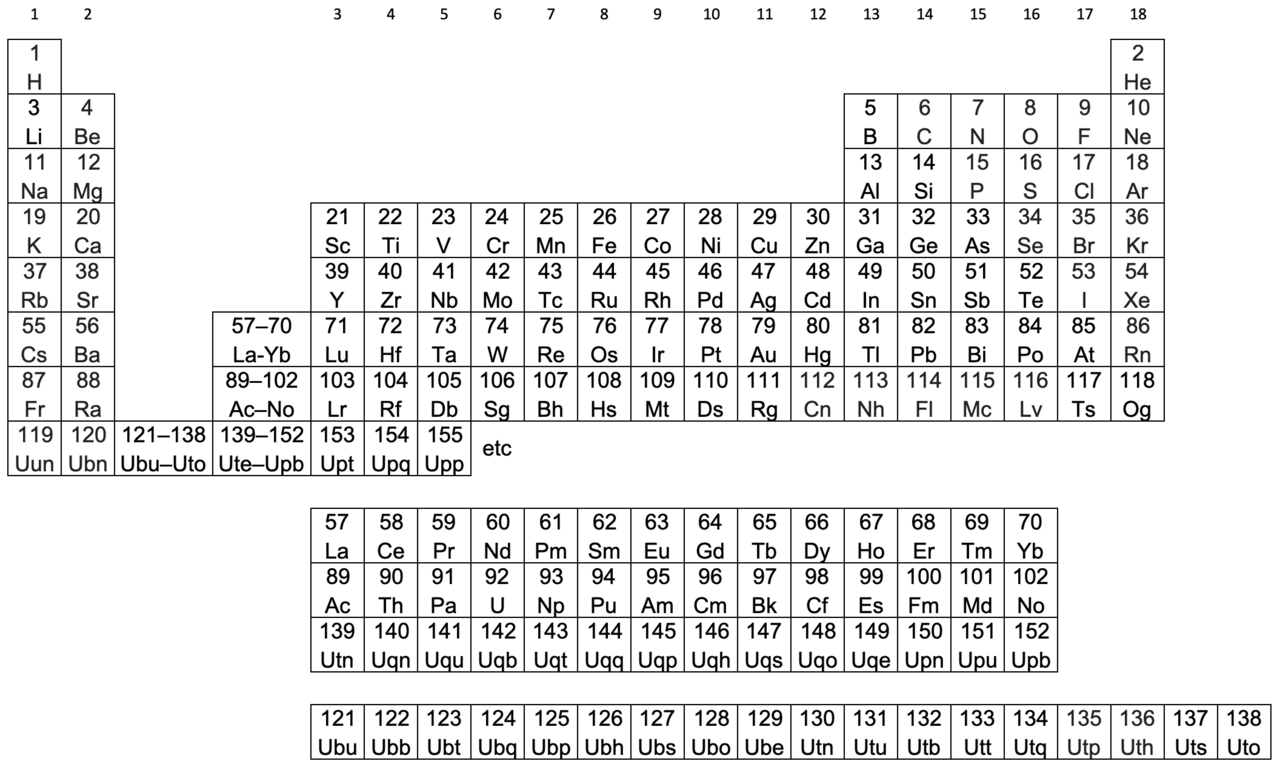
The first element of the g-block may have atomic number 121, with the systematic name unbiunium, but despite many searches, no elements in this region have been synthesized or discovered in nature. Spin–orbit coupling effects reduce the validity of the orbital approximation for high atomic numbers, and models incorporating relativistic effects predict deviations from the pattern set by lighter elements. Computer modeling by Pekka Pyykkö and Burkhard Fricke for elements up to Z = 172 found several displaced from the Madelung rule, leading to no current consensus on placement beyond element 120.

Nuclear properties
Elements in this region are likely highly unstable, undergoing alpha decay or spontaneous fission with extremely short half-lives, though element 126 is hypothesized to be within an island of stability resistant to fission but not alpha decay. Another island around element 164 may be possible, but the extent of stabilizing effects from closed nuclear shells is uncertain.
End of the periodic table
The International Union of Pure and Applied Chemistry defines an element as existing if its lifetime exceeds 10⁻¹⁴ seconds, the time needed for the nucleus to form an electron cloud. A simplistic interpretation of the Dirac equation suggests neutral atoms cannot exist beyond element 137, but a more rigorous analysis sets the limit at Z ≈ 168–172, where the 1s subshell dives into the Dirac sea, posing no obstacle to further extension of the periodic system. Atoms beyond this critical atomic number are called supercritical atoms.
Quick Facts
- Governing body
- International Union of Pure and Applied Chemistry (IUPAC)
Facts from the source article.
Lore & Background
The extended periodic table is a theoretical arrangement of chemical elements beyond atomic number 118 (oganesson), which currently completes the seventh period. All elements in period eight and beyond are hypothetical, as none have been synthesized or observed in nature. These additional periods are predicted to contain more elements than the seventh period due to the inclusion of a g-block, comprising at least 18 elements with partially filled g-orbitals per period. Glenn T. Seaborg proposed an eight-period table featuring this block in 1969, with the first g-block element possibly at atomic number 121, systematically named unbiunium.
However, spin–orbit coupling effects at high atomic numbers reduce the validity of the orbital approximation, and models incorporating relativistic effects—such as those by Pekka Pyykkö and Burkhard Fricke for elements up to Z = 172—predict deviations from the Madelung rule, leading to no consensus on placement beyond element 120. Elements in this region are expected to be highly unstable, decaying via alpha decay or spontaneous fission with extremely short half-lives, though an island of stability is hypothesized around element 126, resistant to fission but not alpha decay, and another around element 164. The International Union of Pure and Applied Chemistry (IUPAC) defines an element as existing if its nucleus lasts longer than 10⁻¹⁴ seconds, sufficient to form an electron cloud.
A simplistic interpretation of the Dirac equation suggests neutral atoms cannot exist beyond Z ≈ 137, but a more rigorous analysis places the limit at Z ≈ 168–172, where the 1s subshell enters the Dirac sea, affecting bare nuclei rather than neutral atoms, thus not preventing further extension of the periodic system. Atoms beyond this critical number are termed supercritical atoms. Historically, predictions of elements beyond the actinides date to 1895, when Hans Peter Jørgen Julius Thomsen proposed a 32-element period ending at atomic weight 292.
In 1913, Johannes Rydberg predicted noble gases at Z = 118, 168, 218, 290, 362, and 460. Niels Bohr in 1922 suggested elements beyond uranium were too unstable to be observed naturally. Richard Swinne in 1926 anticipated an island of stability, speculating longer-lived elements at Z = 98–102 and 108–110, possibly in Earth’s core or meteorites. By 1955, these were termed superheavy elements.
Spectroscopic Roots of Block Nomenclature
The block system of the periodic table traces its terminology back to the language of atomic spectroscopy. Each block takes its letter from the historical name assigned to a particular value of an electron's azimuthal quantum number. The s-block corresponds to "sharp" (quantum number 0), the p-block to "principal" (1), the d-block to "diffuse" (2), and the f-block to "fundamental" (3). Beyond these four, the naming simply continues in alphabetical order—g, h, and so on—though no elements occupying such hypothetical blocks have been discovered to date.
The very concept of dividing the table into orbital-based blocks appears to have been introduced by Charles Janet, who is credited with the earliest use of the term. This nomenclature creates a direct bridge between the abstract mathematics of quantum mechanics and the practical layout of the periodic table, allowing chemists to predict where an element's valence electrons reside simply by identifying its block. The correspondence between orbital type and chemical behavior is not exact, but it provides a remarkably useful first approximation for understanding reactivity, bonding, and physical properties across the entire table.
Reader's Guide
The extended periodic table theorizes about chemical elements beyond oganesson (atomic number 118), which completes the seventh period. All elements in the eighth period and beyond remain hypothetical. Any additional periods are expected to contain more elements than the seventh, including a so-called g-block of at least 18 elements with partially filled g-orbitals per period. The first g-block element may have atomic number 121, named unbiunium, though no such elements have been synthesized or discovered.
Quantum mechanical orbital approximations for these elements are complicated by spin–orbit coupling, which reduces the orbital approximation’s validity at high atomic numbers. Models incorporating relativistic effects predict deviations from Seaborg’s pattern; computer modeling by Pekka Pyykkö and Burkhard Fricke for elements up to Z = 172 found several displaced from the Madelung rule. There is no consensus on placement beyond element 120 due to uncertainty in predicted properties.
These elements are likely highly unstable, undergoing alpha decay or spontaneous fission with extremely short half-lives, though element 126 is hypothesized to lie within an island of stability resistant to fission but not alpha decay. Another island around element 164 may exist, but stabilizing effects from closed nuclear shells are uncertain. The International Union of Pure and Applied Chemistry defines an element as existing if its lifetime exceeds 10⁻¹⁴ seconds. A simplistic interpretation of the Dirac equation suggests neutral atoms cannot exist beyond element 137, but a more rigorous analysis places the limit at Z ≈ 168–172, where the 1s subshell dives into the Dirac sea, posing no obstacle to further extension.
More in Periodic Table & Elements
Sources
Compiled from Wikipedia and the sources listed below. Text from Wikipedia is available under CC BY-SA 4.0; this entry is adapted from it.
- Wikipedia: Extended periodic table (CC BY-SA 4.0).
- Word definitions: the Codexery glossary, each quoted from its Wikipedia article.
Spotted an error? Know more?
Reader corrections go straight into our review queue. Suggest an edit · How this site is sourced