Group 12 element
Last updated

U.S. Navy · Public domain
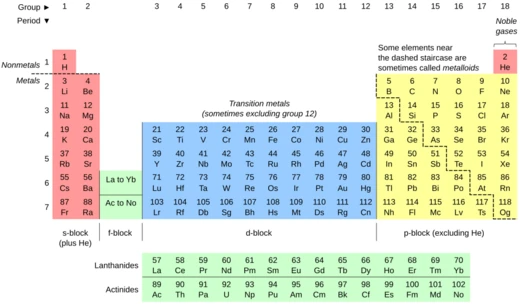
Zinc, cadmium, mercury, and copernicium constitute the chemical elements in group 12, which is designated by modern IUPAC numbering.[1][2] The metals in group 12 are soft, diamagnetic, and divalent, and they possess the lowest melting points of any transition metals.[3]
Key facts and history
The name of zinc was first documented in the 16th century and is probably derived from the German zinke for the needle-like appearance of metallic crystals.[4] The heaviest known group 12 element, copernicium, was first created on February 9, 1996, at the Gesellschaft für Schwerionenforschung in Darmstadt, Germany.[5] Copernicium was officially named by IUPAC after Nicolaus Copernicus on February 19, 2010.[5] Impure forms of zinc and alloys like brass, which are over 2000 years old, show that zinc was utilized in ancient times.[4]
Credit for isolating pure metallic zinc is typically assigned to German chemist Andreas Marggraf, who performed an experiment in 1746.[6] Friedrich Stromeyer and Karl Samuel Leberecht Hermann discovered cadmium in 1817 in Germany, finding it as an impurity within zinc carbonate minerals.[7] Cosmetics containing mercury have been discovered in Egyptian tombs that date to 1500 BC.[8] The creation of amalgams with other metals using mercury was occurring by 500 BC.[9]
What the research sources say
Mercury forms amalgams with metals such as gold, zinc, and sodium.[14][15] Alchemists thought that altering the quality and quantity of sulfur within mercury could produce different metals.[16][17]
References
- Wikipedia, "Group 12 element" (CC BY-SA 4.0), which cites: Fluck, "New Notations in the Periodic Table", Pure Appl. Chem., 1988, p. 431–436 (original not read by us) en.wikipedia.org
- Wikipedia, "Group 12 element" (CC BY-SA 4.0), which cites: Greenwood Earnshaw 1997, p. ; Cotton Wilkinson Murillo Bochmann 1999, p. ; ; Eichler, "Chemical Characterization of Element 112", Nature, 2007, p. 72–75 (original not read by us) en.wikipedia.org
- Wikipedia, "Group 12 element" (CC BY-SA 4.0), which cites: "Zinc Metal Properties", American Galvanizers Association, 2008; "Handbook of Chemistry and Physics", CRC Press, Taylor & Francis Group, 2006, p. 4 41; Heiserman, "Exploring Chemical Elements and their Compounds", TAB Books, 1992, p. 123; Ingalls, "Production and Properties of Zinc: A Treatise on the Occurrence and Distribution of Zinc Ore, the Commercial and Technical Conditions Affecting the Production of the Spelter, Its Chemical and Physical Propertie (we also read that source) en.wikipedia.org
- Wikipedia, "Group 12 element" (CC BY-SA 4.0), which cites: Weeks 1933, p. 20; Greenwood Earnshaw 1997, p. ; Ray, "A History of Hindu Chemistry from the Earliest Times to the Middle of the Sixteenth Century, A.D.: With Sanskrit Texts, Variants, Translation and Illustrations", The Bengal Chemical & Pharmaceutical Works, 1903, p.; Arny, "Principles of Pharmacy", W. B. Saunders company, 1917, p. 483; Habashi, "Discovering the 8th Metal", International Zinc Association (IZA); Hoover, "Georgius Agricola de Re Metallica", Kessinger Publishing, 2003, p. 409; Gerhartz, "Ullmann's Encyclopedia of Indust en.wikipedia.org
- Wikipedia, "Group 12 element" (CC BY-SA 4.0), which cites: Hofmann, S., "The new element 112", Zeitschrift für Physik A, 1996, p. 229–230; Barber, "Element 112 is Named Copernicium", Pure and Applied Chemistry, 2009, p. 1331–1343 (original not read by us) en.wikipedia.org
- Wikipedia, "Group 12 element" (CC BY-SA 4.0), which cites: Emsley 2001, p. 502; Weeks 1933, p. 20; Warren, "Excel Preliminary Physics", Pascal Press, 2000, p. 47; "The New International Encyclopaedia", Dodd, Mead and Company, 1903, p. 80; Warren, "Excel Preliminary Physics", Pascal Press, 2000, p. 47; Cotton Wilkinson Murillo Bochmann 1999, p. (original not read by us) en.wikipedia.org
- Wikipedia, "Group 12 element" (CC BY-SA 4.0), which cites: "Kirk-Othmer Encyclopedia of Chemical Technology", John Wiley & Sons, 1994; Hermann, "Noch ein schreiben über das neue Metall (Another letter about the new metal)", Annalen der Physik, 1818, p. 113–116; "Cyclopædia of commerce, mercantile law, finance, commercial geography and navigation", 1844, p. 122; "The art of landscape painting in water colours, by T. and T. L. Rowbotham", 1850, p. 10; "The life cycle of copper, its co-products and byproducts", Springer, 2003, p. 135–141 (original not read by us) en.wikipedia.org
- Wikipedia, "Group 12 element" (CC BY-SA 4.0), which cites: "Mercury and the environment — Basic facts", Environment Canada, Federal Government of Canada, 2004 (original not read by us) en.wikipedia.org
- Wikipedia, "Group 12 element" (CC BY-SA 4.0), which cites: Wright, David Curtis, "The History of China", Greenwood Publishing Group, 2001, p. 49; Hesse, R. W., "Jewelrymaking through history", Greenwood Publishing Group, 2007, p. 120 (original not read by us) en.wikipedia.org
- Open Library record, ISBN 9780849304873 ("CRC Handbook of Chemistry and Physics, 87th Edition (Crc Handbook of Chemistry and Physics)"). CC0 (metadata); book content not read. openlibrary.org
- Wikipedia, "Group 12 element" (CC BY-SA 4.0), which cites: Lehto 1968, p. 826; "Handbook of Chemistry and Physics", CRC Press, Taylor & Francis Group, 2006, p. 4 41; Heiserman, "Exploring Chemical Elements and their Compounds", TAB Books, 1992, p. 123; Scoffern, "The Useful Metals and Their Alloys", Houlston and Wright, 1861, p. 591–603; "Handbook of Chemistry and Physics", CRC Press, Taylor & Francis Group, 2006, p. 4 41; "Zinc Metal Properties", American Galvanizers Association, 2008; Holleman, "Lehrbuch der Anorganischen Chemie", Walter de Gruyter, 1985, p. 1056–1057 (we also read that sour en.wikipedia.org
- Wikipedia, "Group 12 element" (CC BY-SA 4.0), which cites: Ingalls, "Production and Properties of Zinc: A Treatise on the Occurrence and Distribution of Zinc Ore, the Commercial and Technical Conditions Affecting the Production of the Spelter, Its Chemical and Physical Propertie; "Handbook of Chemistry and Physics", CRC Press, Taylor & Francis Group, 2006, p. 4 41; Scoullos, "Mercury, Cadmium, Lead: Handbook for Sustainable Heavy Metals Policy and Regulation", Springer, 2001; Brady, "Materials handbook: an encyclopedia for managers, technical professionals, purchasing and production managers, en.wikipedia.org
- Wikipedia, "Group 12 element" (CC BY-SA 4.0), which cites: Lehto 1968, p. 826; Lehto 1968, p. 826; Electric current will naturally flow between zinc and steel but in some circumstances inert anodes are used with an external DC source.; Bounoughaz, "A comparative study of the electrochemical behaviour of Algerian zinc and a zinc from a commercial sacrificial anode", Journal of Materials Science, 2003, p. 1139–1145; Stwertka 1998, p. 99; Besenhard, "Handbook of Battery Materials", Wiley-VCH, 1999; Wiaux, "Recycling zinc batteries: an economical challenge in consumer waste management", Journal of en.wikipedia.org
- Open Library record, ISBN 9780080444956 ("Corrosion of aluminium"). CC0 (metadata); book content not read. openlibrary.org
- Wikipedia, "Group 12 element" (CC BY-SA 4.0), which cites: "Corrosion of Aluminium", Elsevier, 2004, p. 158 (we also read that source) en.wikipedia.org
- Open Library record, ISBN 9780766132306 ("Story of Alchemy and Early Chemistry"). CC0 (metadata); book content not read. openlibrary.org
- Wikipedia, "Group 12 element" (CC BY-SA 4.0), which cites: Stillman, J. M., "Story of Alchemy and Early Chemistry", Kessinger Publishing, May 2023, p. 7–9 (we also read that source) en.wikipedia.org
Each numbered sentence above was checked against the source it cites before publication. Sentences citing Wikipedia adapt text from the English Wikipedia article Group 12 element (contributors), used under CC BY-SA 4.0; this entry is available under the same licence. Other sources were used for facts only.
More in Periodic Table & Elements
Sources
Compiled from Wikipedia and the sources listed below. Text from Wikipedia is available under CC BY-SA 4.0; this entry is adapted from it.
- Wikipedia: Group 12 element (CC BY-SA 4.0).
- Word definitions: the Codexery glossary, each quoted from its Wikipedia article.
Spotted an error? Know more?
Reader corrections go straight into our review queue. Suggest an edit · How this site is sourced