Germanium
A metalloid that enabled early semiconductor electronics and modern optics.
Last updated
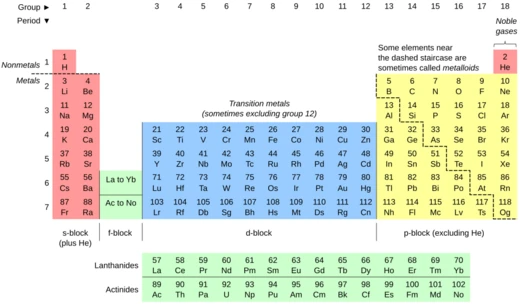
Germanium is a chemical element with the symbol Ge and atomic number 32. It is a lustrous, hard-brittle, grayish-white metalloid in the carbon group, chemically similar to silicon. Discovered relatively late due to its low concentration in nature, it became the foundation of the first decade of semiconductor electronics and remains important in fiber-optic systems, infrared optics, solar cells, and LEDs.
Quick Facts
- Atomic number
- 32
- Discovered by
- Clemens Winkler
- Year of discovery
- 1886
- Named after
- Germany (Latin: Germania)
- Predicted by
- Dmitri Mendeleev (1869, as ekasilicon)
Facts from the source article.
History
In 1869, Dmitri Mendeleev predicted an element to fill a gap between silicon and tin in the carbon family, calling it ekasilicon with an estimated atomic weight of 70 (later 72). In mid-1885, a new mineral named argyrodite was discovered near Freiberg, Saxony, and chemist Clemens Winkler analyzed it, finding it to contain silver, sulfur, and a new element. Isolating the new element in 1886, Winkler initially thought it resembled antimony and considered naming it neptunium, but that name was already taken, so he chose germanium after his homeland.
Argyrodite proved to be Ag8GeS6. Winkler confirmed the element's properties in 1887 using 500 kg of ore, determining an atomic weight of 72.32 from pure germanium tetrachloride, while Lecoq de Boisbaudran deduced 72.3 from spark spectrum lines. Winkler prepared several germanium compounds, including tetraethylgermane, the first organogermane. The close match between the physical data of these compounds and Mendeleev's predictions provided important confirmation of the periodic law.
Characteristics
Under standard conditions, germanium is a brittle, silvery-white semiconductor with a diamond cubic crystal structure (α-germanium). Like silicon and water, germanium expands upon solidification from the molten state. In 2005, an alloy of germanium, uranium, and rhodium became the first semi-metallic material found to become a superconductor in an extremely strong electromagnetic field. Pure germanium can spontaneously extrude long screw dislocations called germanium whiskers, a primary cause of failure in early germanium diodes and transistors.
Elemental germanium begins oxidizing in air at about 250 °C, forming germanium dioxide. It is insoluble in dilute acids and alkalis but dissolves in hot concentrated sulfuric and nitric acids and reacts violently with molten alkalis. Germanium primarily exhibits the +4 oxidation state, though +2 compounds are common; other states (+3, +1, and negative) occur in specific compounds or on oxide surfaces.
Production
Worldwide production of germanium in 2011 was about 118 tonnes, led by China (80 t), Russia (5 t), and the United States (3 t). Germanium is recovered as a by-product from sphalerite zinc ores, where it can reach concentrations of 0.3%, especially in low-temperature sediment-hosted and carbonate-hosted Zn-Pb deposits. At least 10,000 tonnes of extractable germanium exist in known zinc reserves, with an additional 112,000 tonnes in coal reserves. In 2007, 35% of demand was met by recycled germanium.
Other sources include silver, lead, and copper ores, as well as fly ash from coal-fired power plants, used in Russia and China. The ore concentrates, mostly sulfidic, are roasted to convert them to oxides: GeS2 + 3 O2 → GeO2 + 2 SO2. Germanium is leached from the cinder with sulfuric acid, then precipitated after neutralization. The Waelz process removes some zinc, and the resulting oxide is leached again.
Germanium dioxide is converted to germanium tetrachloride using chlorine gas or hydrochloric acid, then purified by fractional distillation and hydrolyzed back to highly pure GeO2. This is reduced with hydrogen for semiconductor and infrared optics use, or with carbon for steel production and other industrial processes.
Applications
Major global end uses for germanium include electronics and solar applications, fiber-optic systems, infrared optics, and polymerization catalysts. Germania (GeO2) has a high refractive index and low optical dispersion, making it valuable for wide-angle camera lenses, microscopy, and optical fiber cores, where it replaced titania as a dopant. GeSbTe is a phase-change material used in rewritable DVDs. Germanium is transparent in the infrared and is used for lenses and windows in thermal imaging cameras operating in the 8 to 14 micron range for military, night vision, and fire fighting applications; it requires an anti-reflection coating, often diamond-like carbon.
Silicon-germanium alloys are important for high-speed integrated circuits, leveraging Si-SiGe heterojunctions. Germanium substrates, having nearly the same lattice constant as gallium arsenide, are used for high-efficiency multijunction solar cells in space applications, such as the Mars Exploration Rovers. High-brightness LEDs for automobile headlights and LCD backlighting also use germanium.
Did You Know?
- Germanium is one of the few substances that expands as it solidifies from the molten state.
- Germanium cluster anions (Zintl ions) such as Ge4^2-, Ge9^4-, Ge9^2-, and Ge5^2- have been prepared from alloys with alkali metals.
Also in the Codexery
More in Periodic Table & Elements
Sources
Compiled from Wikipedia and the sources listed below. Text from Wikipedia is available under CC BY-SA 4.0; this entry is adapted from it.
- Wikipedia: Germanium (CC BY-SA 4.0).
- Word definitions: the , each quoted from its Wikipedia article.
Spotted an error? Know more?
Reader corrections go straight into our review queue. Suggest an edit · How this site is sourced