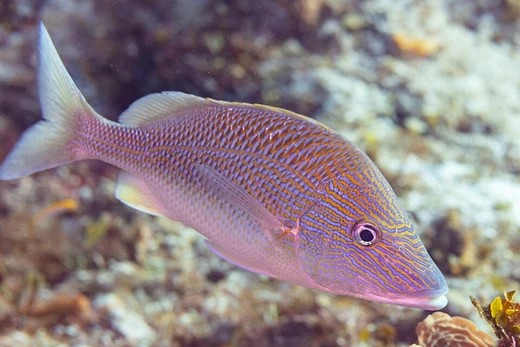
Lutjanus biguttatus
A slender snapper with two white spots on its back.
Last updated
The two-spot banded snapper, also called the two-spot snapper, is a marine fish in the Lutjanidae family. Its scientific name is Lutjanus biguttatus. It lives in the western Pacific and eastern Indian Oceans.
Taxonomy
French zoologist Achille Valenciennes first described this species in 1830, naming it Serranus biguttatus. The name biguttatus means "two spotted," referring to the two spots on its back under the dorsal fin. He gave the type location as Trincomalee in Sri Lanka and Ambon Island in Indonesia.
Description
This snapper has a slender, fusiform body and a low, gently sloping snout. The knob and notch on its preoperculum are weak. Its vomerine teeth form a triangular patch with a rear extension, or a rhombus shape, and it has no teeth on its tongue.
The caudal fin is truncate. The dorsal fin has 11 spines and 12 soft rays, while the anal fin has 3 spines and 8 soft rays. Its back is greyish, with a wide horizontal white stripe from the mouth to the caudal peduncle, bordered on each side by a reddish-brown stripe.
Two white spots sit on the back beneath the dorsal fin’s base. Juveniles are mostly white with a grey back, a dark brown stripe along the lateral line, and two faint white spots on the back. The maximum recorded standard length is 25 cm (9.8 in), though 15 cm (5.9 in) is more typical.
Distribution and habitat
The species ranges across the Indo-Pacific, from the Maldives and Sri Lanka through the Andaman Sea and Malay Archipelago east to the Solomon Islands, north to the Philippines, and south to Australia. Records also exist from Samoa, Fiji, and the Caroline Islands. In Australia, it appears off Western Australia from Hibernia Reef to Scott Reef, at Ashmore Reef in the Coral Sea, and off the Cape York Peninsula in northern Queensland. It inhabits coral reefs at depths of 3 to 30 m (9.8 to 98.4 ft).
Biology
Though uncommon, this snapper sometimes gathers in groups of over 100 individuals, but it is often seen alone. It is a predator, feeding mainly on smaller fish and crustaceans.
In some areas, like Sri Lanka, it is an important food fish, though it is uncommon in fish markets, where it is sold fresh. Fishermen catch it using traps, hand lines, and gill nets.
Scientific classification
- KingdomAnimalia
- PhylumChordata
- ClassActinopterygii
- DivisionTeleostei
- OrderAcanthuriformes
- FamilyLutjanidae
- GenusLutjanus
- SpeciesLutjanus biguttatus
Named by (Valenciennes, 1830)
Close relatives
Other species of Lutjanus with a Codexery entry.
- African brown snapper Lutjanus dentatus
- Blackfin snapper Lutjanus buccanella
- Blue and gold snapper Lutjanus viridis
- Bluestriped snapper Lutjanus notatus
- Brazilian snapper Lutjanus alexandrei
- Common bluestripe snapper Lutjanus kasmira
- Cubera snapper Lutjanus cyanopterus
- Dog snapper Lutjanus jocu
Sources: Wikipedia taxobox: Lutjanus biguttatus (CC BY-SA 4.0) · differs from this box at order: WoRMS AphiaID 276525 (CC BY 4.0)
Conservation status
Least Concern (LC)
- LC▲ this species
- NT
- VU
- EN
- CR
- EW
- EX
Source: IUCN Red List assessment · GBIF copy of the Red List category
How big is it?
Largest length in the source, 0.25 m, next to a 1.8 m person.
Diagram: drawn by Codexery, schematic shapes to scale (not a likeness). Length: Wikipedia: Lutjanus biguttatus
Where the lutjanus biguttatus has been recorded
- Trincomalee
- Ambon Island
- Caroline Islands
- Ashmore and Cartier Islands
- Scott and Seringapatam Reefs
- Queensland
Each dot is a place where the species has been observed and reported (914 records, half-degree grid) — not a modelled range. 30 inland records left out (institution coordinates).
Map: drawn by Codexery. Data: GBIF occurrence search (records CC0 / CC BY) · Natural Earth basemap (public domain) · place coordinates: Wikipedia (CC BY-SA 4.0)
Ranked in
More in Snappers
Elsewhere in Snappers and Grunts
Test yourself
Three questions drawn from this entry’s sources. Pick an answer to check it.
Answers checked against the source article
Sources
Compiled from Wikipedia and the sources listed below. Text from Wikipedia is available under CC BY-SA 4.0; this entry is adapted from it.
- Wikipedia: Lutjanus biguttatus (CC BY-SA 4.0).
- Classification: the source article's taxobox; compare WoRMS, the World Register of Marine Species (CC BY 4.0).
- Conservation status: IUCN Red List assessment.
- Occurrence records: GBIF (CC0 / CC BY). Basemap: Natural Earth (public domain).
- Word definitions: the , each quoted from its Wikipedia article.
Spotted an error? Know more?
Reader corrections go straight into our review queue. Suggest an edit · How this site is sourced