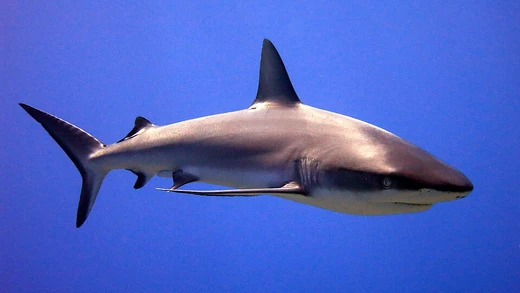
Whitetip reef shark
A small, nocturnal reef shark that rests in caves and hunts in groups.
Last updated

Unknown authorUnknown author · via Wikipedia: Whitetip reef shark · Public domain
Whitetip reef sharks are among the three most common sharks on Indo-Pacific reefs, along with blacktip and grey reef sharks.[1][2] Unlike many other requiem sharks, this species can just chill on the seafloor and actively pump water over its gills to breathe.[1]
Scientific classification
- KingdomAnimalia
- PhylumChordata
- ClassChondrichthyes
- SubclassElasmobranchii
- DivisionSelachii
- OrderCarcharhiniformes
- FamilyCarcharhinidae
- GenusTriaenodon
- SpeciesTriaenodon obesus
Named by (Rüppell, 1837)
Sources: Wikipedia taxobox: Whitetip reef shark (CC BY-SA 4.0) · order, family and genus agree with WoRMS AphiaID 214557 (CC BY 4.0)
Conservation status
Vulnerable (VU)
- LC
- NT
- VU▲ this species
- EN
- CR
- EW
- EX
Source: IUCN Red List assessment · GBIF copy of the Red List category
Where the whitetip reef shark has been recorded
Each dot is a place where the species has been observed and reported (33,607 records, half-degree grid) — not a modelled range. 18 inland records left out (institution coordinates).
Map: drawn by Codexery. Data: GBIF occurrence search (records CC0 / CC BY) · Natural Earth basemap (public domain) · place coordinates: Wikipedia (CC BY-SA 4.0)
Description
Few whitetip reef sharks grow longer than 1.6 m, and the maximum length often reported is 2.1 m, though that figure may be unreliable.[3] The upper jaw holds 42 to 50 rows of teeth, and the lower jaw holds 42 to 48 rows. Each tooth has one narrow central point with two much smaller points on either side.[4] The skin feels smooth because the small, overlapping scales—called dermal denticles—usually have seven horizontal ridges.[4]
Biology and ecology
During the day, its home range is about 0.05 km², but at night it expands to roughly 1 km².[5] They generally stay within a very local area and rarely make long movements.[6] At Rangiroa Atoll, about 40% of tagged sharks were still on the same reef after more than three years.[6] They will also hunt opportunistically during the day.[7]
Its slender body lets it wriggle into narrow crevices and holes in the reef to reach prey that other reef sharks cannot get to.[8] The shark is highly sensitive to smells, sounds, and electrical signals from potential prey, and its vision is better at detecting movement and contrast than fine details.[8] Important predators include tiger sharks, Galapagos sharks, and possibly silvertip sharks, though those usually live in deeper water.[9] An 80 cm whitetip reef shark was found in the stomach of a giant grouper, but such groupers are rare and unlikely to be major predators.[9]
Like other requiem sharks, whitetip reef sharks are viviparous—the young grow inside the mother.[10] Once the embryos use up their yolk supply, the yolk sac becomes a placental connection that delivers nourishment from the mother for the rest of gestation.[10] Once a male has a hold, the pair sinks to the bottom. The male rotates one of his claspers forward, inflates a siphon sac that takes in seawater to flush sperm into the female, and tries to make contact with her vent.[11] The male has only a short time to complete mating because he is being deprived of oxygen while holding the female's fin in his mouth.[11]
Feeding
This shark grows slowly compared to other requiem sharks.[12] In 2008, a whitetip reef shark at a facility in Hungary produced a single pup through possibly asexual means.[12] Each shark hunts for itself and competes with others in its group, but they don't get more excited when feeding together and are unlikely to start a feeding frenzy.[7]
Distribution and habitat
Whitetip reef sharks live across the entire Indo-Pacific region.[13] In the western and central Pacific, they swim near South China, Taiwan, the Ryukyu Islands, the Philippines, and throughout the Coral Triangle, including Indonesia, East Timor, and Papua New Guinea.[4] It was once thought to have lived in the Atlantic Ocean based on fossil teeth from North Carolina, but those teeth are now believed to belong to a mackerel shark.[13] This shark almost always stays near coral reefs, especially around coral heads and ledges with high vertical relief, and also over sandy flats, in lagoons, and near drop-offs to deeper water.[2]
Human interactions
Its meat and liver are eaten, though sharks from some areas pose a risk of ciguatera poisoning, especially the liver.[14]
Taxonomy and phylogeny
Scientists once placed this shark in the family Triakidae, but most now put it in the family Carcharhinidae. That decision is based on features like a full nictitating membrane (a protective third eyelid), a well-developed pit in front of the tail fin, a strong lower tail fin lobe, and scroll-like intestinal valves.[15][16] The only described extinct species of this genus is T. willei, found in Belgium in rocks from the Eocene period.[17]
References
- Wikipedia, "Whitetip reef shark" (CC BY-SA 4.0), which cites: Compagno, L.J.V., "Sharks of the World: An Annotated and Illustrated Catalogue of Shark Species Known to Date", Food and Agricultural Organization, 1984, p. 535–538; Compagno, L.J.V., "Sharks of the World: An Annotated and Illustrated Catalogue of Shark Species Known to Date", Food and Agricultural Organization, 1984, p. 535–538 (we also read that source) en.wikipedia.org
- Wikipedia, "Whitetip reef shark" (CC BY-SA 4.0), which cites: Hobson, E.S., "Feeding Behavior in Three Species of Sharks", Pacific Science, 1963, p. 171–194; Randall, J.E., "Contribution to the Biology of the Whitetip Reef Shark (Triaenodon obesus)", Pacific Science, 1977, p. 143–164; Compagno, L.J.V., "Sharks of the World: An Annotated and Illustrated Catalogue of Shark Species Known to Date", Food and Agricultural Organization, 1984, p. 535–538; Randall, J.E., "Contribution to the Biology of the Whitetip Reef Shark (Triaenodon obesus)", Pacific Science, 1977, p. 143–1 en.wikipedia.org
- Wikipedia, "Whitetip reef shark" (CC BY-SA 4.0), which cites: Randall, J.E., "Contribution to the Biology of the Whitetip Reef Shark (Triaenodon obesus)", Pacific Science, 1977, p. 143–164; (original not read by us) en.wikipedia.org
- Wikipedia, "Whitetip reef shark" (CC BY-SA 4.0), which cites: Compagno, L.J.V., "Sharks of the World: An Annotated and Illustrated Catalogue of Shark Species Known to Date", Food and Agricultural Organization, 1984, p. 535–538 (we also read that source) en.wikipedia.org
- Wikipedia, "Whitetip reef shark" (CC BY-SA 4.0), which cites: Martin, R.A. Coral Reefs: Whitetip Reef Shark. ReefQuest Centre for Shark Research. Retrieved on August 7, 2009.; Compagno, L.J.V., "Sharks of the World: An Annotated and Illustrated Catalogue of Shark Species Known to Date", Food and Agricultural Organization, 1984, p. 535–538; Hobson, E.S., "Feeding Behavior in Three Species of Sharks", Pacific Science, 1963, p. 171–194 (we also read that source) en.wikipedia.org
- Wikipedia, "Whitetip reef shark" (CC BY-SA 4.0), which cites: Randall, J.E., "Contribution to the Biology of the Whitetip Reef Shark (Triaenodon obesus)", Pacific Science, 1977, p. 143–164 (original not read by us) en.wikipedia.org
- Wikipedia, "Whitetip reef shark" (CC BY-SA 4.0), which cites: Hobson, E.S., "Feeding Behavior in Three Species of Sharks", Pacific Science, 1963, p. 171–194; Hobson, E.S., "Feeding Behavior in Three Species of Sharks", Pacific Science, 1963, p. 171–194; Randall, J.E., "Contribution to the Biology of the Whitetip Reef Shark (Triaenodon obesus)", Pacific Science, 1977, p. 143–164; Bight, M., "The Private Life of Sharks: The Truth Behind the Myth", Stackpole Books, 2000, p. 123–124; Carrier, J.C., "Biology of Sharks and Their Relatives", CRC Press, 2004, p. 52, 502; Randal en.wikipedia.org
- Wikipedia, "Whitetip reef shark" (CC BY-SA 4.0), which cites: Randall, J.E., "Contribution to the Biology of the Whitetip Reef Shark (Triaenodon obesus)", Pacific Science, 1977, p. 143–164; Compagno, L.J.V., "Sharks of the World: An Annotated and Illustrated Catalogue of Shark Species Known to Date", Food and Agricultural Organization, 1984, p. 535–538; Hobson, E.S., "Feeding Behavior in Three Species of Sharks", Pacific Science, 1963, p. 171–194; Nelson, D.R. and R.H. Johnson. (1970). Acoustic studies on sharks: Rangiroa Atoll, July 1969. ONR Technical Report 2, No. N00014-6 en.wikipedia.org
- Wikipedia, "Whitetip reef shark" (CC BY-SA 4.0), which cites: Randall, J.E., "Contribution to the Biology of the Whitetip Reef Shark (Triaenodon obesus)", Pacific Science, 1977, p. 143–164; Bester, C. Biological Profiles: Whitetip Reef Shark. Florida Museum of Natural History Ichthyology Department. Retrieved on August 7, 2009.; Coetzee, M., "A new gnathiid (Crustacea: Isopoda) parasitizing two species of requiem sharks from Lizard Island, Great Barrier Reef, Australia", The Journal of Parasitology, June 2008, p. 608–615 (we also read that source) en.wikipedia.org
- Wikipedia, "Whitetip reef shark" (CC BY-SA 4.0), which cites: Robbins, W.D. (2006). Abundance, demography and population structure of the grey reef shark (Carcharhinus amblyrhynchos) and the white tip reef shark (Triaenodo (original not read by us) en.wikipedia.org
- Wikipedia, "Whitetip reef shark" (CC BY-SA 4.0), which cites: Whitney, N.M., "Group courtship, mating behaviour and siphon sac function in the whitetip reef shark, Triaenodon obesus", Animal Behaviour, 2004, p. 1435–1442; "Mating in the reef white-tip shark Triaenodon obesus", Marine Biology, 1985, p. 233–237 (we also read that source) en.wikipedia.org
- Wikipedia, "Whitetip reef shark" (CC BY-SA 4.0), which cites: Randall, J.E., "Contribution to the Biology of the Whitetip Reef Shark (Triaenodon obesus)", Pacific Science, 1977, p. 143–164; Fowler, S.L., "Sharks, Rays and Chimaeras: The Status of the Chondrichthyan Fishes", International Union for Conservation of Nature and Natural Resources, 2005, p. 314; Randall, J.E., "Contribution to the Biology of the Whitetip Reef Shark (Triaenodon obesus)", Pacific Science, 1977, p. 143–164; Robbins, W.D. (2006). Abundance, demography and population structure of the grey reef shark (Carcharh en.wikipedia.org
- Wikipedia, "Whitetip reef shark" (CC BY-SA 4.0), which cites: "Oceanic dispersal in a sedentary reef shark (Triaenodon obesus): genetic evidence for extensive connectivity without a pelagic larval stage", Journal of Biogeography, 2012, p. 1144–1156 (we also read that source) en.wikipedia.org
- Wikipedia, "Whitetip reef shark" (CC BY-SA 4.0), which cites: Compagno, L.J.V., "Sharks of the World: An Annotated and Illustrated Catalogue of Shark Species Known to Date", Food and Agricultural Organization, 1984, p. 535–538; Randall, J.E., "Contribution to the Biology of the Whitetip Reef Shark (Triaenodon obesus)", Pacific Science, 1977, p. 143–164; Fowler, S.L., "Sharks, Rays and Chimaeras: The Status of the Chondrichthyan Fishes", International Union for Conservation of Nature and Natural Resources, 2005, p. 314; Simpfendorfer, C., "Triaenodon obesus", 2020 (we also read that en.wikipedia.org
- Wikipedia, "Whitetip reef shark" (CC BY-SA 4.0), which cites: Randall, J.E., "Contribution to the Biology of the Whitetip Reef Shark (Triaenodon obesus)", Pacific Science, 1977, p. 143–164; Carrier, J.C., "Biology of Sharks and Their Relatives", CRC Press, 2004, p. 52, 502 (original not read by us) en.wikipedia.org
- World Register of Marine Species, Triaenodon obesus (AphiaID 214557). CC BY 4.0. marinespecies.org
- Wikipedia, "Whitetip reef shark" (CC BY-SA 4.0), which cites: Van den Eeckhaut, G., "Inventaire systématique des Invertebrata, Vertebrata, Plantae et Fungi des Sables de Bruxelles", Geominpal Belgica Découvertes géologiques, minéralogiques et paléontologiques en Belgique, 2010 (original not read by us) en.wikipedia.org
Each numbered sentence above was checked against the source it cites before publication. Sentences citing Wikipedia adapt text from the English Wikipedia article Whitetip reef shark (contributors), used under CC BY-SA 4.0; this entry is available under the same licence. Other sources were used for facts only; no text or images are copied from them.
More in Reef sharks
Elsewhere in Sharks
Test yourself
Three questions drawn from this entry’s sources. Pick an answer to check it.
Answers checked against the source article
Sources
Compiled from Wikipedia and the sources listed below. Text from Wikipedia is available under CC BY-SA 4.0; this entry is adapted from it.
- Wikipedia: Whitetip reef shark (CC BY-SA 4.0).
- Classification: the source article's taxobox; order, family and genus checked against WoRMS, the World Register of Marine Species (CC BY 4.0).
- Conservation status: IUCN Red List assessment.
- Occurrence records: GBIF (CC0 / CC BY). Basemap: Natural Earth (public domain).
- Word definitions: the Codexery glossary, each quoted from its Wikipedia article.
Spotted an error? Know more?
Reader corrections go straight into our review queue. Suggest an edit · How this site is sourced