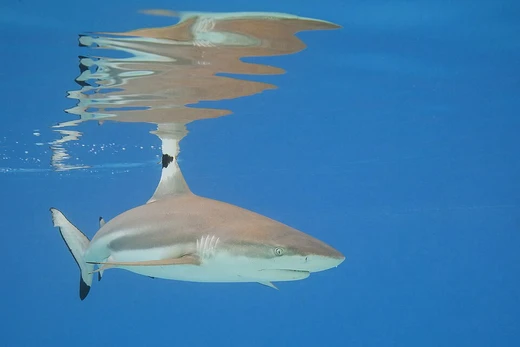
Borneo broadfin shark
Endangered ground shark of turbid estuarine waters.

The Borneo broadfin shark (*Lamiopsis tephrodes*) is a medium-sized ground shark from the family Carcharhinidae. It lives in shallow coastal waters of the western central and northwestern Pacific Ocean, typically in murky estuaries on the continental shelf at depths under 50 meters. The species is listed as Endangered on the IUCN Red List because heavy fishing across its range is believed to have caused major population declines.
Originally described as *Carcharhinus tephrodes* by Fowler in 1905, it has also been called *Carcharhinus microphthalmus*. It belongs to the genus *Lamiopsis*, whose taxonomy was recently clarified: this species was resurrected and redescribed from Southeast Asia, while *Lamiopsis temminckii* was redescribed from the Arabian Sea. Common names include Borneo broadfin shark, Hiu Bujit (Indonesian), and Yu Sirip Lebar (Malay).
This shark reaches a maximum total length of 157 cm. Males mature at about 114 cm, females at 130 cm. Reproduction is placental viviparous, with litters of 4–8 pups (usually 8). Gestation lasts roughly eight months, and pups are born at 40–60 cm. Generation length is estimated at around 6.5 years, based on similarity to the daggernose shark.
The species is reported from Thailand, Indonesia, Malaysia, and likely occurs more widely through the Indo-Malay Archipelago to southern China, including Cambodia, China, and Vietnam. It inhabits inshore areas on the continental shelf, favoring turbid estuaries and subtidal sandy, sandy-muddy, or muddy bottoms, generally shallower than 50 meters.
Population trend is decreasing. No species-specific time-series data exist, but the shark lives in some of the world’s most heavily fished and poorly monitored waters, including parts of the South China Sea and Gulf of Thailand. Reconstructed catch data for sharks, rays, and skates in parts of its range show substantial declines, used to infer population reduction. In the Gulf of Thailand, all shark landings fell 86% from 2003 to 2018, following earlier sharp drops in catch-per-unit effort after industrial trawling began in the 1960s. In Vietnam, reconstructed catches of sharks, rays, and skates in the Exclusive Economic Zone declined 97% between 1986 and 2014, despite rising fishing effort.
Quick Facts
- Genus
- Lamiopsis
- Species
- tephrodes
Facts from the source article.
Lore & Background
The Borneo broadfin shark was originally described as Carcharhinus tephrodes by Fowler in 1905 and has also been referred to as Carcharhinus microphthalmus Chu, 1960. It is a member of the genus Lamiopsis within the family Carcharhinidae. The taxonomy of Lamiopsis has recently been resolved, with Lamiopsis tephrodes resurrected and redescribed from Southeast Asia, and Lamiopsis temminckii redescribed from the Arabian Sea. Common names include Borneo broadfin shark (English), Hiu Bujit (Indonesian), and Yu Sirip Lebar (Malay).
This species is associated with inshore habitats on the continental shelf, linked to turbid estuarine waters and presumably in depths of less than 50 m. It occurs in estuaries and over subtidal sandy, sandy–muddy, and muddy substrates. Reproduction is placental viviparous, with litters typically comprising 4–8 pups (usually 8) and a gestation period of around eight months. Pups are born at 40–60 cm total length. The generation length is suspected to be approximately 6.5 years, based on similarity to the daggernose shark (Isogomphodon oxyrhynchus).
The current population trend is considered decreasing. No species-specific time-series data are available, but the species occurs in some of the most heavily fished and poorly monitored marine regions in the world, including parts of the South China Sea and Gulf of Thailand. Reconstructed catches and landings data for sharks, rays, skates, and carcharhinid sharks in parts of the species’ range indicate substantial declines used to infer population reduction. Overall, the species is suspected to have undergone a population reduction of 50–79% over the past three generation lengths (20 years).
Reader's Guide
The Borneo broadfin shark is significant as a species heavily impacted by fishing pressure across its range, leading to its Endangered status on the IUCN Red List under criteria A2d. It is taken in a variety of coastal fisheries, including demersal trawls and inshore gillnets, particularly in areas influenced by river run-off such as Mukah, Sarawak, Malaysian Borneo. The species is also affected by coastal habitat destruction and degradation, including loss of mangroves, seagrass, and other coastal wetlands in the South China Sea region. Its meat is often sold fresh for human consumption in local markets, and its fins are dried and traded internationally. No species-specific conservation measures are currently in place for Lamiopsis tephrodes. In Indonesia, trawl nets were banned in 1980, although large numbers of smaller trawls (Lampara) are still used. A subsequent ban on seine nets (Cantrang) was intended to be fully implemented in 2020, but there are plans to lift bans and allow some gear types to operate. The species' decline is inferred from reconstructed catches showing broad reductions in carcharhinids in the core of its range, with declines of 76% in the Gulf of Thailand, 72% in Malaysia, 29% in China, and 28% in Indonesia over three generation lengths. These figures underscore the severe pressure on this species from intensive, often unregulated fishing.
Did You Know?
- In the Gulf of Thailand, landings of all combined sharks fell by 86% from 2003 to 2018.
- Market surveys in Sarawak between 2017 and 2019 recorded 42 specimens of Borneo broadfin shark, representing 0.9% of elasmobranchs on sale.
More in Reef Sharks and Rays, Part 2 1-24
Spotted an error? Know more?
Reader corrections go straight into our review queue. Suggest an edit · How this site is sourced