Actinium
Last updated
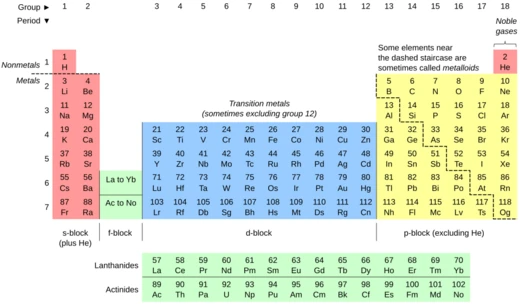
Actinium is a chemical element with symbol Ac and atomic number 89, discovered by Friedrich Oskar Giesel in 1902 and named after a substance found by André-Louis Debierne in 1899. It is the namesake of the actinide series, a set of 15 elements on the periodic table. Along with polonium, radium, and radon, it was among the first non-primordial radioactive elements discovered.
Quick Facts
- Atomic number
- 89
- Discovered by
- Friedrich Oskar Giesel (1902)
- Series
- actinide series
- Appearance
- soft, silvery-white radioactive metal
- Oxidation state
- +3 in nearly all compounds
Facts from the source article.
History
André-Louis Debierne announced a new element in 1899, separating it from pitchblende residues after Marie and Pierre Curie had extracted radium. He described the substance as similar to titanium in 1899 and as similar to thorium in 1900. Friedrich Oskar Giesel found a substance similar to lanthanum in 1902 and called it "emanium" in 1904. After comparing half-lives determined by Debierne, Harriet Brooks in 1904, and Otto Hahn and Otto Sackur in 1905, Debierne's chosen name was retained because of seniority, despite his contradictory chemical claims.
Later articles suggest Debierne's 1904 results conflict with his earlier ones, and the known chemistry of actinium makes it unlikely that his 1899 and 1900 samples contained more than a minor amount; he may have accidentally identified protactinium, which was not discovered for another fourteen years. Some authors advocate crediting Giesel alone, while Adloff notes that Debierne's original claims were prudent and that nobody can contend his substance did not contain actinium.
Debierne is considered the discoverer by most historians, but Giesel prepared the first radiochemically pure actinium and identified its atomic number 89. The name comes from Ancient Greek aktis, aktinos, meaning beam or ray.
Chemical compounds
Only a limited number of actinium compounds are known due to its intense radioactivity. These include AcF3, AcCl3, AcBr3, AcOF, AcOCl, AcOBr, Ac2S3, Ac2O3, AcPO4, and Ac(NO3)3, all with actinium in the +3 oxidation state. Lattice constants of analogous lanthanum and actinium compounds differ by only a few percent. Actinium oxide (Ac2O3) is obtained by heating the hydroxide at 500 °C or the oxalate at 1100 °C in vacuum; its crystal lattice is isotypic with most trivalent rare-earth metal oxides.
Actinium trifluoride can be produced in solution at room temperature by adding hydrofluoric acid to actinium ions, or by treating actinium metal with hydrogen fluoride vapors at 700 °C in an all-platinum setup. Treating actinium trifluoride with ammonium hydroxide at 900–1000 °C yields oxyfluoride AcOF; burning actinium trifluoride in air at 800 °C does not produce AcOF but melts the product. Actinium trichloride is obtained by reacting actinium hydroxide or oxalate with carbon tetrachloride vapors above 960 °C. Actinium oxychloride can be prepared by hydrolyzing actinium trichloride with ammonium hydroxide at 1000 °C, or by igniting a solution of actinium trichloride in hydrochloric acid with ammonia.
Actinium tribromide is produced by reacting aluminium bromide with actinium oxide, and treating it with ammonium hydroxide at 500 °C yields oxybromide AcOBr. Actinium hydride was obtained by reducing actinium trichloride with potassium at 300 °C.
Occurrence and synthesis
Actinium is found only in traces in uranium ores, with one tonne of uranium containing about 0.2 milligrams of 227Ac, and in thorium ores, which contain about 5 nanograms of 228Ac per tonne. 227Ac is a transient member of the uranium-actinium decay chain starting with 235U or 239Pu and ending with stable 207Pb. 228Ac is a transient member of the thorium decay chain starting with 232Th and ending with 208Pb. Another isotope, 225Ac, appears in the neptunium decay chain starting with 237Np or 233U; although all primordial 237Np has decayed, it is continuously produced by neutron knock-out reactions on natural 238U.
The low natural concentration and close similarity to lanthanum and other lanthanides, which are abundant in actinium-bearing ores, make separation from ore impractical. The most concentrated sample from raw material was 7 micrograms of 227Ac in less than 0.1 milligrams of La2O3, and complete separation was never achieved. Instead, actinium is prepared in milligram amounts by neutron irradiation of radium-226 in a nuclear reactor, with a yield of about 2% of the radium weight.
After synthesis, actinium is separated from radium and decay products using thenoyltrifluoroacetone-benzene solution at pH about 6.0, or by anion exchange with a resin in nitric acid, achieving a separation factor of 1,000,000 for radium and actinium versus thorium in a two-stage process.
Applications
Owing to its scarcity, high price, and radioactivity, 227Ac has no significant industrial use, but 225Ac is being studied for cancer treatments such as targeted alpha therapy. 227Ac was studied for use in radioisotope thermoelectric generators for spacecraft. Its oxide pressed with beryllium is an efficient neutron source, exceeding the activity of standard americium-beryllium and radium-beryllium pairs.
In these applications, 227Ac is a beta source that generates alpha-emitting isotopes upon decay; beryllium captures alpha particles and emits neutrons via the (α,n) reaction. 227AcBe neutron sources are used in neutron probes for measuring soil water content and moisture/density in highway construction, as well as in well logging, neutron radiography, tomography, and other radiochemical investigations. 225Ac is applied in medicine to produce other isotopes in a reusable generator or alone for radiation therapy, particularly targeted alpha therapy.
Its 10-day half-life makes it more suitable than 213Bi (46 minutes). 225Ac decays to nontoxic 209Bi rather than toxic lead.
Both 225Ac and its daughters emit alpha particles that kill cancer cells. A difficulty was that intravenous injection of simple actinium complexes led to accumulation in bones and liver for tens of years, potentially inducing new mutations. Binding 225Ac to chelating agents such as citrate, EDTA, or DTPA reduced bone accumulation, though excretion remained slow.
Did You Know?
- Actinium glows in the dark with a pale blue light from ionized air.
- Its estimated shear modulus is similar to that of lead.
- The introduction of the actinides to the periodic table was proposed as early as 1892 by British chemist Henry Bassett.
More in Periodic Table & Elements
Sources
Compiled from Wikipedia and the sources listed below. Text from Wikipedia is available under CC BY-SA 4.0; this entry is adapted from it.
- Wikipedia: Actinium (CC BY-SA 4.0).
- Word definitions: the Codexery glossary, each quoted from its Wikipedia article.
Spotted an error? Know more?
Reader corrections go straight into our review queue. Suggest an edit · How this site is sourced