Chemical element
A species of atom defined by its proton count.
Last updated
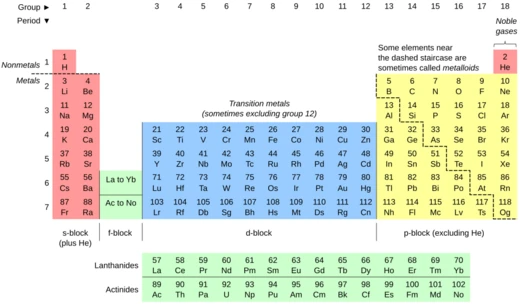
A chemical element is a species of atom defined by its number of protons, known as the atomic number. The term also refers to a pure chemical substance consisting of a single element, such as oxygen gas. The modern understanding of elements was shaped by Dmitri Mendeleev's 1869 periodic table, which organizes elements by atomic number into rows and columns that reflect recurring properties.
Quick Facts
- Atomic numbers
- 1 to 118
- Naturally occurring
- 94
- Synthetic elements
- 24
- Recognizing body
- International Union of Pure and Applied Chemistry (IUPAC)
- Key figure
- Dmitri Mendeleev
- Year of periodic table
- 1869
Facts from the source article.
Atomic nucleus properties
The atomic nucleus consists of protons and neutrons held together by the strong nuclear force, which overcomes the electrical repulsion between protons. The number of protons in the nucleus, called the atomic number, defines the element and determines its electric charge. This charge dictates the number of electrons in a neutral atom, which occupy atomic orbitals and govern chemical behavior. Neutrons are required for stability, as they counterbalance proton repulsion; the necessary neutron-to-proton ratio increases with atomic number.
For example, light elements like oxygen can have equal numbers of neutrons and protons, while lead needs about three neutrons for every two protons. Isotopes are atoms of the same element with different numbers of neutrons. Carbon, for instance, has three main isotopes: carbon-12, carbon-13, and carbon-14, all with six protons but six, seven, or eight neutrons respectively. Natural carbon is mostly carbon-12 (about 98.9%) and carbon-13 (about 1.1%), with trace amounts of carbon-14.
The number of neutrons generally has little effect on chemical properties, except in hydrogen where the kinetic isotope effect is significant. Thus, atomic number, not mass number, identifies an element.
Chemical and physical properties
Electrons in an atom are organized into layered shells, each with a fixed capacity determined by the principal quantum number. The formula for shell capacity is 2n², where n is 1, 2, 3, and so on, giving capacities of 2, 8, 18, 32 electrons. These shells correspond to rows on the periodic table. Electrons occupy discrete energy levels, a phenomenon called quantization, and their arrangement in orbitals is the electron configuration.
The simplest atom, hydrogen, has one electron in the first shell (K shell), occupying the 1s subshell. Helium, with two electrons, fills this shell. Lithium's third electron goes into the second shell (L shell) in the 2s subshell, following the Aufbau principle. The electron configuration mediates interactions with neighboring atoms and determines chemical properties.
Elements are broadly classified as metals, which conduct electricity; nonmetals, which do not; and metalloids, which have intermediate properties and often act as semiconductors.
Nomenclature and symbols
Chemical elements are formally identified by their atomic numbers, accepted names, and chemical symbols. Atomic numbers range from 1 to 118 and are written as Arabic numerals. Elements are often referred to in sequences such as 'through iron' or 'beyond uranium'. The terms 'light' and 'heavy' informally indicate relative atomic numbers, though atomic weight does not always increase with atomic number; for example, argon (atomic number 18) has an atomic weight of 39.95, while potassium (atomic number 19) has an atomic weight of 39.098.
Names for anciently known elements like gold, mercury, and iron were retained after their identification as elements. National differences in naming exist, such as German 'Wasserstoff' for hydrogen and French 'azote' for nitrogen. Since 1947, the International Union of Pure and Applied Chemistry (IUPAC) has determined official names and symbols for new elements, though discoverers may suggest names.
Did You Know?
- Only about 4.6% of the universe's total mass is ordinary matter made of elements; the rest is dark matter and dark energy.
- Elements heavier than iron, such as uranium and plutonium, are produced by explosive nucleosynthesis in supernovae and neutron star mergers.
Also in the Codexery
More in Periodic Table & Elements
Sources
Compiled from Wikipedia and the sources listed below. Text from Wikipedia is available under CC BY-SA 4.0; this entry is adapted from it.
- Wikipedia: Chemical element (CC BY-SA 4.0).
- Word definitions: the , each quoted from its Wikipedia article.
Spotted an error? Know more?
Reader corrections go straight into our review queue. Suggest an edit · How this site is sourced