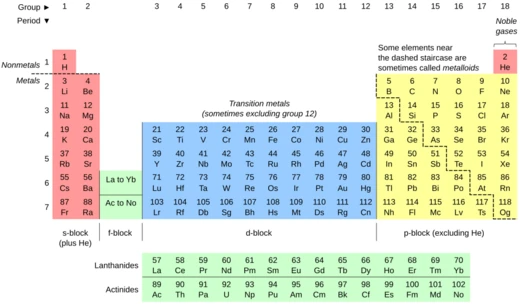
Group 4 element
Last updated

KKPCW · CC BY-SA 4.0
All stable members are silvery refractory metals that crystallize in a hexagonal close-packed structure at room temperature.[1] As atomic mass rises, the crustal abundance of these group 4 metals falls.[2]
Key facts and history
Zircon was known as a gemstone from ancient times, but Klaproth in 1789 analyzed the mineral jargoon and found a new earth (oxide).[3][4] Jöns Jakob Berzelius isolated an impure form of zirconium in 1824 and also first prepared titanium metal in 1825.[4][5] Martin Heinrich Klaproth, a chemist, found the same titanium oxide independently in 1795 within rutile from the Hungarian village of Boinik, and he gave the element its name after the Titans of Greek mythology.[5] Dirk Coster and Georg von Hevesy discovered hafnium in 1923 while working in Copenhagen, Denmark.[6]
Rutherfordium is a synthetic element not found in nature; the first reported detection came in 1964 from a team at the Joint Institute for Nuclear Research.[7]
What the research sources say
That manual also reports that zirconium possesses a very low thermal neutron-capture cross-section, while hafnium's is high.[8][9]
References
- Wikipedia, "Group 4 element" (CC BY-SA 4.0), which cites: Greenwood and Earnshaw, pp. 956–8; Greenwood and Earnshaw, pp. 946–8; Östlin, "First-principles calculation of the structural stability of 6d transition metals", Physical Review B, 2011 (original not read by us) en.wikipedia.org
- Wikipedia, "Group 4 element" (CC BY-SA 4.0), which cites: "Abundance in Earth's Crust", WebElements.com (original not read by us) en.wikipedia.org
- Wikipedia, "Group 4 element" (CC BY-SA 4.0), which cites: "CRC Handbook of Chemistry and Physics", CRC Press, 2007–2008, p. 42 (we also read that source) en.wikipedia.org
- Wikipedia, "Group 4 element" (CC BY-SA 4.0), which cites: ; "CRC Handbook of Chemistry and Physics", CRC Press, 2007–2008, p. 42 (we also read that source) en.wikipedia.org
- Wikipedia, "Group 4 element" (CC BY-SA 4.0), which cites: ; Weeks, "III. Some Eighteenth-Century Metals", Journal of Chemical Education, 1932, p. 1231–1243; Greenwood and Earnshaw, p. 954 (original not read by us) en.wikipedia.org
- Wikipedia, "Group 4 element" (CC BY-SA 4.0), which cites: Paneth, "Ergebnisse der Exakten Naturwissenschaften 1", 1922, p. 362; Fernelius, "Hafnium", Journal of Chemical Education, 1982, p. 242; Urbain, "Sur les séries L du lutécium et de l'ytterbium et sur l'identification d'un celtium avec l'élément de nombre atomique 72", Comptes Rendus, 1922, p. 1347; Coster, "On the Missing Element of Atomic Number 72", Nature, 1923, p. 79; Hevesy, "The Discovery and Properties of Hafnium", Chemical Reviews, 1925, p. 1–41; Scerri, "Prediction of the nature of hafnium from chemistry, Bohr's theory and quan en.wikipedia.org
- Wikipedia, "Group 4 element" (CC BY-SA 4.0), which cites: Barber, R. C., "Discovery of the transfermium elements. Part II: Introduction to discovery profiles. Part III: Discovery profiles of the transfermium elements", Pure and Applied Chemistry, 1993, p. 1757–1814; Ghiorso, "Positive Identification of Two Alpha-Particle-Emitting Isotopes of Element 104", Physical Review Letters, 1969, p. 1317–1320; "Rutherfordium", Rsc.org (original not read by us) en.wikipedia.org
- Open Library record, ISBN 9780803105058 ("Astm Manual on Zirconium and Hafnium"). CC0 (metadata); book content not read. openlibrary.org
- Wikipedia, "Group 4 element" (CC BY-SA 4.0), which cites: Schemel, "ASTM Manual on Zirconium and Hafnium", ASTM International, 1977, p. 1–5; Hedrick, "Hafnium", United States Geological Survey; Spink, "Reactive Metals. Zirconium, Hafnium, and Titanium", Industrial and Engineering Chemistry, 1961, p. 97–104 (we also read that source) en.wikipedia.org
Each numbered sentence above was checked against the source it cites before publication. Sentences citing Wikipedia adapt text from the English Wikipedia article Group 4 element (contributors), used under CC BY-SA 4.0; this entry is available under the same licence. Other sources were used for facts only.
More in Periodic Table & Elements
Sources
Compiled from Wikipedia and the sources listed below. Text from Wikipedia is available under CC BY-SA 4.0; this entry is adapted from it.
- Wikipedia: Group 4 element (CC BY-SA 4.0).
- Word definitions: the Codexery glossary, each quoted from its Wikipedia article.
Spotted an error? Know more?
Reader corrections go straight into our review queue. Suggest an edit · How this site is sourced