Chemical symbol
Abbreviations for elements and compounds in chemistry.
Last updated
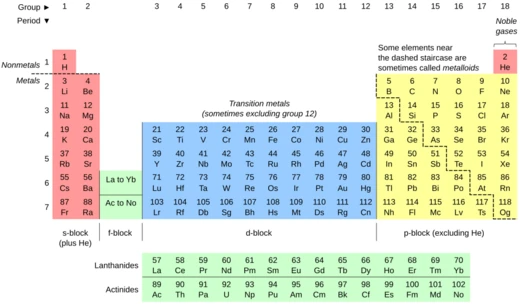
In chemistry, a chemical symbol is a short abbreviation used to represent an element, functional group, compound, or other entity. These atomic symbols are typically one or two letters from the Latin alphabet, with the first letter always capitalized. They offer a compact way to denote elements and their characteristics in scientific writing.
Extension of the symbol
Additional details may be added to an element symbol as superscripts or subscripts to indicate a specific isotope, ionization state, oxidation state, or other atomic detail. The nucleon number (mass number) is placed in the left superscript position (e.g., 14N) to define the isotope; letters such as "m" or "f" may denote a nuclear isomer (e.g., 99mTc), or the number can represent a spin state (e.g., 1O2). The proton number (atomic number) may appear in the left subscript position (e.g., 64Gd), though it is redundant to the element and is sometimes used to emphasize changes in nuclear reactions.
A state of ionization or an excited state is indicated in the right superscript position (e.g., Ca2+). The number of atoms of an element in a molecule is shown in the right subscript position (e.g., N2 or Fe2O3); if the number is one, it is normally omitted. A radical is indicated by a dot on the right side (e.g., Cl•), often omitted unless relevant. Many functional groups have their own chemical symbols, such as Ph for phenyl and Me for methyl.
Symbols and names not currently used
Before elements get their official names and symbols, they often go by temporary systematic names. For elements 101 through 118, these systematic names and symbols—like Unu for unnilunium—were later replaced by the trivial names and symbols we use today, such as Md for mendelevium. This pattern continues for all elements up to 118, with each systematic entry followed by its final trivial counterpart. When elements beyond oganesson, starting with ununennium (Uue) for element 119, are discovered, their systematic names and symbols will presumably be replaced by trivial ones as well.
Long before modern chemistry, alchemists used ideographic symbols for elements known since ancient times. These did not include spurious elements like fire or water, or substances now known to be compounds.
A common system in alchemy linked the seven classical metals to the seven planets, a practice that began to fade with the discovery of antimony, bismuth, and zinc in the 16th century. Alchemists called lead "Saturn" and iron "Mars," and compounds of tin, iron, and silver were referred to as "jovial," "martial," and "lunar" well into the 17th century. This tradition survives today in the element name mercury, chosen over "quicksilver," and in terms like lunar caustic for silver nitrate and saturnism for lead poisoning.
Symbols for named isotopes
A few isotopes have been given unique symbols. The symbols for isotopes of hydrogen, deuterium (D) and tritium (T), are still in use today, as is thoron (Tn) for radon-220.
Heavy water and other deuterated solvents are commonly used in chemistry, and a single character is convenient (e.g., D2O instead of 2H2O). The practice continues with tritium compounds, and a lowercase d is sometimes used for the solvent name (e.g., d-benzene). Symbols for isotopes of elements other than hydrogen and radon are no longer used in the scientific community; many were designated during the early years of radiochemistry, with placeholder names using the early naming system devised by Ernest Rutherford.
Other symbols
In Chinese, each chemical element has a dedicated character, but Latin symbols are also used, especially in formulas. General symbols include A for a deprotonated acid or anion, An for any actinide, B for a base, E for any element or electrophile, L for any ligand, Ln for any lanthanide, M for any metal, Mm for mischmetal, Ng for any noble gas, Nu for any nucleophile, R for any unspecified radical, St for steel, and X for any halogen.
From organic chemistry: Ac for acetyl, Ad for 1-adamantyl, All for allyl, Am for amyl, Ar for aryl, Bn for benzyl, Bs for brosyl, Bu for butyl, Bz for benzoyl, Cp for cyclopentadienyl, Cp for pentamethylcyclopentadienyl, Cy for cyclohexyl, Cyp for cyclopentyl, Et for ethyl, Me for methyl, Mes for mesityl, Ms for mesyl, Np for neopentyl, Ns for nosyl, Pent for pentyl, Ph or Φ for phenyl, Pr for propyl, R for an alkyl group, Tf for triflyl, Tr or Trt for trityl, Ts or Tos for tosyl, and Vi for vinyl. From organometallic chemistry: Fc for ferrocenyl, Fp for (cyclopentadienyl)iron dicarbonyl. Exotic atoms: Mu for muonium, Pn for protonium, Ps for positronium.
Did You Know?
- Earlier symbols for chemical elements stem from classical Latin and Greek words; for example, Pb is the symbol for lead (plumbum in Latin), and Hg is the symbol for mercury (hydrargyrum in Greek).
- A three-letter temporary symbol may be assigned to a newly synthesized element; for example, "Uno" was the temporary symbol for hassium (element 108) with the temporary name unniloctium.
- Some symbols come from other sources, such as W for tungsten (Wolfram in German), which was not known in Roman times.
More in Periodic Table & Elements
Sources
Compiled from Wikipedia and the sources listed below. Text from Wikipedia is available under CC BY-SA 4.0; this entry is adapted from it.
- Wikipedia: Chemical symbol (CC BY-SA 4.0).
- Word definitions: the , each quoted from its Wikipedia article.
Spotted an error? Know more?
Reader corrections go straight into our review queue. Suggest an edit · How this site is sourced