Group 3 element
Last updated

Sandbh · CC BY-SA 4.0
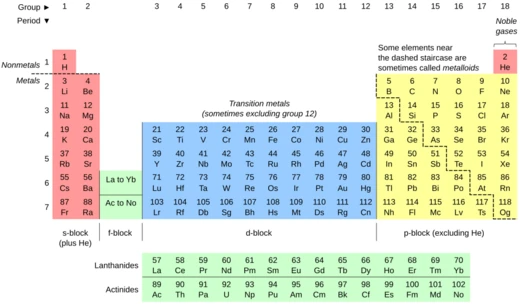
Group 3 elements are scandium, yttrium, lutetium, and lawrencium according to most chemists and physicists who have examined the evidence.[1] The history of discovering group 3 elements cannot be separated from the history of rare earths, because in nature these elements always appear together with rare earths.[2]
Key facts and history
Per Teodor Cleve recognized that scandium matched Mendeleev's predicted element eka-boron and notified Mendeleev.[3] The Commission on Atomic Mass granted priority to Urbain in 1909, adopting his name lutecium, later changed to lutetium in 1949.[4][5] Lawrencium was probably first synthesized on February 14, 1961, by Albert Ghiorso's team at the Lawrence Radiation Laboratory.[6] The first lawrencium atoms were produced by bombarding californium with boron-10 and boron-11 nuclei.[6]
IUPAC kept the name lawrencium and symbol Lr for element 103 in its 1997 final decision.[7] A heavy black rock was discovered in 1787 near Ytterby, Sweden, by the Swedish chemist Carl Axel Arrhenius, who gave it the name ytterbite.[2] Johan Gadolin, a Finnish scientist, detected a new oxide in that sample in 1789; this oxide received the name yttria in 1797.[8] Lars Fredrik Nilson, a Swedish chemist, succeeded in separating ytterbia in 1879, thereby revealing scandium; he derived its name from the Latin word Scandia, which means "Scandinavia".[9]
What the research sources say
The Lenntech account states that scandium is a soft, silvery transition element occurring in rare minerals from Scandinavia.[10] According to Lenntech, only trace amounts of scandium reach the food chain, with the average daily intake being less than 0.1 microgram.[10] The Barbalace periodic table resource shows lutetium (Lu) and lawrencium (Lr) placed in group 3, below yttrium.[11] Lenntech states that the primary hazard of scandium occurs in workplaces, where inhaling damps and gases can lead to lung embolisms after prolonged exposure.[10]
Lenntech reports that scandium slowly builds up in soil and water, which causes higher concentrations of the element to appear in humans and animals over time.[10]
References
- Wikipedia, "Group 3 element" (CC BY-SA 4.0), which cites: Rothbaum, J. O.; Motta, A.*; Kratish, Y.*; Marks, T.J.* Chemodivergent Organolanthanide Catalyzed C-H a-Mono-Borylation of Pyridines. J. Am. Chem. Soc. 2022, 14; Jensen, "The positions of lanthanum (actinium) and lutetium (lawrencium) in the periodic table: an update", Foundations of Chemistry, 2015, p. 23–31; Fluck, "New Notations in the Periodic Table", Pure Appl. Chem., 1988, p. 431–436; Jensen, "The Positions of Lanthanum (Actinium) and Lutetium (Lawrencium) in the Periodic Table", J. Chem. Educ., 1982, p. 634–636; L. D. Landau, E. en.wikipedia.org
- Wikipedia, "Group 3 element" (CC BY-SA 4.0), which cites: van der Krogt, "39 Yttrium – Elementymology & Elements Multidict", Elements.vanderkrogt.net; Emsley 2001, p. 496 (original not read by us) en.wikipedia.org
- Wikipedia, "Group 3 element" (CC BY-SA 4.0), which cites: Cleve, Per Teodor, "Sur le scandium", Comptes Rendus, 1879, p. 419–422; Fischer, "Über das metallische Scandium", Zeitschrift für anorganische und allgemeine Chemie, 1937, p. 54–62; Greenwood and Earnshaw, p. 944 (original not read by us) en.wikipedia.org
- Wikipedia, "Group 3 element" (CC BY-SA 4.0), which cites: "Die Zerlegung des Ytterbiums in seine Elemente", Monatshefte für Chemie, 1908, p. 181–225; Urbain, G., "Lutetium und Neoytterbium oder Cassiopeium und Aldebaranium – Erwiderung auf den Artikel des Herrn Auer v. Welsbach", Monatshefte für Chemie, 1909, p. I (original not read by us) en.wikipedia.org
- Wikipedia, "Group 3 element" (CC BY-SA 4.0), which cites: "Bericht des Internationalen Atomgewichts-Ausschusses für 1909", Berichte der Deutschen Chemischen Gesellschaft, 1909, p. 11–17; van der Krogt, "70. Ytterbium – Elementymology & Elements Multidict", Elements.vanderkrogt.net; van der Krogt, "71. Lutetium – Elementymology & Elements Multidict", Elements.vanderkrogt.net (original not read by us) en.wikipedia.org
- Wikipedia, "Group 3 element" (CC BY-SA 4.0), which cites: Ghiorso, "New Element, Lawrencium, Atomic Number 103", Phys. Rev. Lett., 1961, p. 473 (original not read by us) en.wikipedia.org
- Wikipedia, "Group 3 element" (CC BY-SA 4.0), which cites: Greenwood, "Recent developments concerning the discovery of elements 101–111", Pure Appl. Chem., 1997, p. 179–184 (original not read by us) en.wikipedia.org
- Wikipedia, "Group 3 element" (CC BY-SA 4.0), which cites: Gadolin, "Undersökning af en svart tung Stenart ifrån Ytterby Stenbrott i Roslagen", Kongl. Vetenskaps Academiens Nya Handlingar, 1794, p. 137–155; Greenwood and Earnshaw, p. 944 (original not read by us) en.wikipedia.org
- Wikipedia, "Group 3 element" (CC BY-SA 4.0), which cites: van der Krogt, "39 Yttrium – Elementymology & Elements Multidict", Elements.vanderkrogt.net; Nilson, Lars Fredrik, "Sur l'ytterbine, terre nouvelle de M. Marignac", Comptes Rendus, 1879, p. 642–647; Nilson, Lars Fredrik, "Ueber Scandium, ein neues Erdmetall", Berichte der deutschen chemischen Gesellschaft, 1879, p. 554–557 (original not read by us) en.wikipedia.org
- Lenntech, "Scandium (Sc) — chemical properties of scandium, health effects of scandium, environmental effects of scandium", Lenntech, 1998. lenntech.com
- Barbalace, "Periodic Table of Elements", Environmental Chemistry.com. environmentalchemistry.com
Each numbered sentence above was checked against the source it cites before publication. Sentences citing Wikipedia adapt text from the English Wikipedia article Group 3 element (contributors), used under CC BY-SA 4.0; this entry is available under the same licence. Other sources were used for facts only.
More in Periodic Table & Elements
Sources
Compiled from Wikipedia and the sources listed below. Text from Wikipedia is available under CC BY-SA 4.0; this entry is adapted from it.
- Wikipedia: Group 3 element (CC BY-SA 4.0).
- Word definitions: the Codexery glossary, each quoted from its Wikipedia article.
Spotted an error? Know more?
Reader corrections go straight into our review queue. Suggest an edit · How this site is sourced