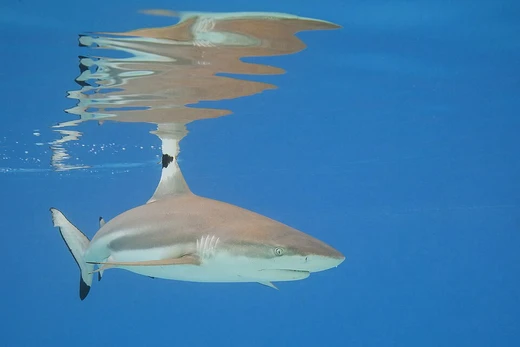
Broadfin shark
A tropical requiem shark with broad pectoral fins, now endangered.

The broadfin shark (Lamiopsis temminckii) is a tropical whaler shark characterized by the broad shape of its pectoral fins. It is classified as a requiem shark of the family Carcharhinidae and is one of two species in the genus Lamiopsis, the other being the Borneo broadfin shark (Lamiopsis tephrodes). Native to the northern Indian Ocean and found close to shore, its current IUCN status is endangered.
Quick Facts
- Genus
- Lamiopsis
- Species
- temminckii
Facts from the source article.
Lore & Background
The broadfin shark is named in honor of Coenraad Jacob Temminck, director of the Rijksmuseum van Natuurlijke Historie in Leiden, Netherlands. Females and males are sexually dimorphic: females are on average larger than males, and males mature at a smaller size. The reported maximum size of females has decreased compared to previous recordings, now around 175 cm, while reported male size has increased. Males can be distinguished by calcified claspers on the ends of their pelvic fins.
The species is found in both the Indian Ocean and the Pacific Ocean, with sporadic sightings off the coasts of Pakistan, India, Indonesia, Burma, China, and Sarawak. It spends most of its time in coastal waters within the continental shelf, and females and males are evenly distributed throughout their habitat. As a placental viviparous species, young are born with an umbilical scar. Females average two to four embryos per uterus, with typical litters of about eight. Late-term embryos are common in summer (April–August), and births occur mostly during the pre-southwest and southwest monsoon seasons (March to September). The shark has a low productivity rate and limited rebound potential.
Its diet consists primarily of crustaceans, teleosts, and cephalopods; analysis of 214 individuals showed crustaceans as the most abundant prey. Although a top predator in coastal habitats, it is parasitized by the blood-sequestering tapeworm Sanguilevator yearsleyi.
Reader's Guide
The broadfin shark is currently listed as endangered globally, but this status may need reassessment because it was last evaluated before the identification of the Borneo broadfin shark (Lamiopsis tephrodes). Misidentification of Borneo broadfin sharks as broadfin sharks could have skewed population numbers, potentially making the actual status worse than recorded—possibly critically endangered. Historically, the species was considered common in heavily fished areas like Indonesia, the Arabian Sea, and the western coast of India, despite always having low population numbers. This is thought to contribute to its decline, as one main reason for its endangerment is frequent bycatch in sailors’ nets. Juveniles are disproportionately caught in late summer, as their birthing season coincides with the seasonal closure of mechanized fishing in their habitat, especially in the Arabian Sea and along the coast of India. The shark's inshore habits put it at risk from bottom nets, floating gill nets, and fishing line, with little remediation effort made. Additional threats include fishing for shark fin soup, meat, and liver for vitamin oil, though new policies are being developed to prevent further decline.
Did You Know?
- The shark is parasitized by Sanguilevator yearsleyi, a blood-sequestering tapeworm.
- Its IUCN status may be underestimated due to historical misidentification with the Borneo broadfin shark.
More in Reef Sharks and Rays, Part 2 1-24
Spotted an error? Know more?
Reader corrections go straight into our review queue. Suggest an edit · How this site is sourced