Group 5 element
Group 5 elements are refractory transition metals with high melting points.
Last updated
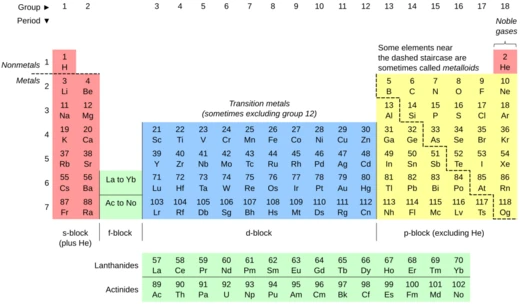
Group 5 is a group of elements in the periodic table, comprising vanadium (V), niobium (Nb), tantalum (Ta), and the synthetic dubnium (Db). This group resides in the d-block and is occasionally referred to as the vanadium group or vanadium family after its lightest member, though it lacks a trivial name because it falls within the broader category of transition metals. As is typical for early transition metals, niobium and tantalum primarily exhibit a +5 oxidation state, are quite electropositive, and have a less extensive coordination chemistry.
Due to the lanthanide contraction, which reduces ionic radii across the lanthanide series, niobium and tantalum are remarkably similar in their properties. Vanadium, being smaller, is more distinct and possesses well-defined +2, +3, and +4 oxidation states, although +5 is the most stable. The three lighter elements occur naturally and are all hard refractory metals under standard conditions.
Vanadium
Dubnium, the fourth element, does not occur naturally and must be synthesized in a laboratory; its most stable isotope, dubnium-268, has a half-life of only 16 hours, with other isotopes being even more radioactive. Vanadium was first discovered in 1801 by Spanish mineralogist Andrés Manuel del Río, who extracted it from a Mexican ore and named it panchromium for its colorful salts, later renaming it erythronium. However, his discovery was incorrectly dismissed as impure chromium in 1805. Swedish chemist Nils Gabriel Sefström rediscovered the element in 1831, naming it vanadium after the Norse goddess Freyja.
Niobium and tantalum
Niobium was identified in 1801 by English chemist Charles Hatchett, who named it columbium, while tantalum was discovered in 1802 by Anders Gustav Ekeberg. Considerable confusion between the two elements persisted until the 19th century, with pure tantalum not produced until 1903. Dubnium was first reported in 1968 by a team at the Joint Institute for Nuclear Research, which bombarded americium-243 with neon-22 ions, observing alpha activities assigned to isotopes of element 105.
Lore & Background
Group 5 consists of vanadium, niobium, tantalum, and the synthetic dubnium. The three naturally occurring members are hard, refractory metals under standard conditions. Vanadium is somewhat distinct from its heavier congeners due to its smaller atomic size; while its +5 oxidation state is the most stable, it also exhibits well-defined +2, +3, and +4 states. Niobium and tantalum, by contrast, are quite electropositive and primarily display only the +5 oxidation state, and their coordination chemistry is less rich.
The lanthanide contraction makes niobium and tantalum extremely similar in their chemical properties. Dubnium does not occur in nature and must be created in a laboratory; its most stable known isotope has a half-life of only about 16 hours, with other isotopes being even more short-lived. Vanadium was first isolated in 1801 by Andrés Manuel del Río from a sample of Mexican ore, who initially named it panchromium for its colorful salts and later erythronium. His discovery was incorrectly dismissed as impure chromium, but the element was rediscovered in 1831 by Nils Gabriel Sefström, who named it vanadium after the Norse goddess Freyja.
Niobium was identified in 1801 by Charles Hatchett, who named it columbium after the United States; the name niobium was later adopted internationally in 1949. Tantalum was first discovered in 1802 by Anders Gustav Ekeberg. For decades, niobium and tantalum were confused with one another due to their close similarity, and pure tantalum was not isolated until 1903. Dubnium was first reported in 1968 by a team at the Joint Institute for Nuclear Research, produced by bombarding americium with neon ions.
Reader's Guide
Group 5 elements are significant as early transition metals with high melting points and reactive properties, though a stable oxide layer often masks their reactivity. Vanadium, niobium, and tantalum are naturally occurring and share similar properties, including a dominant +5 oxidation state; vanadium is distinct with additional +2, +3, and +4 states. Niobium and tantalum are very similar due to the lanthanide contraction.
Dubnium, the synthetic member, has a half-life of only 16 hours for its most stable isotope and its chemistry is not well established, but it appears to match expectations for a heavier congener of tantalum. The group's history involves multiple discoveries, disputes, and renaming, reflecting the challenges of distinguishing closely related elements. Their industrial uses, though not detailed in the article, stem from their refractory nature and oxide stability.
Did You Know?
- Vanadium was originally named panchromium (Greek for 'all colors') by its discoverer due to its colorful salts.
- The group's old US system name was VB, which should not be confused with the old European system name VB for group 15 (pnictogens).
More in Periodic Table & Elements
Sources
Compiled from Wikipedia and the sources listed below. Text from Wikipedia is available under CC BY-SA 4.0; this entry is adapted from it.
- Wikipedia: Group 5 element (CC BY-SA 4.0).
- Word definitions: the Codexery glossary, each quoted from its Wikipedia article.
Spotted an error? Know more?
Reader corrections go straight into our review queue. Suggest an edit · How this site is sourced