Hassium
Last updated
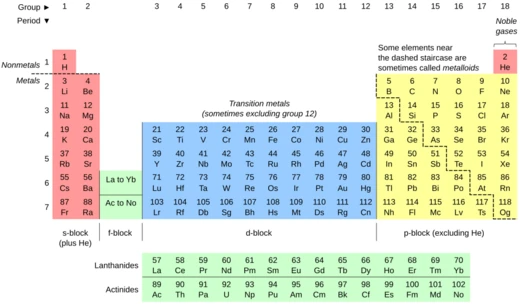
Hassium is a synthetic element with atomic number 108 that has no stable or naturally occurring isotopes.[1] Every hassium isotope known to exist has a short half-life, and the total amount ever created is roughly a few hundred atoms.[1][2]
Quick Facts
- Atomic number
- 108
- Group
- 8
- Period
- 7
Facts from the source article.
Key facts and history
Later in 1984, a GSI team led by Peter Armbruster and Gottfried Münzenberg bombarded a lead target with iron nuclei and reported synthesis of three atoms of element 108.[3][4] The name "hassium" was proposed by the German discoverers and derived from the Latin name for Hesse.[5] IUPAC officially adopted the name hassium (Hs) for element 108 in a 1997 compromise.[6] In Mendeleev's nomenclature, hassium would be called "eka-osmium".[7]
Theoretical models predict a region of instability for some hassium isotopes around mass number 275.[8] The initial effort to synthesize element 108 occurred in 1978, directed by Oganessian at JINR.[9] In 1991, Polish researchers predicted that for deformed nuclei, 108 acts as a proton magic number.[10]
What the research sources say
The same report noted the GSI work clearly identified the decay path of those element 108 isotopes.[11] In 2006, Russian geologist Alexei Ivanov hypothesized that an isomer of hassium might have a half-life of about 2.5e8 years.[12] Ivanov's hypothesis suggested this isomer could explain alpha particles observed in molybdenite and osmiridium samples.[12] A 2012 search for hassium in nature at the Maier-Leibnitz Laboratory set an upper limit of 3 atoms per gram of osmium.[13]
References
- Wikipedia, "Hassium" (CC BY-SA 4.0), which cites: Scerri, "The Periodic Table: Its Story and Its Significance", Oxford University Press, 2019; Helmenstine, "Hassium Facts—Hs or Element 108", ThoughtCo, 2019; Audi et al. 2017, p. 030001-134; Hofmann, "The reaction <sup>48</sup>Ca + <sup>248</sup>Cm → <sup>296</sup>116<sup>*</sup> studied at the GSI-SHIP", The European Physical Journal A, 2012, p. 62; Audi et al. 2017, p. 030001-134; (original not read by us) en.wikipedia.org
- Wikipedia, "Hassium" (CC BY-SA 4.0), which cites: Kragh 2018 (original not read by us) en.wikipedia.org
- Wikipedia, "Hassium" (CC BY-SA 4.0), which cites: Münzenberg, G., "The identification of element 108", Zeitschrift für Physik A, 1984, p. 235; Hofmann, "The discovery of elements 107 to 112", EPJ Web Conf., 2016, p. 4–5 (original not read by us) en.wikipedia.org
- Wikipedia, "Hassium" (CC BY-SA 4.0), which cites: Hofmann, "The discovery of elements 107 to 112", EPJ Web Conf., 2016, p. 4–5 (original not read by us) en.wikipedia.org
- Wikipedia, "Hassium" (CC BY-SA 4.0), which cites: "GSI—Element 107-109", GSI, 2012; "GSI - Element 107-109", GSI Helmholtz Centre for Heavy Ion Research, 2012; "GSI - Element 107-109", GSI Helmholtz Centre for Heavy Ion Research, 2012 (original not read by us) en.wikipedia.org
- Wikipedia, "Hassium" (CC BY-SA 4.0), which cites: Hoffman Ghiorso Seaborg 2000, p. 337–338, 384; Hoffman Ghiorso Seaborg 2000, p. 337–338, 384; Bera, "Names of the Heavier Elements", Resonance, 1999, p. 53–61; "Names and symbols of transfermium elements (IUPAC Recommendations 1997)", Pure and Applied Chemistry, 1997, p. 2471–2474 (original not read by us) en.wikipedia.org
- Wikipedia, "Hassium" (CC BY-SA 4.0), which cites: Chatt, "Recommendations for the naming of elements of atomic numbers greater than 100", Pure and Applied Chemistry, 1979, p. 381–384 (original not read by us) en.wikipedia.org
- Wikipedia, "Hassium" (CC BY-SA 4.0), which cites: Zagrebaev Karpov Greiner 2013; Oganessian, "Experimental studies of the <sup>249</sup>Bk + <sup>48</sup>Ca reaction including decay properties and excitation function for isotopes of element 117, and discovery of the new isotope <sup>277</sup>Mt", Phy (original not read by us) en.wikipedia.org
- Wikipedia, "Hassium" (CC BY-SA 4.0), which cites: Oganessian, "Опыты по синтезу 108 элемента в реакции Ra + Ca", Joint Institute for Nuclear Research, 1978; Orlova, "Опыты по синтезу 108 элемента в реакции Pb + Fe", Joint Institute for Nuclear Research, 1979 (original not read by us) en.wikipedia.org
- Wikipedia, "Hassium" (CC BY-SA 4.0), which cites: Patyk, "Ground-state properties of the heaviest nuclei analyzed in a multidimensional deformation space", Nuclear Physics A, 1991, p. 150 (original not read by us) en.wikipedia.org
- Wikipedia, "Hassium" (CC BY-SA 4.0), which cites: Barber et al. 1993, p. 1790 (original not read by us) en.wikipedia.org
- Wikipedia, "Hassium" (CC BY-SA 4.0), which cites: Ivanov, "The possible existence of Hs in nature from a geochemical point of view", Physics of Particles and Nuclei Letters, 2006, p. 165–168 (original not read by us) en.wikipedia.org
- Wikipedia, "Hassium" (CC BY-SA 4.0), which cites: Oganessian, "Heaviest nuclei from Ca-induced reactions", Journal of Physics G: Nuclear and Particle Physics, 2007, p. R235; Ludwig, "Search for superheavy elements with 292 ≤ A ≤ 310 in nature with accelerator mass spectrometry", Physical Review C, 2012, p. 024315 1–024315 8 (original not read by us) en.wikipedia.org
Each numbered sentence above was checked against the source it cites before publication. Sentences citing Wikipedia adapt text from the English Wikipedia article Hassium (contributors), used under CC BY-SA 4.0; this entry is available under the same licence. Other sources were used for facts only.
More in Periodic Table & Elements
Sources
Compiled from Wikipedia and the sources listed below. Text from Wikipedia is available under CC BY-SA 4.0; this entry is adapted from it.
- Wikipedia: Hassium (CC BY-SA 4.0).
- Word definitions: the Codexery glossary, each quoted from its Wikipedia article.
Spotted an error? Know more?
Reader corrections go straight into our review queue. Suggest an edit · How this site is sourced