Group 8 element
Group 8: iron, ruthenium, osmium, and hassium.
Last updated
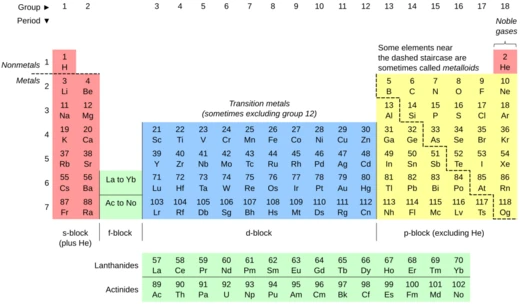
Group 8 is a group (column) of chemical elements in the periodic table, consisting of iron (Fe), ruthenium (Ru), osmium (Os), and hassium (Hs). This designation, adopted by the IUPAC in 1990, is the modern standard for the group and should not be confused with "group VIIIA" in the CAS system, which refers to the noble gases (group 18).
In older naming conventions, this group was combined with groups 9 and 10, labeled "VIIIB" in the CAS U.S. system or simply "VIII" in the pre-1990 IUPAC European system and in Mendeleev’s original table. All four elements are transition metals located in the d-block. While groups are often named after their lightest member, the term "iron group" has historically been applied to a set of adjacent elements on period 4—such as chromium, manganese, iron, cobalt, and nickel—rather than exclusively to group 8.
The members of this family exhibit patterns in electron configuration and chemical behavior. Iron, the fourth most common element in Earth’s crust, has a silvery-gray surface that readily rusts when exposed to oxygen and water, forming hydrated oxides that flake off rather than passivate. Ruthenium, a rare metal often recovered as a byproduct of nickel refining, is used to harden platinum and palladium alloys, particularly in electrical contacts where a thin film provides durability. Osmium is a hard, brittle metal with a very low compressibility and a bulk modulus rivaling diamond; its high melting point and low vapor pressure make it difficult to machine.
Hassium, not found naturally due to its extreme radioactivity, is produced synthetically by bombarding lead-208 with iron-58. Its properties are largely unknown, though chemists have formed compounds such as hassium tetroxide and sodium hassate(VII). Biologically, iron is essential for oxygen transport in hemoglobin and myoglobin, while ruthenium, osmium, and hassium have no known biological roles.
Lore & Background
Group 8 comprises iron, ruthenium, osmium, and hassium, all of which are transition metals located in the d-block of the periodic table. Pure iron surfaces have a mirror-like silvery-gray appearance, but iron readily reacts with oxygen and water, forming brown-to-black hydrated iron oxides known as rust. Unlike some metals that develop a protective oxide layer, rust occupies more volume than the original metal and flakes away, continuously exposing fresh surfaces to corrosion; however, high-purity electrolytic iron is more resistant to this process.
Ruthenium is a very rare metal in Earth’s crust, often found in minerals such as pentlandite and pyroxinite, and is commercially obtained as a waste product from nickel refining. It is used to harden platinum and palladium alloys, particularly in electrical contacts, where a thin film applied by electroplating or sputtering provides sufficient durability. Osmium is a hard, brittle metal that retains its lustre even at high temperatures and has extremely low compressibility, with a bulk modulus reported between 395 and 462 GPa, rivaling that of diamond.
Its hardness, brittleness, low vapor pressure (the lowest among platinum-group metals), and very high melting point (fourth highest of all elements) make solid osmium difficult to machine or form. Hassium is extremely radioactive and does not occur naturally; it is produced by bombarding lead-208 atoms with iron-58 atoms. Very few properties of hassium metal have been measured due to its limited production and rapid decay, though chemists have synthesized compounds such as hassium tetroxide and sodium hassate(VII).
Reader's Guide
Group 8 elements are significant for their varied roles in industry and biology. Iron is essential for human health as a component of hemoglobin and myoglobin, transporting oxygen, and its deficiency causes anemia. Ruthenium is valuable in electrical contacts due to its durability and lower cost than rhodium.
Osmium's extreme hardness and high bulk modulus make it notable for materials science, though its brittleness limits workability. Hassium, while only synthetically produced and short-lived, allows chemists to study transactinide chemistry, with compounds like hassium tetroxide and sodium hassate(VII) having been formed. The group's historical naming has been complex, previously grouped with groups 9 and 10 under older systems, but the modern IUPAC designation clarifies its identity.
Frequently Asked Questions
What elements make up Group 8 on the periodic table?
Group 8 contains four transition metals: iron, ruthenium, osmium, and hassium. All four sit in the d-block and follow shared patterns in their electron configurations.
What do all Group 8 elements have in common?
Every element in this group is classified as a transition metal within the d-block. They share trends in chemical behavior and electron configuration, though their individual reactivity and physical properties differ noticeably.
More in Periodic Table & Elements
Sources
Compiled from Wikipedia and the sources listed below. Text from Wikipedia is available under CC BY-SA 4.0; this entry is adapted from it.
- Wikipedia: Group 8 element (CC BY-SA 4.0).
- Word definitions: the Codexery glossary, each quoted from its Wikipedia article.
Spotted an error? Know more?
Reader corrections go straight into our review queue. Suggest an edit · How this site is sourced