Livermorium
Last updated
The element is named after the Lawrence Livermore National Laboratory in the United States.[1] The synthetic chemical element with atomic number 116 and symbol Lv is called livermorium.[1] This extremely radioactive element is produced solely in laboratory settings, with roughly 35 atoms having been created.[1]
Key facts and history
The results were published in December 2000.[2] No properties of livermorium or its compounds have been measured due to its extremely limited production and rapid decay.[3] Ken Hulet and his Lawrence Livermore National Laboratory team conducted the initial 1977 search for element 116 using a reaction between curium-248 and calcium-48.[4] On July 19, 2000, researchers at Dubna achieved the first synthesis of livermorium by bombarding a curium-248 target with calcium-48 ions.[2]
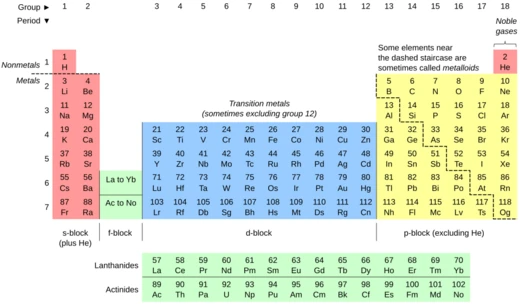
That synthesis yielded a single atom which underwent alpha decay, releasing 10.54 MeV of energy.[2] May 23, 2012, was the date when the symbol Lv and the name livermorium were officially accepted.[5] Within the periodic table, this element belongs to group 16 (the chalcogens) and is classified as a p-block transactinide.[6][7]
What the research sources say
The 2025 paper also stated that the JINR team studied the reaction between 242 Pu and 50 Ti in 2024, discovering the new isotope 289 Lv.[8] A 2023 study at JINR using a reaction between uranium-238 and chromium-54 produced one atom of the new isotope livermorium-288; further analysis published in 2025 reported an additional atom.[9]
References
- Wikipedia, "Livermorium" (CC BY-SA 4.0), which cites: Rennie, "A dictionary of chemistry", Oxford university press, 2020, p. 33; "Livermorium - Element information, properties and uses Periodic Table", periodic-table.rsc.org; "Livermorium Definition & Facts Britannica", www.britannica.com, 2025-07-05 (we also read that source) en.wikipedia.org
- Wikipedia, "Livermorium" (CC BY-SA 4.0), which cites: Oganessian, Yu. Ts., "Observation of the decay of <sup>292</sup>116", Physical Review C, 2000 (original not read by us) en.wikipedia.org
- Wikipedia, "Livermorium" (CC BY-SA 4.0), which cites: Subramanian, "Making New Elements Doesn't Pay. Just Ask This Berkeley Scientist", Bloomberg Businessweek, 2019-08-28 (original not read by us) en.wikipedia.org
- Wikipedia, "Livermorium" (CC BY-SA 4.0), which cites: Hulet, "Search for Superheavy Elements in the Bombardment of <sup>248</sup>Cm with<sup>48</sup>Ca", Physical Review Letters, 1977, p. 385–389 (original not read by us) en.wikipedia.org
- Wikipedia, "Livermorium" (CC BY-SA 4.0), which cites: Loss, "Names and symbols of the elements with atomic numbers 114 and 116 (IUPAC Recommendations 2012)", IUPAC; Pure and Applied Chemistry; "News: Start of the Name Approval Process for the Elements of Atomic Number 114 and 116", International Union of Pure and Applied Chemistry (original not read by us) en.wikipedia.org
- Wikipedia, "Livermorium" (CC BY-SA 4.0), which cites: Rennie, "A dictionary of chemistry", Oxford university press, 2020, p. 33 (we also read that source) en.wikipedia.org
- Wikipedia, "Livermorium" (CC BY-SA 4.0), which cites: Hoffman, "The Chemistry of the Actinide and Transactinide Elements", Springer Science+Business Media, 2006 (we also read that source) en.wikipedia.org
- Wikipedia, "Livermorium" (CC BY-SA 4.0), which cites: Biron, "A New Way to Make Element 116 Opens the Door to Heavier Atoms", lbl.gov, 23 July 2024; Bourzac, "Heaviest element yet within reach after major breakthrough", Nature, 23 July 2024, p. 16–17; Gates, "Towards the Discovery of New Elements: Production of Livermorium (Z=116) with <sup>50</sup>Ti", 2024-07-22; Ibadullayev, "Synthesis and study of the decay properties of isotopes of superheavy element Lv in Reactions <sup>238</sup>U + <sup>54</sup>Cr and <sup>242</sup>Pu + <sup>50</sup>Ti", jinr.ru, 2024; Oganessian, "Investigation of reac en.wikipedia.org
- Wikipedia, "Livermorium" (CC BY-SA 4.0), which cites: "В ЛЯР ОИЯИ впервые в мире синтезирован ливерморий-288", Joint Institute for Nuclear Research, 23 October 2023; Oganessian, "Investigation of reactions with <sup>50</sup>Ti and <sup>54</sup>Cr for the synthesis of new elements", Physical Review C, 2025, p. 014603 (original not read by us) en.wikipedia.org
Each numbered sentence above was checked against the source it cites before publication. Sentences citing Wikipedia adapt text from the English Wikipedia article Livermorium (contributors), used under CC BY-SA 4.0; this entry is available under the same licence. Other sources were used for facts only.
More in Periodic Table & Elements
Sources
Compiled from Wikipedia and the sources listed below. Text from Wikipedia is available under CC BY-SA 4.0; this entry is adapted from it.
- Wikipedia: Livermorium (CC BY-SA 4.0).
- Word definitions: the Codexery glossary, each quoted from its Wikipedia article.
Spotted an error? Know more?
Reader corrections go straight into our review queue. Suggest an edit · How this site is sourced