Tennessine
Last updated
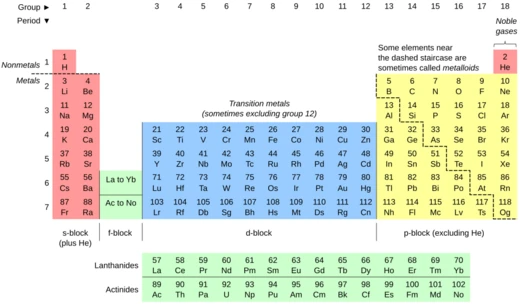
The artificially produced element Ts, which has 117 protons in its nucleus, is known as tennessine.[1] Among all known elements, tennessine shares the top spot for atomic mass and is second only to one other in atomic number.[1] In the periodic table's seventh row, tennessine is the second-to-last element.[1]
Quick Facts
- Atomic number
- 117
- Discovery year
- 2010
- Discovery location
- Dubna, Russia
- Named after
- Tennessee, U.S.
- Group
- 17 (halogens)
- Period
- 7
Facts from the source article.
Key facts and history
In December 2004, the JINR team proposed a joint experiment with ORNL to synthesize element 117.[2] The proposal involved fusing a berkelium target with a calcium beam.[2] ORNL could not then provide berkelium, as production had temporarily ceased.[3] The required berkelium-249 is a by-product in californium-252 production.[3]
In February 2005, Yuri Oganessian presented a colloquium at ORNL attended by representatives of Lawrence Livermore National Laboratory and Joseph Hamilton.[4] ORNL resumed californium production in spring 2008.[5] On 9 April 2010, an official report identified the isotopes as 294 Ts and 293 Ts.[6] In December 2015, the JWP officially recognized the discovery of 293 Ts.[7]
In March 2016, the discovery team agreed on the name "tennessine" for element 117.[4] Periodically, Hamilton would check in on the status of the berkelium production.[4] IUPAC gave its official approval to the names, which included tennessine, in November 2016.[8]
What the research sources say
A Vanderbilt University account states that six atoms of element 117 were produced after 150 days of bombardment.[9] Element 117 is the 26th new element added to the periodic table since 1940.[9] A Science News article reports that an oil company's order of californium enabled the berkelium production.[10] A story from National Public Radio reports that the name "tennessine" was originally proposed by Hamilton.[11]
References
- Wikipedia, "Tennessine" (CC BY-SA 4.0), which cites: "Dictionary of chemistry", Oxford University Press, 2020, p. 43 (original not read by us) en.wikipedia.org
- Wikipedia, "Tennessine" (CC BY-SA 4.0), which cites: Cabage, "International team discovers element 117", Oak Ridge National Laboratory, 2010 (original not read by us) en.wikipedia.org
- Wikipedia, "Tennessine" (CC BY-SA 4.0), which cites: Cabage, "International team discovers element 117", Oak Ridge National Laboratory, 2010; "Vanderbilt physicist plays pivotal role in discovery of new super-heavy element", Vanderbilt University, April 2010; Oganessian, "Results from the first <sup>249</sup>Cf+<sup>48</sup>Ca experiment", JINR Communication, 2002; "Vanderbilt physicist plays pivotal role in discovery of new super-heavy element", Vanderbilt University, April 2010; Bardi, "An Atom at the End of the Material World", Inside Science, 2010 (we also read that source) en.wikipedia.org
- Wikipedia, "Tennessine" (CC BY-SA 4.0), which cites: "What it takes to make a new element" (we also read that source) en.wikipedia.org
- Wikipedia, "Tennessine" (CC BY-SA 4.0), which cites: Witze, "The backstory behind a new element", Science News, 2010; Subramanian, "Making New Elements Doesn't Pay. Just Ask This Berkeley Scientist", Bloomberg Businessweek, 28 August 2019; Siner, "How scientists plan to enshrine Tennessee on the periodic table of elements", National Public Radio, 2016; Bardi, "An Atom at the End of the Material World", Inside Science, 2010; "Clarice Phelps", IUPAC 100; "Clarice Phelps", IUPAC 100; "PT of Younger Chemists", IUPAC 100; "Two ORNL researchers featured on 'Periodic Table of Younger Chemists' - News en.wikipedia.org
- Wikipedia, "Tennessine" (CC BY-SA 4.0), which cites: Roberto, "The discovery of element 117", Oak Ridge National Laboratory, 2010; Greiner, "Recommendations", 2010, p. 6; "Nations work together to discover new element", U.S. Department of Energy, 2011 (original not read by us) en.wikipedia.org
- Wikipedia, "Tennessine" (CC BY-SA 4.0), which cites: "Discovery and assignment of elements with atomic numbers 113, 115, 117 and 118", IUPAC, 2015 (original not read by us) en.wikipedia.org
- Wikipedia, "Tennessine" (CC BY-SA 4.0), which cites: "IUPAC Is Naming The Four New Elements Nihonium, Moscovium, Tennessine, and Oganesson", IUPAC, 2016-06-08 (original not read by us) en.wikipedia.org
- "Vanderbilt physicist plays pivotal role in discovery of new super-heavy element", Vanderbilt University, April 2010. news.vanderbilt.edu
- Witze, "The backstory behind a new element", Science News, 2010. sciencenews.org
- Siner, "How scientists plan to enshrine Tennessee on the periodic table of elements", National Public Radio, 2016. nashvillepublicradio.org
Each numbered sentence above was checked against the source it cites before publication. Sentences citing Wikipedia adapt text from the English Wikipedia article Tennessine (contributors), used under CC BY-SA 4.0; this entry is available under the same licence. Other sources were used for facts only.
More in Periodic Table & Elements
Sources
Compiled from Wikipedia and the sources listed below. Text from Wikipedia is available under CC BY-SA 4.0; this entry is adapted from it.
- Wikipedia: Tennessine (CC BY-SA 4.0).
- Word definitions: the Codexery glossary, each quoted from its Wikipedia article.
Spotted an error? Know more?
Reader corrections go straight into our review queue. Suggest an edit · How this site is sourced