Group 9 element
Rare transition metals including cobalt, rhodium, iridium, and meitnerium.
Last updated
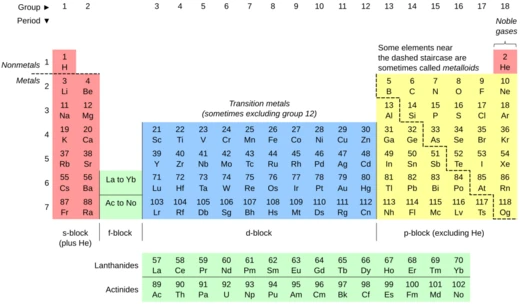
Group 9 is a column of elements in the d-block of the periodic table, according to the modern IUPAC numbering system. It contains cobalt, rhodium, iridium, and meitnerium. These are some of the scarcest transition metals; as of 2025, only non-radioactive rhodium and iridium cost more per weight than gold. While the group generally shows patterns in electron configuration and chemical behavior, rhodium is an exception.
History
The group was officially designated "Group 9" by IUPAC in 1990. Earlier naming systems lumped it with Group 8 (iron, ruthenium, osmium, hassium) and Group 10 (nickel, palladium, platinum, darmstadtium). In the CAS "U.S. system" it was called group VIIIB, and in the old IUPAC "European system" (and Mendeleev’s original table) it was simply group VIII.
Cobalt
Cobalt compounds have been used for centuries to give a deep blue color to glass, glazes, and ceramics. Traces have been found in Egyptian sculpture, Persian jewelry from the third millennium BC, the ruins of Pompeii (destroyed in 79 AD), and Chinese artifacts from the Tang and Ming dynasties.
Swedish chemist Georg Brandt is credited with discovering cobalt around 1735, proving it was a new element distinct from bismuth and other traditional metals. He called it a "semi-metal" and showed that cobalt compounds—not bismuth—were responsible for the blue color in glass. Cobalt was the first metal discovered since prehistoric times; all other known metals (iron, copper, silver, gold, zinc, mercury, tin, lead, and bismuth) had no recorded discoverers.
Rhodium
Rhodium was discovered in 1803 by William Hyde Wollaston, shortly after he found palladium. He worked with crude platinum ore, likely from South America. He dissolved the ore in aqua regia, neutralized the acid with sodium hydroxide, and precipitated platinum as ammonium chloroplatinate using ammonium chloride. Most other metals—copper, lead, palladium, and rhodium—were precipitated with zinc.
Dilute nitric acid dissolved everything except palladium and rhodium. Palladium then dissolved in aqua regia, but rhodium did not. Adding sodium chloride precipitated rhodium as Na₃[RhCl₆]·nH₂O. After washing with ethanol, the rose-red precipitate was reacted with zinc, which displaced the rhodium and released it as free metal.
Iridium
Iridium was discovered in 1803 by British scientist Smithson Tennant. Chemists studying platinum had noticed a dark, insoluble residue when dissolving the metal in aqua regia. Tennant analyzed this residue and concluded it contained a new metal. Vauquelin had treated the powder with alkali and acids, obtaining a volatile new oxide he named ptene (from the Greek for "winged").
Tennant, with more residue, identified two new elements in the black residue: iridium and osmium. He obtained dark red crystals (probably Na₂[IrCl₆]·nH₂O) through reactions with sodium hydroxide and hydrochloric acid. He named iridium after Iris, the Greek winged goddess of the rainbow, because many of its salts were strongly colored. The discovery was reported to the Royal Society on June 21, 1804.
Meitnerium was first synthesized on August 29, 1982, by a German team led by Peter Armbruster and Gottfried Münzenberg at the Institute for Heavy Ion Research in Darmstadt. They bombarded a bismuth-209 target with accelerated iron-58 nuclei and detected a single atom of meitnerium-266: ²⁰⁹₈₃Bi + ⁵⁸₂₆Fe → ²⁶⁶₁₀₉Mt + n. This result was confirmed three years later at the Joint Institute for Nuclear Research in Dubna (then in the Soviet Union).
The first three elements are hard, silvery-white metals. Cobalt turns glass a deep blue and is mainly used in lithium-ion batteries and in making magnetic, wear-resistant, and high-strength alloys. Cobalt silicate and cobalt(II) aluminate (cobalt blue) give a distinctive blue to glass, ceramics, inks, paints, and varnishes. Cobalt occurs naturally as only one stable isotope, cobalt-59.
Cobalt-60 is a commercially important radioisotope used as a tracer and for producing high-energy gamma rays. It also serves as a catalyst in petroleum refining to remove sulfur, which causes acid rain when burned. Rhodium is a hard, silvery, durable metal with high reflectance, used in jewelry. It does not normally form an oxide, even when heated; it absorbs oxygen only at its melting point and releases it upon solidification.
Rhodium has a higher melting point and lower density than platinum. It is not attacked by most acids—completely insoluble in nitric acid and only slightly soluble in aqua regia. Iridium is mainly used to harden platinum alloys. It is the most corrosion-resistant metal known, unaffected by acids including aqua regia, though it reacts in the presence of oxygen.
Lore & Background
Cobalt, rhodium, iridium, and meitnerium constitute Group 9 of the periodic table, a set of d-block transition metals that are among the rarest of their kind. As of 2025, rhodium and iridium are the only non-radioactive metals more expensive per weight than gold. The first three members are hard, silvery-white metals.
Cobalt, discovered by Swedish chemist Georg Brandt around 1735, was the first metal found since prehistoric times; its compounds have been used for centuries to produce a deep blue color in glass, glazes, and ceramics, with evidence found in Egyptian sculpture, third-millennium BC Persian jewelry, Pompeii (destroyed in 79 AD), and Chinese Tang and Ming dynasty artifacts. Cobalt occurs naturally as a single stable isotope, cobalt-59, while cobalt-60 is a commercially important radioisotope used as a tracer and for gamma ray production. It is essential in lithium-ion batteries, magnetic and high-strength alloys, and as a catalyst in petroleum refining to remove sulfur. Rhodium, discovered in 1803 by William Hyde Wollaston, is a hard, silvery, durable metal with high reflectance; it does not normally form an oxide even when heated, and is insoluble in nitric acid while dissolving only slightly in aqua regia.
Iridium, identified in 1803 by Smithson Tennant from a dark, insoluble residue left after dissolving platinum in aqua regia, is the most corrosion-resistant metal known, unaffected by acids including aqua regia, though it reacts with cyanide salts in the presence of oxygen. It is primarily used as a hardening agent for platinum alloys. Meitnerium, first synthesized in 1982 by a German team bombarding bismuth-209 with iron-58 nuclei, is a synthetic, radioactive element.
Reader's Guide
Group 9 elements are historically and industrially significant. Cobalt's use in blue glass and ceramics spans millennia, and its discovery by Georg Brandt marked the first new metal identified since antiquity. Today, cobalt is essential in lithium-ion batteries, high-strength alloys, and as a catalyst in petroleum refining.
Rhodium and iridium, both discovered in the early 1800s, are extremely rare and corrosion-resistant, with rhodium used in jewelry and iridium as a hardening agent for platinum. Meitnerium, a synthetic radioactive element, has only been produced in minute quantities and is considered a homologue to iridium. Biologically, only cobalt plays a role, as a key component of vitamin B12, essential for ruminant animals and humans.
More in Periodic Table & Elements
Sources
Compiled from Wikipedia and the sources listed below. Text from Wikipedia is available under CC BY-SA 4.0; this entry is adapted from it.
- Wikipedia: Group 9 element (CC BY-SA 4.0).
- Word definitions: the Codexery glossary, each quoted from its Wikipedia article.
Spotted an error? Know more?
Reader corrections go straight into our review queue. Suggest an edit · How this site is sourced