Georges Cuvier
Founding father of paleontology who helped establish extinction as a scientific concept.
Last updated

Georges Cuvier · Public domain
Georges Cuvier was a French naturalist who established the fields of comparative anatomy and paleontology.[1][2] He is considered the founder of vertebrate paleontology and proved that extinction is a scientific fact.[3][2] Cuvier also served as a peer of France and held high government positions under Napoleon and the Bourbon kings.[4][5]
Life and work
He studied at the Caroline Academy in Stuttgart, where he won a prize for German after only nine months of learning the language.[6] In 1795 he became assistant to Jean-Claude Mertrud at the Jardin des Plantes, and succeeded him as Chair of Comparative Anatomy in 1802.[7] Cuvier's first paleontological paper in 1796 analyzed elephant and mammoth fossils, establishing that they belonged to extinct species.[8][9] He identified the Megatherium as a giant extinct ground sloth by comparing its skull with living sloths.[10][9]
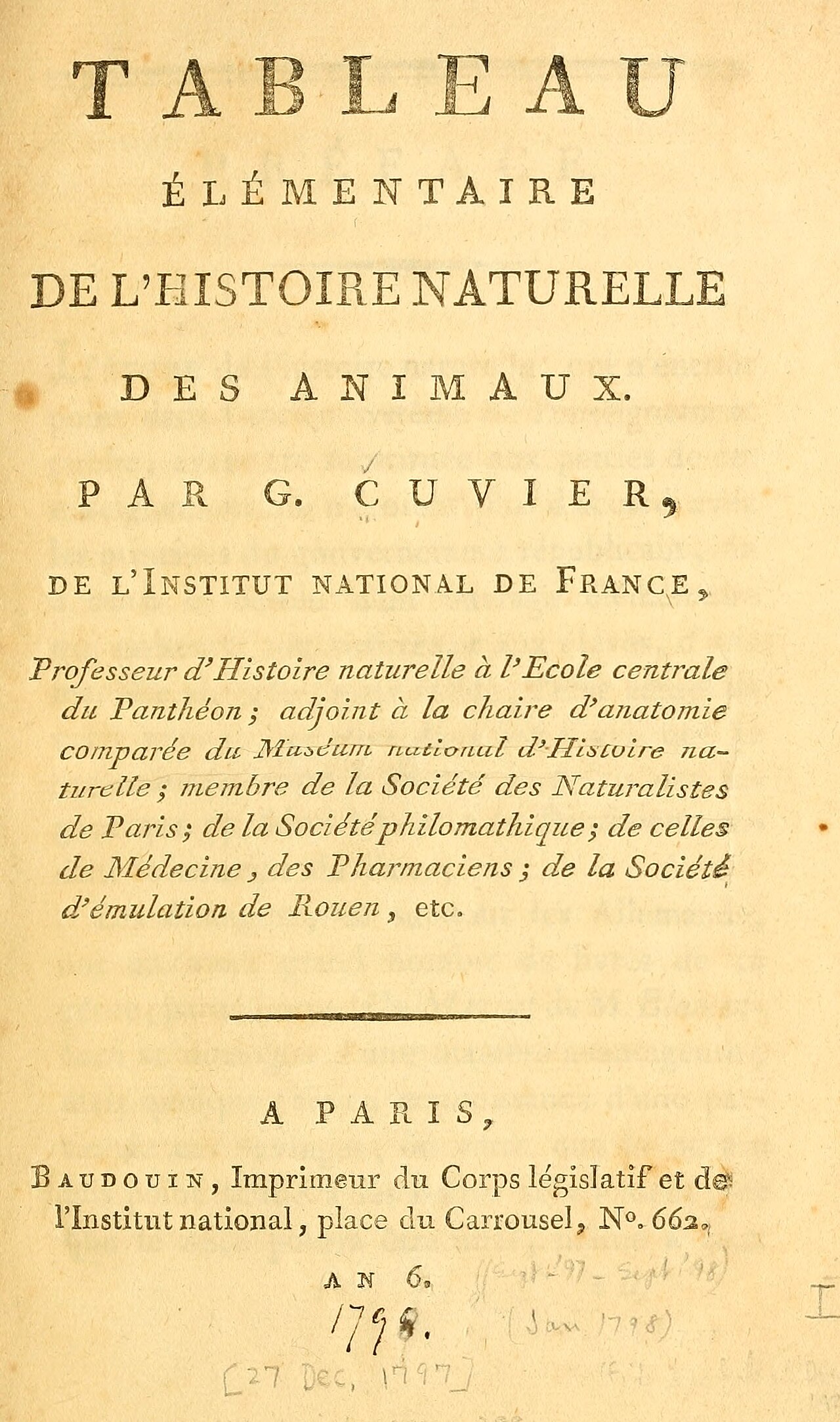
Cuvier proposed that periodic catastrophic flooding wiped out extinct species, making him a leading proponent of catastrophism.[11] He strongly opposed evolutionary theories of Lamarck and Geoffroy Saint-Hilaire, arguing that fossil forms appear abruptly and remain unchanged.[12][13][14] Cuvier was a devout Lutheran who helped found the Parisian Biblical Society in 1818.[5][14] He died on 13 May 1832.[1]
On 23 August 1769, in Montbéliard, Jean Léopold Nicolas Frédéric Cuvier was born to Anne Clémence Chatel and Jean-Georges Cuvier, the latter being a lieutenant in the Swiss Guards.[15]
What the cited sources add
The Random House dictionary notes that Cuvier extended his system to fossils and his reconstructions advanced paleontology.[2] It also states that Cuvier correctly recognized a fossil as a flying reptile.[2]
References
- Wikipedia, "Georges Cuvier" (CC BY-SA 4.0), which cites: "Cuvier". Random House Webster's Unabridged Dictionary.; Reybrouck, "From Primitives to Primates: A History of Ethnographic and Primatological Analogies in the Study of Prehistory", Sidestone Press, 2012, p. 54 (we also read that source) en.wikipedia.org
- "Cuvier". Random House Webster's Unabridged Dictionary.. facts only, no text reused. dictionary.com
- Wikipedia, "Georges Cuvier" (CC BY-SA 4.0), which cites: Felipe Faria, "Georges Cuvier et le premier paradigme de la paléontologie", Revue de Paléobiologie, 2013 (original not read by us) en.wikipedia.org
- Wikipedia, "Georges Cuvier" (CC BY-SA 4.0), which cites: Andrew Dickson White, A History of the Warfare of Science with Theology in Christendom Appleton (1922) Vol. 1 p. 64 (original not read by us) en.wikipedia.org
- Wikipedia, "Georges Cuvier" (CC BY-SA 4.0) en.wikipedia.org
- Wikipedia, "Georges Cuvier" (CC BY-SA 4.0), which cites: Rudwick, "Georges Cuvier, fossil bones, and geological catastrophes: new translations & interpretations of the primary texts", University of Chicago Press, 1998, p. 4, 7 (original not read by us) en.wikipedia.org
- Wikipedia, "Georges Cuvier" (CC BY-SA 4.0), which cites: Thierry Malvésy, Georges Cuvier : Montbéliard 1769 – Paris 1832, Les Amis du Muséum national d'histoire naturelle - Publication trimestrielle (quarterly publica (original not read by us) en.wikipedia.org
- Wikipedia, "Georges Cuvier" (CC BY-SA 4.0), which cites: Chisholm 1911, p. 676 (original not read by us) en.wikipedia.org
- Wikipedia, "Georges Cuvier" (CC BY-SA 4.0), which cites: Smith, "Georges Cuvier: an annotated bibliography of his published works", Smithsonian Institution Press, 1993; Cuvier, "Fossil Bones, and Geological Catastrophes", 1998; Cuvier, "Note on the skeleton of a very large species of quadruped, hitherto unknown, found in Paraguay and deposited in the Cabinet of Natural History in Madrid.", Magasin Encyclopédique, 1796 (we also read that source) en.wikipedia.org
- Wikipedia, "Georges Cuvier" (CC BY-SA 4.0), which cites: Babcock, "Nomenclatural history of Megalonyx Jefferson, 1799 (Mammalia, Xenarthra, Pilosa, Megalonychidae)", ZooKeys, 2024-03-18, p. 297–308 (original not read by us) en.wikipedia.org
- Wikipedia, "Georges Cuvier" (CC BY-SA 4.0), which cites: ; Bowler, "Evolution: the history of an idea", University of California Press, 2009, p. 112–113 (we also read that source) en.wikipedia.org
- Wikipedia, "Georges Cuvier" (CC BY-SA 4.0), which cites: Appel, "The Cuvier-Geoffroy Debate: French Biology in the Decades Before Darwin", Oxford University Press, 1987 (we also read that source) en.wikipedia.org
- Wikipedia, "Georges Cuvier" (CC BY-SA 4.0), which cites: Coleman, "Georges Cuvier, zoologist a study in the history of evolution theory.", Harvard University Press, 1964, p. 141–169 (original not read by us) en.wikipedia.org
- Wikipedia, "Georges Cuvier" (CC BY-SA 4.0), which cites: ; (original not read by us) en.wikipedia.org
- Wikipedia, "Georges Cuvier" (CC BY-SA 4.0), which cites: 'Extrait du 7.e Registre des Enfants baptises dans l'Eglise françoise de Saint Martin de la Ville de Montbéliard deposé aux Archives de l'Hôtel de Ville', Cultu (original not read by us) en.wikipedia.org
Each numbered sentence above was checked against the source it cites before publication. Sentences citing Wikipedia adapt text from the English Wikipedia article Georges Cuvier (contributors), used under CC BY-SA 4.0; this entry is available under the same licence. Other sources were used for facts only; no text or images are copied from them.
More in Explorers & Pioneers
Sources
Compiled from Wikipedia and the sources listed below. Text from Wikipedia is available under CC BY-SA 4.0; this entry is adapted from it.
- Wikipedia: Georges Cuvier (CC BY-SA 4.0).
- Word definitions: the Codexery glossary, each quoted from its Wikipedia article.
Spotted an error? Know more?
Reader corrections go straight into our review queue. Suggest an edit · How this site is sourced