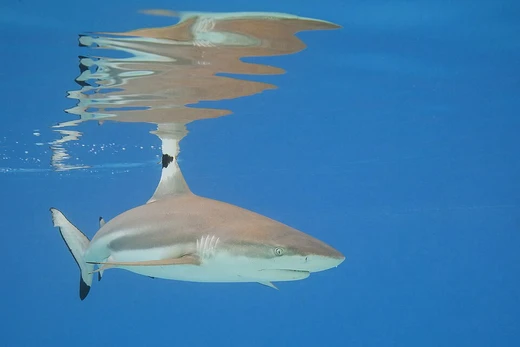
Lemon shark
A yellowish, social shark found in shallow subtropical waters.

The lemon shark (Negaprion brevirostris) is a requiem shark whose yellowish skin gives it its common name. The International Union for the Conservation of Nature lists it as a "vulnerable" species. These sharks can reach 3.4 meters (11 feet) in length and are typically found in shallow subtropical waters, where they return to specific nursery sites for breeding. They feed mainly at night, using electroreceptors to locate fish. Living in groups offers them advantages like better communication, courtship, predatory behavior, and protection. Females give birth to live young, are polyandrous, and reproduce every two years. Lemon sharks pose little threat to humans; only 10 bites have been recorded, none life-threatening. Their lifespan is unknown, but most live 25 to 30 years. In 2023, the oldest recorded captive lemon shark died at age 40.
Felipe Poey first named and described the lemon shark in 1868, calling it *Hypoprion brevirostris* before reclassifying it as *Negaprion brevirostris*, the accepted scientific name. It has also appeared in literature as *Negaprion fronto*, *Carcharias fronto* (Jordan and Gilbert, 1882), *Carcharias brevirostris* (Gunther, 1870), and *Carcharhinus brevirostris* (Henshall, 1891).
The earliest fossil remains come from the Early Miocene of Odisha (India), Peru, and Cuba. Fossils become more common in the Americas and western Africa from the Middle Miocene onward.
The lemon shark’s yellow coloring camouflages it over sandy seafloors in coastal habitats. Adults commonly reach 2.4 to 3.1 meters (7.9 to 10.2 feet) and weigh up to 90 kilograms (200 pounds), though sexual maturity occurs at 2.24 meters (7.3 feet) for males and 2.40 meters (7.9 feet) for females. The maximum recorded length and weight are 3.43 meters (11.3 feet) and 183.7 kilograms (405 pounds). It has a flattened head, a short, broad snout, and a second dorsal fin nearly as large as the first. Like all cartilaginous fish, it has electroreceptors called ampullae of Lorenzini concentrated in its head, which detect electrical pulses from prey during nocturnal feeding. Lemon sharks can be confused with bull sharks; the former have similarly sized first and second dorsal fins, while the latter’s are different.
Lemon sharks range from New Jersey to southern Brazil in the tropical western Atlantic.
Quick Facts
- Genus
- Negaprion
- Species
- brevirostris
Facts from the source article.
Lore & Background
The lemon shark was first named and described in 1868 by Felipe Poey, who originally called it Hypoprion brevirostris before reclassifying it as Negaprion brevirostris. Its earliest fossil remains are known from the Early Miocene of Odisha (India), Peru, and Cuba, with fossils becoming more widespread in the Americas and western Africa from the Middle Miocene onward. The lemon shark's yellow coloring serves as excellent camouflage when swimming over sandy seafloors in its coastal habitat. It has a flattened head with a short, broad snout, and its second dorsal fin is almost as large as the first. Like all cartilaginous fishes, it has electroreceptors (ampullae of Lorenzini) concentrated in its head to detect prey. Lemon sharks can be confused with bull sharks, but the former have similarly sized first and second dorsal fins, whereas those of the latter are differently sized. They are found from New Jersey to southern Brazil in the tropical western Atlantic, off the coast of west Africa, and in the eastern Pacific from southern Baja California to Ecuador, as well as in Cape Verde at Sal Island. They occupy subtropical, shallow waters of coral reefs, mangroves, enclosed bays, and river mouths, and have been found in the open ocean down to 92 m (302 ft). They select warm, shallow water with a rocky or sandy bottom and avoid areas with thick sea grasses. Mangrove habitats serve as nursery sites, providing abundant prey and protection from adult lemon sharks that occasionally feed on juveniles. Ontogenetic niche shifts to deeper waters occur as body size increases.
Reader's Guide
The lemon shark is significant as a model species for studying social behavior in sharks, challenging the belief that all sharks are asynchronous, opportunistic predators. It is known to live in groups or loose aggregations, with up to twenty juveniles observed together. Benefits of group living include enhanced communication, courtship, predatory behavior, and protection, though costs include increased risk of disease and competition for resources. The species is mainly piscivorous, feeding at night using electroreceptors, and displays a high degree of prey preference, conforming to optimal foraging theory. Its feeding behavior involves approaching prey with speed, braking with pectoral fins, and shaking its head to tear flesh. Group feeding, such as pack hunting or communal scavenging, has been observed. The lemon shark is not thought to be a large threat to humans, with only 10 recorded bites, none life-threatening. Its biennial reproductive cycle and polyandrous females contribute to its vulnerability. The oldest recorded lemon shark in captivity died in 2023 at age 40, though typical lifespan is 25 to 30 years. Its use of nursery sites for extended periods has provided insights into shark habitat selection and behavior.
Did You Know?
- Only 10 bites on humans have been recorded, none life-threatening.
- The oldest recorded captive lemon shark died in 2023 at age 40.
- Lemon sharks use electroreceptors (ampullae of Lorenzini) to detect prey at night.
More in Reef Sharks and Rays, Part 2 1-24
Spotted an error? Know more?
Reader corrections go straight into our review queue. Suggest an edit · How this site is sourced