Copernicium
A synthetic, highly radioactive element named after Nicolaus Copernicus.
Last updated
Copernicium is a synthetic chemical element with symbol Cn and atomic number 112. Its known isotopes are extremely radioactive and have only been created in a laboratory. The most stable known isotope, copernicium-285, has a half-life of approximately 30 seconds.
Quick Facts
- Atomic number
- 112
- Discovered
- February 1996
- Discovered by
- Sigurd Hofmann, Victor Ninov et al.
- Location of discovery
- GSI Helmholtz Centre for Heavy Ion Research, Darmstadt, Germany
- Named after
- Nicolaus Copernicus
- Group
- 12
Facts from the source article.
History
Copernicium was first created on 9 February 1996 at the Gesellschaft für Schwerionenforschung (GSI) in Darmstadt, Germany, by Sigurd Hofmann, Victor Ninov et al. The element was produced by firing accelerated zinc-70 nuclei at a target made of lead-208 nuclei in a heavy ion accelerator, yielding a single atom of copernicium-277. A second atom was originally reported but later retracted because the data had been fabricated by Ninov. In May 2000, the GSI successfully repeated the experiment to synthesize another atom of copernicium-277. The reaction was repeated at RIKEN in 2004 and 2013 using the Search for a Super-Heavy Element Using a Gas-Filled Recoil Separator set-up, producing three further atoms and confirming the decay data reported by the GSI team.
Work at Dubna from 1998 aimed to synthesize the heavier isotope copernicium-283 via the hot fusion reaction 238U(48Ca,3n)283Cn; most observed atoms of 283Cn decayed by spontaneous fission, though an alpha decay branch to 279Ds was detected. The long-lived activity initially assigned to 283Cn may instead have come from its electron capture daughter 283Rg or a metastable isomeric state. Later cross-bombardments confirmed the properties of 283Cn and its parents, but priority for the discovery was assigned to the GSI.
Isotopes
Copernicium exists only as a synthetic element, with no stable or naturally occurring isotopes. Scientists have created eight radioactive isotopes in the lab, with mass numbers 277 and 280 through 286, plus a possible metastable isomer of 285Cn that has not been confirmed. These isotopes mostly decay by alpha emission, though some undergo spontaneous fission, and copernicium-283 might also decay via electron capture. That isotope, 283Cn, played a key role in verifying the discoveries of flerovium and livermorium.
Every confirmed isotope is highly unstable; generally, heavier ones last longer than lighter ones, and those with an odd number of neutrons have slightly longer half-lives because they resist spontaneous fission more. The most stable known isotope, 285Cn, has a half-life of 30 seconds. Copernicium-283 lasts 4 seconds, while the unconfirmed 285mCn and 286Cn have half-lives around 15 and 8.45 seconds, respectively.
All other isotopes decay in under a second. Theoretical predictions suggest that 291Cn and 293Cn might have half-lives of several decades, as they could lie near the center of the so-called island of stability. These heavy isotopes may have formed in the r-process and could be detectable in cosmic rays, but they would be about one trillion times less abundant than lead. The lightest copernicium isotopes are made by fusing two lighter nuclei directly, while the heavier ones, from 284Cn upward, have only been observed as decay products of even heavier elements.
Predicted properties
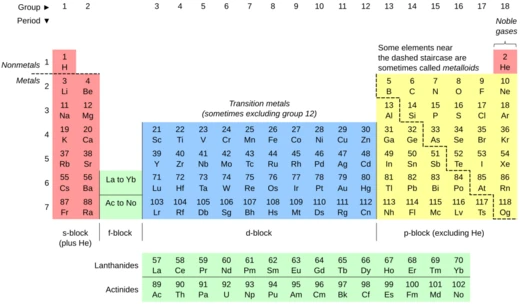
Copernicium is the heaviest element in group 12, sitting below zinc, cadmium, and mercury, and it closes out the 6d series. Scientists expect it to behave quite differently from its lighter group 12 neighbors. The strongest relativistic contraction of the valence s-subshells among group 12 and period 7 elements is predicted to occur at copernicium, and together with its closed-shell electron configuration, this likely makes it a very noble metal. The predicted standard reduction potential for the Cn2+/Cn couple is +2.1 V. Its first ionization energy is estimated at 1155 kJ/mol, which is very close to xenon’s value of 1170.4 kJ/mol.
Copernicium’s metallic bonds are expected to be quite weak, possibly giving it volatility similar to noble gases and even making it a gas at room temperature. Still, it should be able to form metal–metal bonds with copper, palladium, platinum, silver, and gold, with these bonds predicted to be only about 15–20 kJ/mol weaker than the analogous bonds with mercury. Contrary to earlier ideas, advanced ab initio calculations indicate that singly-valent copernicium behaves chemically like mercury, not like a noble gas. This result comes from a large spin–orbit interaction that significantly lowers the energy of its vacant 7p1/2 state.
Experimental atomic gas phase chemistry
Scientists first became interested in copernicium because of calculations suggesting it would display the strongest relativistic effects of any element in period 7, group 12, and indeed among all 118 known elements. Its predicted ground state electron configuration is [Rn] 5f14 6d10 7s2, placing it in group 12 as a heavier counterpart to mercury, expected to form strong compounds with noble metals such as gold. To study its reactivity, researchers have measured how atoms of element 112 adsorb onto a gold surface at different temperatures, using this data to determine an adsorption enthalpy.
Relativistic effects stabilize the 7s electrons, giving copernicium properties similar to radon. The earliest chemical experiments on copernicium used the reaction 238U(48Ca,3n)283Cn, detecting the claimed parent isotope through spontaneous fission with a half-life of about 5 minutes. Those results suggested copernicium was more volatile than mercury and behaved like a noble gas, but uncertainty about the synthesis of copernicium-283 raised questions.
To clarify, a FLNR–PSI team at JINR conducted experiments from April to May 2006, producing this isotope as a daughter in the reaction 242Pu(48Ca,3n)287Fl. They unambiguously identified two atoms of copernicium-283, and analysis of adsorption behavior indicated copernicium is a more volatile homologue of mercury, forming a weak metal-metal bond with gold. However, a 2019 study suggested these results might instead be explained by strong dispersion interactions.
More in Periodic Table & Elements
Sources
Compiled from Wikipedia and the sources listed below. Text from Wikipedia is available under CC BY-SA 4.0; this entry is adapted from it.
- Wikipedia: Copernicium (CC BY-SA 4.0).
- Word definitions: the Codexery glossary, each quoted from its Wikipedia article.
Spotted an error? Know more?
Reader corrections go straight into our review queue. Suggest an edit · How this site is sourced