Oganesson
Synthetic element with the highest atomic number known.
Last updated
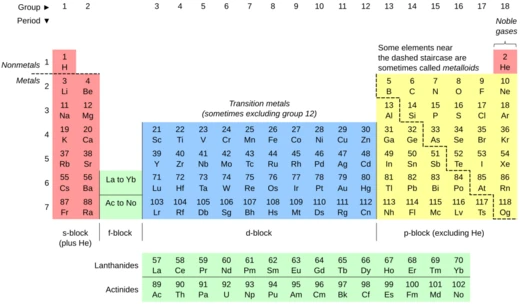
Oganesson, symbol Og and atomic number 118, is a synthetic element first created in 2002 by Russian and American scientists at the Joint Institute for Nuclear Research in Dubna. It holds the highest atomic number and atomic mass of any known element. Named on 28 November 2016 for physicist Yuri Oganessian, its only known isotope, oganesson-294, is highly radioactive with a half-life of 0.7 milliseconds, too brief for chemical study.
Quick Facts
- Atomic number
- 118
- Discovered
- 2002
- Discovery location
- Joint Institute for Nuclear Research, Dubna, Russia
- Named after
- Yuri Oganessian
- Group
- 18
- Period
- 7
Facts from the source article.
History
Even before the full noble gas family was mapped out, scientists suspected a seventh member existed. In April 1895, Danish chemist Hans Peter Jørgen Julius Thomsen predicted a series of inert gases bridging the halogens and alkali metals, with the seventh ending a 32-element period and weighing in at an atomic mass of 292. Niels Bohr, the Danish physicist, later specified in 1922 that this gas would have atomic number 118 and described its electron shell arrangement. German chemist Aristid von Grosse followed up in 1965 with a paper on the element’s likely traits.
It took 107 years from Thomsen’s guess to actually create oganesson, though its chemistry remains untested. In 1975, American chemist Kenneth Pitzer argued that relativistic effects would make element 118 a gas or volatile liquid. Polish physicist Robert Smolańczuk calculated in late 1998 that fusing lead with krypton could yield the element, contradicting earlier assumptions about dropping reaction rates. Researchers at Lawrence Berkeley National Laboratory then announced in 1999 that they had produced elements 118 and 116, publishing their results in Physical Review Letters.
Characteristics
Oganesson is so difficult and costly to produce, and decays so quickly, that none of its properties or those of its compounds have ever been measured; scientists rely entirely on predictions. After element 96, curium, nuclear stability drops sharply. Every element above atomic number 101 decays in under 30 hours, and nothing past lead (element 82) has a stable isotope. Without special stabilizing effects, elements with more than 104 protons should not exist, but 1960s research suggested that closed nuclear shells around 114 protons and 184 neutrons could create an "island of stability." Oganesson’s existence supports this idea.
It decays by alpha emission and spontaneous fission, with a half-life under a millisecond—though longer than some predictions. Calculations indicate heavier isotopes like 293Og, 295Og, 296Og, 297Og, 298Og, 300Og, and 302Og might be slightly more stable than 294Og, with 297Og offering the best chance for longer-lived nuclei. Some very neutron-rich isotopes, such as 313Og, could also last longer. Isotopes 291Og through 295Og might form as decay products of element 120.
More in Periodic Table & Elements
Sources
Compiled from Wikipedia and the sources listed below. Text from Wikipedia is available under CC BY-SA 4.0; this entry is adapted from it.
- Wikipedia: Oganesson (CC BY-SA 4.0).
- Word definitions: the Codexery glossary, each quoted from its Wikipedia article.
Spotted an error? Know more?
Reader corrections go straight into our review queue. Suggest an edit · How this site is sourced