Mendelevium
Synthetic actinide element first produced one atom at a time.
Last updated
Mendelevium is a synthetic, metallic, radioactive transuranium element with atomic number 101. It is the first element by atomic number that cannot currently be produced in macroscopic quantities by neutron bombardment of lighter elements. Named after Dmitri Mendeleev, it is the thirteenth actinide and the first transfermium element.
Quick Facts
- Symbol
- Md (formerly Mv)
- Atomic number
- 101
- Element category
- actinide
- Named after
- Dmitri Mendeleev
- First synthesized
- 1955
- Synthesized by
- Albert Ghiorso
- Glenn T. Seaborg
- Gregory Robert Choppin
- Bernard G. Harvey
- Stanley G. Thompson
Facts from the source article.
Discovery
Mendelevium was the ninth transuranic element synthesized, first produced in early 1955 at the University of California, Berkeley. The team bombarded a target of einsteinium-253, consisting of only a billion atoms, with alpha particles in the 60-inch cyclotron, creating 256Md with a half-life of 77.7 minutes. This was the first isotope of any element synthesized one atom at a time; seventeen mendelevium atoms were detected in total.
The discovery was part of a program begun in 1952 that irradiated plutonium with neutrons to produce heavier actinides. A rough calculation predicted that under optimum conditions only one atom of element 101 per experiment could be expected, which the team deemed feasible. The target material, 253Es, could be produced from a year of plutonium irradiation, yielding a billion atoms, and its three-week half-life allowed experiments within one week after separation.
Characteristics
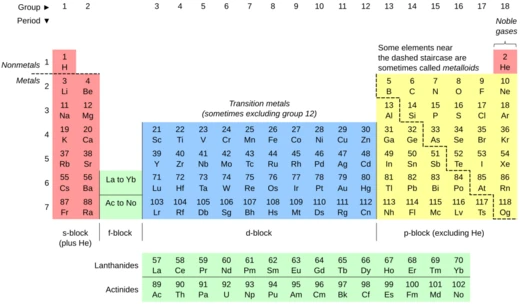
In the periodic table, mendelevium sits to the right of fermium, left of nobelium, and below thulium. Bulk metal has not been prepared, but predictions and some experiments indicate properties. Johansson and Rosengren in 1975 concluded that mendelevium should be a divalent metal because the energy to promote a 5f electron to 6d is not compensated by binding energy, a trend attributed to relativistic stabilization of 5f electrons.
Thermochromatographic studies from 1976 to 1982 confirmed this prediction. In 1990, Haire and Gibson estimated the enthalpy of sublimation between 134 and 142 kJ/mol. In solution, mendelevium exhibits +3 and +2 oxidation states; a +1 state has been reported but not confirmed.
Production and isolation
The lightest isotopes (244Md to 247Md) are produced by bombarding bismuth with argon ions; heavier ones (248Md to 253Md) come from plutonium or americium targets with carbon or nitrogen ions. The most stable isotopes (254Md to 258Md) are made by bombarding einsteinium-253, -254, or -255 with alpha particles; 259Md is a daughter of 259No, and 260Md from a transfer reaction between einsteinium-254 and oxygen-18. The commonly used 256Md is produced from einsteinium-253 or -254, with the latter preferred for its longer half-life. Microgram quantities of einsteinium yield femtogram quantities of mendelevium-256.
The recoil momentum of produced atoms carries them onto a thin metal foil (beryllium, aluminium, platinum, or gold) in vacuum, avoiding immediate chemical separation. The atoms are trapped in helium gas and transported via a capillary tube with potassium chloride aerosols for analysis. Separation involves dissolving the foil in acid, coprecipitating with lanthanum fluoride, and using cation-exchange resin with ethanol–hydrochloric acid eluant; a gold foil can be dissolved in aqua regia followed by anion-exchange chromatography. Final separation from other trivalent actinides uses selective elution with ammonia α-HIB.
Did You Know?
- The International Commission on Radiological Protection set an annual ingestion limit for mendelevium-258 at 9×10^5 becquerels, equivalent to 2.48 ng.
- The inhalation limit for mendelevium-258 is 6000 Bq, or 16.5 pg.
More in Periodic Table & Elements
Sources
Compiled from Wikipedia and the sources listed below. Text from Wikipedia is available under CC BY-SA 4.0; this entry is adapted from it.
- Wikipedia: Mendelevium (CC BY-SA 4.0).
- Word definitions: the Codexery glossary, each quoted from its Wikipedia article.
Spotted an error? Know more?
Reader corrections go straight into our review queue. Suggest an edit · How this site is sourced