Pacific Ocean
The North Pacific's largest cephalopod, weaving through kelp and rock as a master of disguise.

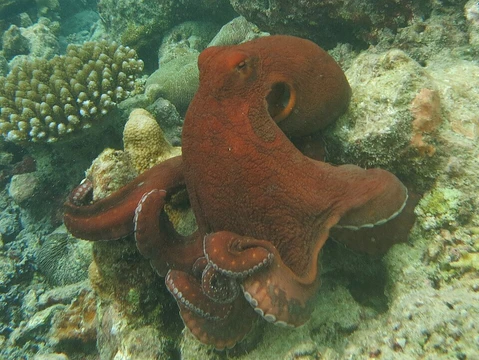
The Giant Pacific Octopus (Enteroctopus dofleini) is the largest known species of octopus, a highly intelligent cephalopod that dominates rocky and kelp-forest habitats across the North Pacific. It occupies a top-predator niche, preying on crabs, clams, and small fish, and its presence shapes benthic community structure wherever it forages.
As a keystone inductive predator, the species regulates populations of crustaceans and mollusks, freeing space for other invertebrates and maintaining the structural complexity of reef and kelp ecosystems. Its wide depth tolerance and remarkable behavioral plasticity allow it to exploit a broad range of Pacific microhabitats, from sunlit intertidal boulders to dim, cold-water slopes.
- Species
- Enteroctopus dofleini
- Class
- Cephalopoda
- Common name
- Giant Pacific Octopus
- Primary range
- North Pacific (Alaska, California, Japan, Korea, Bering Sea)
- Diet
- Carnivorous (crustaceans, mollusks, small fish)
- Distinguishing trait
- Largest octopus species by body mass and arm span
Lore & Background
In the cold, nutrient-rich waters of the North Pacific, the Giant Pacific Octopus is a creature of patience and precision. It clings to boulders and the stipes of giant kelp, its mottled skin rippling with chromatophore displays that mirror the surrounding substrate so faithfully that a passing diver may walk past it without notice. When it strikes, all eight arms extend simultaneously, wrapping a crab or a clam in a tangle of sucker-lined tentacles while the radula and beak do the rest.
The species is a solitary hunter for most of its life, each individual defending a small territory of rocks, crevices, and kelp holdfasts. Males, which grow substantially larger than females, roam wider ranges in search of mates, their arms trailing behind them like the fronds of a drifting weed. After a single brief reproductive season, the octopus's body begins a slow, inevitable decline—a programmed senescence that ends with the animal releasing its grip on the reef and drifting out to die.
Fishers and divers in Alaska, California, and Japan have long regarded the Giant Pacific Octopus with a mixture of admiration and wariness. Its intelligence is well documented: it has been observed opening jars, solving multi-step puzzles, and recognizing individual humans. In the Pacific's kelp forests, it is both a gardener and a ghost, reshaping the benthic world and then vanishing into the blue.
Reader's Guide
North Pacific rocky reefs (Alaska, British Columbia, Bering Sea): The species favors cold, wave-exposed boulder fields and creviced substrates from the intertidal zone down to several hundred meters. These reefs provide the hard attachment points and sheltered dens the octopus needs for resting and brooding. Seasonal upwelling brings nutrient-rich water that sustains the crab and clam prey base, making these grounds the most productive foraging sites.
Kelp forests (California, northern Japan, Korean coast): Here the octopus uses the stipes and holdfasts of Macrocystis and Laminaria as both hunting platforms and camouflage. The three-dimensional structure of the canopy supports dense invertebrate communities, and the octopus's ability to match the brown-green tones of kelp fronds gives it a significant ambush advantage. These forests are ecologically critical because the octopus's predation on urchins and crabs helps maintain the balance that keeps the kelp itself from being overgrazed.
Deeper cold-water slopes (Bering Sea, Gulf of Alaska): In dim, cooler water well below the photic zone, the octopus shifts to a more sedentary, den-based existence, emerging at night to forage on benthic invertebrates. These deeper refuges buffer the population from surface-level temperature fluctuations and provide a stable thermal environment during winter months, supporting the species' year-round presence in the North Pacific.
Did You Know?
- The Giant Pacific Octopus is the largest octopus species known, with arm spans that can exceed four meters in mature males.
- Like all cephalopods, it has three hearts: two branchial hearts pump blood through the gills, while a single systemic heart circulates oxygenated blood to the rest of the body.
- It can change both its skin color and its surface texture (roughness, bumps, smoothness) in a fraction of a second, allowing it to blend into rock, sand, or kelp almost instantaneously.
- Males of the species are significantly larger than females, a pattern of sexual size dimorphism shared by many cephalopods but especially pronounced here.
More in Distribution & Habitat
Elsewhere in Big blue octopus
Spotted an error? Know more?
Reader corrections go straight into our review queue. Suggest an edit · How this site is sourced