Indian Ocean
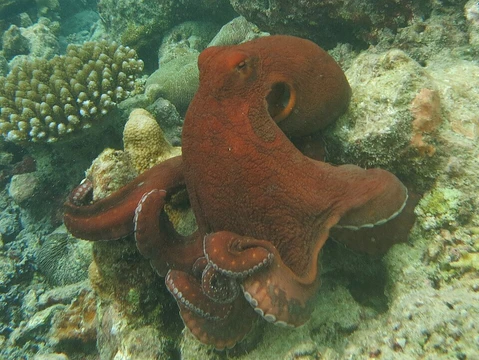
A solitary reef ghost threading the rocky shelves of the world's warmest ocean.

The Indian Ocean hosts a rich assemblage of octopod cephalopods, with the common octopus (Octopus vulgaris) being among the most widely distributed and ecologically significant. Found from the Red Sea and Persian Gulf through the East African coast, the Bay of Bengal, and the waters surrounding Indonesia and the Philippines, this benthic predator occupies rocky reefs, coral rubble, and soft-sediment habitats across tropical and subtropical latitudes.
As a highly mobile, solitary invertebrate predator, the octopus in Indian Ocean waters plays a keystone role in structuring benthic community composition. Its ability to exploit a wide range of substrates and depth zones, combined with rapid behavioural plasticity, makes it a key indicator of reef and nearshore ecosystem health across the basin.
- Species
- Octopus vulgaris (common octopus)
- Ocean basin
- Indian Ocean (Red Sea, East Africa, Indian subcontinent, SE Asia)
- Habitat type
- Benthic; rocky reef, coral rubble, sandy and muddy substrate
- Depth range
- Intertidal to approximately 200 m
- Lifestyle
- Solitary, diurnal-to-nocturnal benthic predator
- Diet
- Crustaceans, molluscs, small demersal fish
- Biogeographic range
- Tropical and subtropical Indian Ocean, including the Red Sea and Persian Gulf
Lore & Background
In the Indian Ocean the common octopus is a creature of remarkable localism within a vast range. Populations along the East African shelf, the coral platforms of the Andaman Sea, and the rocky inlets of the Red Sea each show subtle morphological and behavioural differences shaped by local prey assemblages, water temperature, and the degree of anthropogenic disturbance. Yet the species' fundamental ecology—solitary, benthic, highly plastic—remains consistent from the Gulf of Aden to the Banda Sea.
Fishers across the basin have long recognised the octopus as both a prized catch and a highly elusive quarry. In the coastal waters of Gujarat, the Maldives, and the Andaman Islands, hand-gathering and line-fishing target the species, and local knowledge of its denning behaviour on rocky outcrops and within coral bommies has been passed down through generations. The octopus's capacity to change colour and texture in seconds makes it a near-invisible predator in the dappled light of shallow reef flats.
Ecologically, the Indian Ocean octopus occupies a mid-trophic position that links primary benthic production to higher-level predators. Sea turtles, large groupers, and sharks all take octopuses, while the octopus in turn exerts strong top-down control on urchins, crabs, and bivalves. In heavily fished or degraded reef systems, shifts in octopus abundance can cascade through the entire benthic food web, making the species a practical proxy for monitoring reef condition across the basin.
Reader's Guide
Red Sea and Gulf of Aden: The octopus favours the shallow rocky platforms and coral-rubble slopes of the northern and central Red Sea, typically between the intertidal zone and roughly 30 m. Substrate is a mix of basalt, limestone, and dead coral framework. Water temperatures are high and salinity elevated, and the species is most active during the cooler late-afternoon and early-evening hours. The Red Sea's high productivity and limited connectivity make it a distinct sub-population.
East African shelf and Mozambique Channel: Along the coasts of Tanzania, Mozambique, and around Madagascar, the octopus occupies rocky reefs, seagrass margins, and sandy patches interspersed with boulders. Depths range from the surf zone to about 80 m. Seasonal upwelling along the coast brings nutrient-rich, cooler water, and the octopus shifts to slightly deeper, more sheltered sites during the warmest months. The Mozambique Channel's strong current regime creates patchy reef habitats that the species uses for denning.
Bay of Bengal and Indian subcontinent: In the Andaman Sea, the Gulf of Mannar, and along the coasts of Gujarat and Kerala, the octopus is found on coral bommies, mangrove-adjacent rocky substrates, and sandy bottoms within 5–50 m. The monsoon-driven seasonal shift in temperature and turbidity appears to trigger a modest onshore–offshore movement, with higher densities recorded on inshore reefs during the post-monsoon cooling.
Southeast Asian waters (Indonesia, Philippines, northern Australia): Across the Banda Sea, the Java Sea, and the Coral Sea shelf, the octopus inhabits a mosaic of live coral, rubble, and soft sediment from the intertidal to approximately 150 m. The extraordinary species diversity of the region means the octopus competes with numerous other cephalopods and must exploit microhabitats—crevices, overhangs, and the undersides of boulders—that fewer predators can access. This locale is ecologically significant as the centre of Indo-Pacific cephalopod diversity, and the octopus here serves as a generalist predator linking reef and soft-bottom communities.
Did You Know?
- The Indian Ocean is one of only three major ocean basins where Octopus vulgaris is a native resident, alongside the Atlantic and the Mediterranean.
- In the Red Sea, the octopus tolerates salinities well above open-ocean levels, a physiological flexibility not shared by many other cephalopod species.
- A single Indian Ocean octopus can change its skin texture and colour in under a second, a response mediated by specialized chromatophores and muscle-controlled papillae.
- Fishers in the Maldives and the Andaman Islands traditionally identify octopus dens by the characteristic 'spat' of expelled ink left on the rock face, a mark that can persist for hours after the animal has departed.
More in Distribution & Habitat
Elsewhere in Big blue octopus
Spotted an error? Know more?
Reader corrections go straight into our review queue. Suggest an edit · How this site is sourced