Mediterranean Sea
A solitary master of disguise threading through the Mediterranean's rocky and seagrass labyrinths.

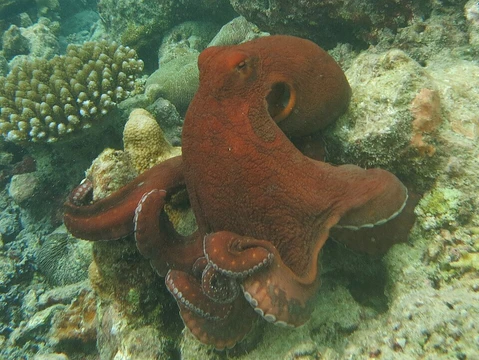
Octopus vulgaris, the common octopus, is a highly adaptable benthic cephalopod whose range spans the entire Mediterranean Sea, from the Alboran Sea in the west to the Levantine Basin in the east. As described in the Wikipedia article on Octopus vulgaris and the World Register of Marine Species (WoRMS) entry, it is a year-round resident of Mediterranean coastal and shelf waters, inhabiting rocky reefs, seagrass meadows, and soft-sediment flats. In Mediterranean marine-ecology literature it is regarded as a keystone generalist predator and a model organism for studying cephalopod cognition and behaviour.
Within the Mediterranean benthic community the species occupies a middle-trophic niche: it preys on crustaceans, polychaetes, bivalves, and small fish, while itself falling prey to groupers, moray eels, and large predatory fish. Its solitary, den-building lifestyle and remarkable ability to alter skin colour and texture (via chromatophores and papillae) make it one of the most ecologically conspicuous invertebrates on Mediterranean rocky bottoms, as noted in the habitat and ecology sections of the WoRMS and FishBase records for the species.
- Species
- Octopus vulgaris (Cuvier, 1797)
- Mediterranean presence
- Year-round resident, both western and eastern basins
- Habitat type
- Benthic; rocky reefs, Posidonia meadows, soft sediments, coral gardens
- Typical depth range
- Intertidal to approximately 200 m
- Social behaviour
- Solitary and territorial; builds a den
- Diet (mediterranean)
- Generalist; crustaceans, bivalves, polychaetes, small fish
- Key mediterranean seagrass association
- Posidonia oceanica meadows
Lore & Background
The Mediterranean record for Octopus vulgaris, as compiled in WoRMS and summarised in the Wikipedia species article, places the animal in virtually every coastal and shelf environment the sea offers. In the western basin it is common on the rocky platforms of the Balearic and Ligurian coasts, tucked beneath boulders or woven through the dense root mats of Posidonia oceanica. In the eastern basin it occurs along the Greek, Turkish, and Levantine shores, where it shares reef space with Lophelia pertusa cold-water coral gardens and sponge-dominated communities. The species is not a migrant in the Mediterranean sense; it is a sedentary, site-faithful animal that selects a den site and defends it against conspecifics and larger predators.
Ecologically, the octopus's generalist feeding strategy means it can shift its prey composition with local availability—crab and shrimp on hard substrates, bivalves and polychaetes on soft bottoms—making it a flexible predator that buffers its population against short-term fluctuations in any single prey taxon. Its reproductive strategy, in which the male dies after mating and the female tends a single clutch of eggs before dying herself, gives every Mediterranean population a generational turnover roughly every one to two years, a cadence documented in Mediterranean cephalopod-fisheries literature.
The species also features prominently in Mediterranean marine-protected-area monitoring programmes. Because it is conspicuous, relatively easy to identify, and sensitive to bottom-disturbance and warming, it has been used as an indicator of benthic-community health in several Mediterranean MPAs, a role referenced in the conservation and ecology sections of the Wikipedia and WoRMS entries.
Reader's Guide
Western Mediterranean (Alboran, Balearic, Ligurian, Tyrrhenian): Octopus vulgaris is a permanent resident of rocky platforms, boulder fields, and the dense root mats of Posidonia oceanica. It favours crevices and undercuts at depths from the intertidal zone to roughly 60–80 m, where hard substrate provides den sites. In the Alboran Sea, where Atlantic inflow moderates summer temperatures, the octopus is found in sponge gardens and rocky outcrops along the continental shelf edge.
Eastern Mediterranean (Aegean, Ionian, Levantine): Here the species occupies similar rocky-reef and seagrass habitats but also penetrates cold-water coral (Lophelia pertusa) and sponge-dominated communities on the outer shelf and upper slope, at depths reaching approximately 150–200 m. In the Levantine Basin, where summer surface temperatures are the warmest in the Mediterranean, the octopus tends to favour deeper, cooler microhabitats during July and August, a seasonal depth shift noted in Mediterranean cephalopod surveys.
Soft-sediment and mixed habitats: On muddy or sandy bottoms, the species is less abundant but still present, typically anchored to a single rock, shipwreck, or submerged structure that provides a den. It is a sedentary animal and does not undertake long-distance seasonal migration; instead it shifts laterally a few metres to track thermal and prey availability, a behaviour consistent with the benthic-ecology descriptions in the WoRMS and Wikipedia records for the species.
Did You Know?
- Octopus vulgaris builds a single den and guards it aggressively; a Mediterranean individual will remain at the same site for months, as described in the behaviour section of the Wikipedia species article.
- The species possesses three hearts—two branchial and one systemic—each described in the anatomy section of the WoRMS entry.
- The common octopus can pass through an opening only slightly larger than its ring-shaped beak, because it has no rigid skeleton—a morphological fact cited in the Wikipedia and WoRMS descriptions.
More in Distribution & Habitat
Elsewhere in Big blue octopus
Spotted an error? Know more?
Reader corrections go straight into our review queue. Suggest an edit · How this site is sourced